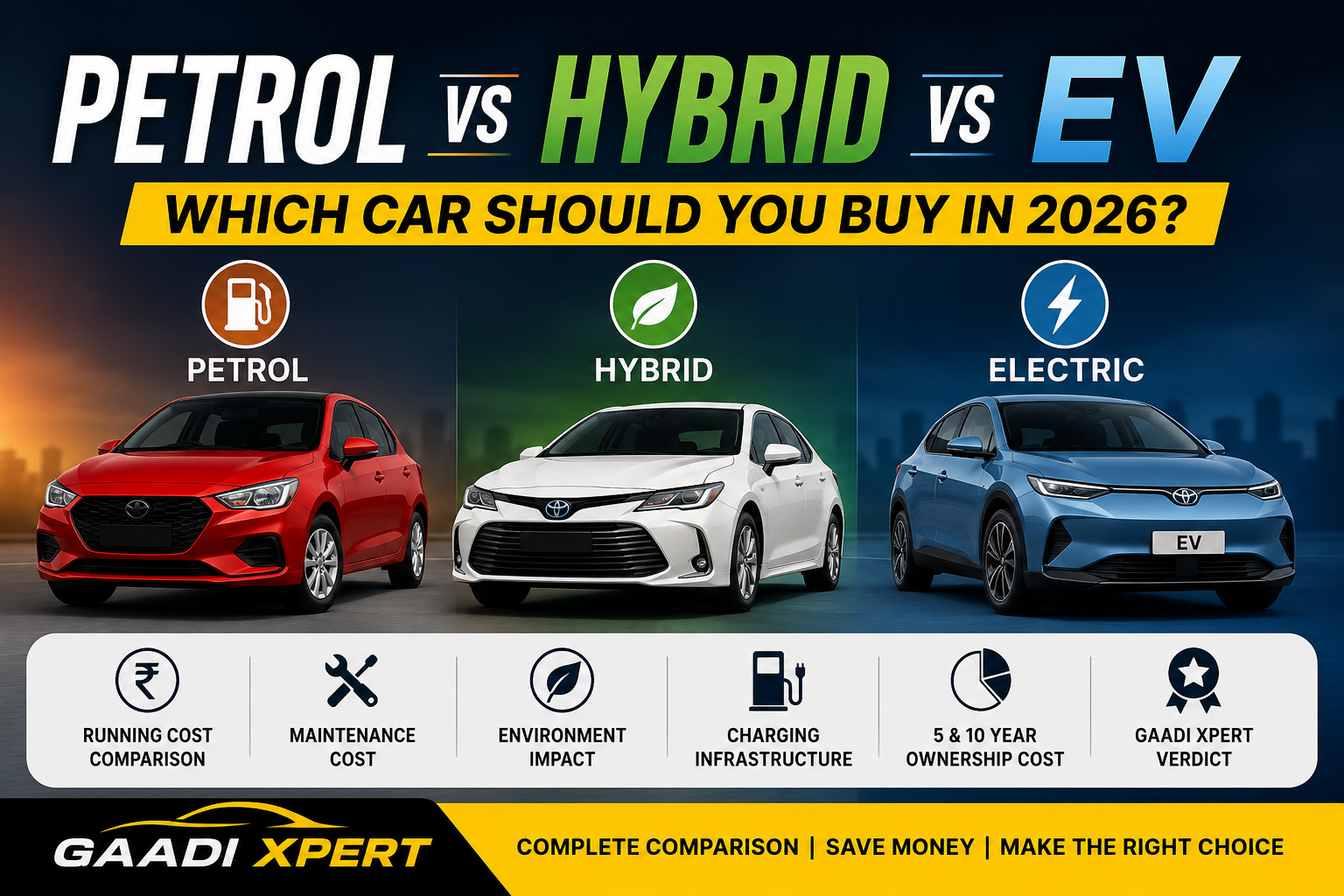
Buying a new car in 2026 is no longer as simple as choosing between a hatchback, sedan, or SUV. Today’s buyers also need to decide which powertrain best suits their lifestyle. Should you choose a Petrol car, invest in a Hybrid vehicle, or make the switch to a fully Electric Vehicle (EV)? With fuel prices remaining unpredictable, EV charging infrastructure expanding across India, and hybrid technology becoming more affordable, this decision has become more important than ever.
The Indian automobile market has changed rapidly over the last few years. Major manufacturers such as Maruti Suzuki, Toyota, Hyundai, Tata Motors, Mahindra, MG, BYD, Kia, and Honda are now offering multiple fuel options to cater to different customer needs. While petrol cars continue to dominate entry-level and budget-friendly segments, hybrid vehicles are becoming increasingly popular among buyers looking for better fuel efficiency without worrying about charging. At the same time, electric vehicles are attracting customers with their low running costs, instant performance, and environmentally friendly nature.
However, every technology comes with its own advantages and limitations. A petrol car offers convenience and lower upfront cost but has higher fuel expenses over time. Hybrid cars provide excellent mileage while retaining the convenience of quick refueling, although they usually cost more than comparable petrol models. EVs deliver the lowest running costs and zero tailpipe emissions, but charging infrastructure and higher purchase prices still remain concerns for many buyers.
The right choice depends on several factors, including:
- Your monthly driving distance
- City or highway usage
- Budget
- Availability of charging facilities
- Long-term ownership plans
- Maintenance expectations
- Resale value
Many buyers make the mistake of choosing a vehicle based only on the purchase price. In reality, the total cost of ownership—including fuel, maintenance, insurance, and resale value—plays a much bigger role over five to ten years of ownership.
In this detailed comparison, we will compare Petrol vs Hybrid vs EV across every important category, including purchase price, mileage, running costs, maintenance, performance, charging, reliability, environmental impact, resale value, and long-term ownership. By the end of this guide, you’ll have a clear understanding of which type of car is the smartest choice for your needs in 2026.
What is a Petrol Car?
A petrol car is powered by an Internal Combustion Engine (ICE) that burns petrol to generate power. This technology has been the backbone of the automobile industry for decades and remains the most common choice among Indian buyers.
When you press the accelerator, petrol is injected into the engine, mixed with air, and ignited inside the cylinders. The resulting combustion creates energy that turns the crankshaft and ultimately powers the wheels.
Although electric mobility is growing rapidly, petrol cars continue to be popular because they are affordable, widely available, and supported by an extensive fuel station network across India.
Advantages of Petrol Cars
Lower Purchase Price
One of the biggest advantages of a petrol vehicle is its affordable upfront cost. Compared to hybrid and electric vehicles, petrol variants usually have the lowest ex-showroom prices, making them ideal for first-time buyers and budget-conscious families.
Easy Refueling
Petrol stations are available in almost every city, town, and highway across India. Refueling takes only a few minutes, making long-distance travel convenient without worrying about charging stops.
Better Availability Across Segments
Whether you’re looking for a compact hatchback, premium sedan, SUV, or performance car, almost every manufacturer offers petrol variants in multiple price ranges.
Lower Initial Maintenance Cost
Routine servicing of petrol engines is generally straightforward, with widespread service centers and readily available spare parts.
Proven Reliability
Modern petrol engines are highly refined, quiet, and dependable when maintained properly.
Disadvantages of Petrol Cars
Despite their popularity, petrol cars also have several drawbacks.
Higher Fuel Cost
Petrol prices remain significantly higher than electricity costs for charging an EV. Over years of ownership, fuel expenses become one of the largest operating costs.
Lower Fuel Efficiency
Compared to strong hybrid vehicles, petrol cars usually deliver lower mileage, especially in heavy city traffic where frequent braking and idling increase fuel consumption.
Higher Emissions
Petrol engines emit carbon dioxide and other pollutants, making them less environmentally friendly than electric vehicles.
Long-Term Ownership Cost
Although purchase prices are lower, higher fuel bills can increase the overall ownership cost over five to seven years.
Who Should Buy a Petrol Car?
A petrol car remains an excellent choice if you:
- Drive less than 1,000 km per month
- Frequently travel on highways
- Live in areas without EV charging infrastructure
- Want the lowest initial investment
- Prefer simple ownership and quick refueling
- Plan to keep the car for only a few years
For occasional drivers, the savings from a hybrid or EV may not justify the higher purchase price, making a petrol car the most practical option.
What is a Hybrid Car?
A hybrid car combines a traditional petrol engine with one or more electric motors and a battery pack. Instead of relying entirely on petrol, the vehicle intelligently switches between the petrol engine, electric motor, or a combination of both to maximize fuel efficiency and reduce emissions.
Unlike a fully electric vehicle, most hybrid cars in India do not require external charging. The battery is automatically recharged through regenerative braking and by the petrol engine itself, making ownership almost as convenient as a regular petrol car.
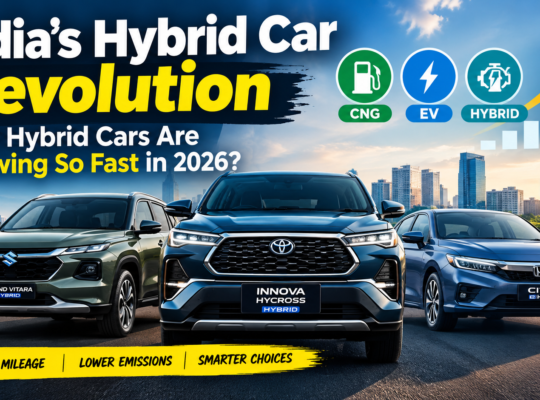
Hybrid technology has become increasingly popular in India because it offers an ideal balance between fuel efficiency and convenience. Models like the Toyota Hyryder Hybrid, Maruti Grand Vitara Strong Hybrid, Toyota Innova Hycross Hybrid, and Honda City e:HEV have demonstrated that hybrids can significantly reduce fuel consumption, especially in city driving conditions.
In the next part, we’ll explore the different types of hybrid systems, their advantages and disadvantages, and compare them with EVs in terms of mileage, running costs, maintenance, and overall ownership.
Types of Hybrid Cars
Not all hybrid vehicles work in the same way. Depending on how the electric motor supports the petrol engine, hybrid cars are mainly classified into three categories.
Mild Hybrid (MHEV)
A Mild Hybrid uses a small electric motor to assist the petrol engine during acceleration and restart the engine quickly after idle stop-start situations. However, the electric motor cannot drive the car independently.
Advantages
- Lower purchase price than strong hybrids
- Better fuel efficiency than regular petrol cars
- Smooth engine start-stop system
- Lower emissions
Disadvantages
- Cannot run in electric-only mode
- Fuel savings are relatively limited
Best For: Buyers looking for a small improvement in fuel efficiency without paying a significant premium.
Strong Hybrid (HEV)
A Strong Hybrid is far more advanced. It uses a larger battery pack and a more powerful electric motor, allowing the vehicle to drive on electricity alone at low speeds before automatically switching to the petrol engine when additional power is needed.
This technology delivers significant fuel savings, especially in city traffic where frequent braking helps recharge the battery through regenerative braking.
Advantages
- Excellent fuel efficiency
- Can drive in EV mode for short distances
- No external charging required
- Lower fuel consumption in urban traffic
- Smooth and refined driving experience
Disadvantages
- Higher purchase price
- More complex technology than petrol vehicles
Best For: Daily commuters who cover long distances in city traffic and want maximum fuel savings without charging hassles.
Plug-in Hybrid (PHEV)
Plug-in Hybrid Electric Vehicles (PHEVs) combine the advantages of hybrids and electric cars. Their larger battery packs can be charged externally using a home charger or public charging station, allowing them to travel much longer distances on electricity alone before the petrol engine starts.
Although PHEVs are popular in several international markets, they are still relatively uncommon in India.
Advantages
- Long electric-only driving range
- Extremely low fuel consumption when charged regularly
- No range anxiety on long trips
Disadvantages
- Highest purchase price among hybrid technologies
- Requires external charging
- Limited model availability in India
Best For: Buyers who can charge at home and want EV-like driving with the flexibility of a petrol engine for long journeys.
Advantages of Hybrid Cars
Outstanding Fuel Efficiency
The biggest advantage of a hybrid vehicle is its exceptional mileage. Since the electric motor assists the petrol engine, fuel consumption is significantly reduced, especially during city driving.
Many strong hybrid SUVs in India deliver real-world mileage figures of 22–27 km/l, which is substantially higher than comparable petrol models.
Lower Running Cost
Although hybrid vehicles cost more to purchase, they consume less fuel over time. Buyers who drive more than 1,500–2,000 km per month can recover the higher initial investment through fuel savings over several years.
No Charging Required
Unlike electric vehicles, hybrid cars eliminate the need for charging stations. The battery recharges automatically while driving, making them extremely convenient for both city and highway users.
Better Performance
The instant torque from the electric motor improves acceleration, especially from a standstill. This results in smoother overtaking and more responsive city driving compared to many conventional petrol cars.
Lower Emissions
Because the petrol engine operates less frequently, hybrid vehicles emit lower levels of carbon dioxide and consume less fuel, making them a more environmentally friendly option than standard petrol cars.
Disadvantages of Hybrid Cars
Despite their many strengths, hybrid cars also have a few drawbacks that buyers should consider.
Higher Purchase Price
Hybrid models generally cost ₹2–4 lakh more than their equivalent petrol versions. Buyers with lower annual mileage may take longer to recover this additional investment.
Limited Model Choices
Although the number of hybrid vehicles is growing, buyers still have fewer options compared to petrol cars, particularly in the entry-level hatchback segment.
Higher Repair Costs
Hybrid systems are more technologically advanced than conventional petrol engines. While they are generally reliable, certain components can be more expensive to repair if they fail outside the warranty period.
Slightly Reduced Boot Space
Some hybrid vehicles sacrifice a small portion of luggage capacity to accommodate the battery pack and associated electrical components.
Who Should Buy a Hybrid Car?
A hybrid car is an excellent choice if you:
- Drive 1,500–2,500 km or more every month
- Spend most of your time in city traffic
- Want excellent fuel economy without charging
- Frequently travel on both city roads and highways
- Plan to keep the car for 5–10 years
- Prefer lower fuel costs while avoiding range anxiety
For buyers who want the convenience of a petrol car with fuel efficiency approaching that of an EV, a strong hybrid offers one of the best long-term ownership experiences in India.
What is an Electric Vehicle (EV)?
An Electric Vehicle (EV) is powered entirely by one or more electric motors instead of a traditional petrol engine. Energy is stored in a high-voltage lithium-ion battery pack, which supplies electricity to the motor and drives the wheels.
Unlike petrol or hybrid cars, EVs produce zero tailpipe emissions because they do not burn fuel. They can be charged at home using an AC charger or at public DC fast-charging stations available across major Indian cities and highways.
Over the past few years, India’s EV ecosystem has grown rapidly. Manufacturers such as Tata Motors, Mahindra, MG, BYD, Hyundai and Kia now offer electric SUVs and hatchbacks with improved driving range, advanced technology, and better safety features. As battery prices continue to fall and charging infrastructure expands, EVs are becoming a practical option for more Indian buyers.
How Does an EV Work?
The working principle of an EV is much simpler than that of a petrol or hybrid vehicle.
- The battery pack stores electrical energy.
- When the accelerator is pressed, electricity flows to the electric motor.
- The motor instantly produces torque and rotates the wheels.
- During braking or coasting, regenerative braking converts kinetic energy back into electricity, recharging the battery.
Since there is no engine, gearbox, clutch, engine oil, or exhaust system, EVs have fewer moving parts than conventional vehicles.
Advantages of Electric Vehicles
Lowest Running Cost
One of the biggest reasons buyers choose an EV is its extremely low running cost.
Charging an EV generally costs much less than filling a petrol tank. Depending on local electricity tariffs and charging methods, the cost per kilometer can be a fraction of that of a petrol car.
For buyers covering long monthly distances, these savings can become substantial over the ownership period.
Instant Performance
Electric motors deliver maximum torque from zero RPM, resulting in:
- Faster acceleration
- Smooth overtaking
- Silent driving
- No gear shifts
This makes EVs especially enjoyable in city traffic.
Lower Maintenance Cost
Since EVs have fewer mechanical components, regular servicing is usually simpler.
There is:
- No engine oil
- No spark plugs
- No clutch
- No fuel filter
- No exhaust system
Routine maintenance mainly includes:
- Brake inspection
- Tire rotation
- Coolant (where applicable)
- Cabin air filter replacement
- Software updates
Environment Friendly
EVs produce zero tailpipe emissions, helping reduce urban air pollution.
When charged using renewable energy sources such as solar power, their environmental impact becomes even lower.
Quiet and Comfortable Driving
Without engine vibrations and gearbox shifts, EVs offer a premium driving experience with very low cabin noise.
Disadvantages of Electric Vehicles
Despite rapid improvements, EVs still have certain limitations.
Higher Purchase Price
Battery packs remain expensive, making EVs costlier than equivalent petrol models.
Although government incentives and lower running costs help offset this difference, the initial investment is still higher.
Charging Time
Unlike petrol cars, which can be refueled in a few minutes, EVs require charging.
Typical charging times vary depending on the charger:
- Home AC Charger: 6–10 hours
- Fast AC Charger: 3–6 hours
- DC Fast Charger: 20–60 minutes (depending on battery size and charging capacity)
Charging Infrastructure
Public charging stations are expanding rapidly across India, but coverage is still better in metro cities than in smaller towns and remote areas.
Long-distance travel requires some planning compared to petrol vehicles.
Range Anxiety
Many first-time EV buyers worry about running out of battery before reaching a charger.
However, modern EVs now commonly offer certified driving ranges between 300 km and over 600 km, reducing this concern significantly for everyday use.
Battery Replacement Cost
Although EV batteries are designed to last many years and usually come with long warranties, replacing a battery outside the warranty period can be expensive.
Fortunately, battery technology continues to improve, with better durability and lower replacement costs expected over time.
Who Should Buy an EV?
An electric car is ideal if you:
- Drive mostly within the city.
- Cover 1,500 km or more per month.
- Have access to home or workplace charging.
- Want the lowest running and maintenance costs.
- Prefer a silent, smooth driving experience.
- Plan to keep the vehicle for several years.
For buyers who frequently travel long highway distances or lack reliable charging access, a hybrid or petrol car may still be a more practical choice.
Petrol vs Hybrid vs EV – Complete Comparison
| Feature | Petrol Car | Hybrid Car | Electric Vehicle (EV) |
|---|---|---|---|
| Initial Purchase Price | ⭐⭐⭐⭐⭐ Lowest | ⭐⭐⭐ Medium | ⭐⭐ Highest |
| Fuel Efficiency | Good | Excellent | Outstanding |
| Running Cost | Highest | Medium | Lowest |
| Maintenance Cost | Medium | Medium-Low | Lowest |
| City Driving | Good | Excellent | Excellent |
| Highway Driving | Excellent | Excellent | Good |
| Refueling / Charging Time | 5 Minutes | 5 Minutes | 20 Minutes–10 Hours |
| Charging Required | No | No | Yes |
| Long Distance Travel | Excellent | Excellent | Good (with planning) |
| Environmental Impact | Highest Emissions | Lower Emissions | Zero Tailpipe Emissions |
| Driving Performance | Good | Very Good | Instant Torque |
| Resale Value | Stable | Improving | Improving Rapidly |
| Best For | Low annual mileage | Mixed city & highway | Heavy city usage |
Purchase Price Comparison
When buying a new car, the purchase price is often the first factor buyers consider.
Petrol Cars
Petrol variants generally have the lowest upfront cost, making them attractive to first-time buyers and those on a tighter budget.
Hybrid Cars
Strong hybrid models usually cost ₹2–4 lakh more than comparable petrol versions due to their advanced battery and electric motor technology.
Electric Vehicles
EVs typically have the highest initial purchase price, primarily because of the battery pack. However, their lower running and maintenance costs can help offset this premium over long-term ownership.
Fuel Efficiency & Energy Efficiency
Petrol Cars
Real-world mileage generally ranges between 15–20 km/l, depending on the vehicle, driving style, and traffic conditions.
Hybrid Cars
Strong hybrids can achieve 22–28 km/l in real-world driving, especially in urban environments where the electric motor is used more frequently.
Electric Vehicles
Instead of fuel efficiency, EVs are measured by energy consumption. Modern electric cars typically consume 12–18 kWh per 100 km, making them the most energy-efficient option among the three.
Running Cost Comparison: Petrol vs Hybrid vs EV (Per 100 km)
One of the biggest reasons buyers compare Petrol vs Hybrid vs EV is the difference in running costs. While the purchase price is important, the real expense of owning a car comes from daily fuel or charging costs. A proper Petrol vs Hybrid vs EV comparison helps you understand which option will save the most money over five to ten years.
To make this Petrol vs Hybrid vs EV comparison practical, let’s use average Indian fuel prices and electricity tariffs in 2026.
Assumptions
- Petrol Price: ₹100/litre
- Home Electricity Cost: ₹8/kWh
- Petrol Car Mileage: 16 km/l
- Strong Hybrid Mileage: 25 km/l
- EV Energy Consumption: 15 kWh/100 km
Petrol vs Hybrid vs EV: Petrol Car Running Cost
In the Petrol vs Hybrid vs EV comparison, a standard petrol car delivering 16 km/l consumes approximately 6.25 litres of petrol to travel 100 km.
Calculation
6.25 litres × ₹100 = ₹625 per 100 km
Running Cost: ₹6.25 per km
Although petrol cars have the lowest purchase price, they also have the highest running cost in the Petrol vs Hybrid vs EV comparison.
Petrol vs Hybrid vs EV: Strong Hybrid Running Cost
A strong hybrid averaging 25 km/l uses around 4 litres of petrol to cover the same 100 km.
Calculation
4 litres × ₹100 = ₹400 per 100 km
Running Cost: ₹4.00 per km
The Petrol vs Hybrid vs EV comparison clearly shows that a strong hybrid can reduce monthly fuel expenses without requiring external charging.
Petrol vs Hybrid vs EV: Electric Vehicle Running Cost
In the Petrol vs Hybrid vs EV comparison, EVs offer the lowest operating cost.
A modern EV consuming 15 kWh per 100 km and charged at home at ₹8 per unit would cost:
15 × ₹8 = ₹120 per 100 km
Running Cost: ₹1.20 per km
Even if you occasionally use DC fast chargers, the Petrol vs Hybrid vs EV comparison still favors electric vehicles for buyers covering high monthly distances.
Petrol vs Hybrid vs EV Running Cost Table
| Vehicle Type | Cost per 100 km | Cost per km |
|---|---|---|
| Petrol Car | ₹625 | ₹6.25 |
| Strong Hybrid | ₹400 | ₹4.00 |
| Electric Vehicle | ₹120 | ₹1.20 |
Petrol vs Hybrid vs EV: Monthly Fuel Cost Comparison
If you drive 2,000 km every month, the Petrol vs Hybrid vs EV comparison becomes even more interesting.
- Petrol Car: Around ₹12,500 per month
- Strong Hybrid: Around ₹8,000 per month
- Electric Vehicle: Around ₹2,400 per month
This Petrol vs Hybrid vs EV comparison proves that EVs deliver the lowest running cost, while strong hybrids provide an excellent balance between fuel savings and convenience.
Petrol vs Hybrid vs EV: Maintenance Cost Comparison
Another important factor in the Petrol vs Hybrid vs EV comparison is maintenance. A vehicle with lower servicing costs can save thousands of rupees every year.
Petrol vs Hybrid vs EV: Petrol Car Maintenance
Petrol cars have conventional engines that require regular servicing.
Routine maintenance includes:
- Engine oil replacement
- Oil filter replacement
- Air filter replacement
- Spark plug replacement
- Coolant replacement
- Brake servicing
- Transmission oil (where applicable)
In the Petrol vs Hybrid vs EV comparison, petrol cars have moderate servicing costs, but fuel expenses remain their biggest disadvantage.
Petrol vs Hybrid vs EV: Hybrid Car Maintenance
Hybrid cars still use petrol engines, so they require regular servicing similar to petrol vehicles.
However, regenerative braking reduces brake wear, helping lower maintenance costs.
Manufacturers also provide long warranties for hybrid batteries, improving long-term ownership confidence.
In the Petrol vs Hybrid vs EV comparison, hybrid servicing is slightly more expensive than petrol but significantly cheaper to operate when fuel savings are considered.
Petrol vs Hybrid vs EV: Electric Vehicle Maintenance
Electric vehicles have the simplest mechanical design.
Routine maintenance generally includes:
- Brake inspection
- Tire rotation
- Suspension inspection
- Cabin air filter replacement
- Battery health check
- Software updates
Since there is no engine oil, clutch, spark plugs, or exhaust system, the Petrol vs Hybrid vs EV comparison clearly favors EVs for maintenance costs.
Petrol vs Hybrid vs EV Maintenance Cost Table
| Vehicle Type | Typical Annual Maintenance |
|---|---|
| Petrol Car | ₹8,000–₹15,000 |
| Strong Hybrid | ₹10,000–₹18,000 |
| Electric Vehicle | ₹5,000–₹10,000 |
The Petrol vs Hybrid vs EV comparison shows that EVs generally require the least maintenance over their lifetime.
Petrol vs Hybrid vs EV: Environmental Impact
Environmental performance has become another major factor in the Petrol vs Hybrid vs EV comparison.
Petrol Cars
Petrol vehicles emit carbon dioxide (CO₂), nitrogen oxides (NOx), hydrocarbons, and other pollutants. While BS6 Phase 2 technology has reduced emissions, petrol cars still produce the highest tailpipe emissions among the three options.
Strong Hybrid Cars
In the Petrol vs Hybrid vs EV comparison, strong hybrids consume less fuel and therefore emit significantly less CO₂, especially in city traffic where the electric motor is used frequently.
Electric Vehicles
Electric vehicles produce zero tailpipe emissions, making them the cleanest option in the Petrol vs Hybrid vs EV comparison. Their overall environmental impact improves further when charged using renewable energy sources.
Petrol vs Hybrid vs EV: Charging Infrastructure in India (2026)
Charging availability plays an important role in the Petrol vs Hybrid vs EV comparison.
Home Charging
Most EV owners charge overnight using an AC wall charger.
Benefits include:
- Lowest charging cost
- Convenient overnight charging
- Better battery health
Public Charging Network
Public chargers are now available at:
- Metro cities
- Shopping malls
- Office complexes
- Hotels
- National highways
- Fuel stations
The expanding charging network has made the Petrol vs Hybrid vs EV comparison much more favorable for EV buyers in 2026.
Petrol vs Hybrid vs EV: Five-Year Ownership Cost
Looking at ownership costs instead of only the purchase price gives a much clearer Petrol vs Hybrid vs EV comparison.
| Expense | Petrol | Hybrid | EV |
|---|---|---|---|
| Purchase Price | Lowest | Medium | Highest |
| Fuel/Energy Cost | Highest | Medium | Lowest |
| Maintenance | Medium | Medium | Lowest |
| Overall 5-Year Ownership Cost | High | Medium | Lowest (High Mileage Users) |
For buyers driving fewer kilometers, petrol cars remain economical. However, the Petrol vs Hybrid vs EV comparison shows that hybrids and EVs become financially attractive as annual mileage increases.
Petrol vs Hybrid vs EV: Ten-Year Ownership Perspective
A long-term Petrol vs Hybrid vs EV comparison tells a different story than looking only at the purchase price.
- Petrol cars continue to have the highest fuel expenses.
- Strong hybrids balance affordability, efficiency, and convenience.
- EVs can deliver the lowest ownership cost when home charging is available and annual mileage is high.
For buyers planning to keep a vehicle for 8–10 years, the Petrol vs Hybrid vs EV comparison clearly demonstrates that total ownership cost is often more important than the initial showroom price.
Which Buyer Should Choose Petrol vs Hybrid vs EV in 2026?
After comparing every important factor, the biggest question remains: Petrol vs Hybrid vs EV – which car should you buy in 2026? The answer depends on your budget, monthly driving, charging availability, and long-term ownership goals. Understanding the Petrol vs Hybrid vs EV comparison from a practical perspective will help you choose the right vehicle instead of simply buying the cheapest or the newest technology.
Petrol vs Hybrid vs EV for First-Time Car Buyers
If you’re buying your first car, the Petrol vs Hybrid vs EV decision should start with your budget.
A petrol car is usually the smartest option if your budget is below ₹10 lakh. Petrol vehicles have a lower purchase price, affordable insurance, and an extensive fuel station network across India.
However, if your budget allows and you drive regularly, the Petrol vs Hybrid vs EV comparison clearly shows that a strong hybrid can recover its higher price through fuel savings over several years.
Petrol vs Hybrid vs EV for Daily Office Commuters
For office commuters covering 40–80 km every day, the Petrol vs Hybrid vs EV comparison changes completely.
If you have home charging, an EV offers the lowest running cost and maintenance expenses.
If charging is not available, a strong hybrid becomes the ideal choice because it provides excellent mileage without changing your refueling habits.
A petrol car is still suitable for shorter daily commutes but becomes more expensive to run as fuel expenses increase.
Petrol vs Hybrid vs EV for Highway Drivers
Frequent highway travelers should carefully evaluate the Petrol vs Hybrid vs EV comparison before making a purchase.
Petrol and hybrid cars remain the easiest options for long-distance travel because refueling takes only a few minutes.
Although EV charging infrastructure has improved significantly in 2026, long road trips still require charging-stop planning. For buyers who regularly travel between cities, hybrid vehicles currently provide the best balance of convenience and fuel economy.
Petrol vs Hybrid vs EV for Families
Family buyers generally prioritize comfort, reliability, fuel efficiency, and ownership costs.
In the Petrol vs Hybrid vs EV comparison, strong hybrid SUVs and MPVs emerge as the best all-round choice. They deliver impressive mileage in city traffic while remaining effortless on highways.
Petrol cars continue to be attractive for buyers on tighter budgets, whereas EVs are ideal for families whose driving is mostly within urban areas.
Petrol vs Hybrid vs EV for Fleet Owners
Taxi operators and commercial users usually cover thousands of kilometers every month.
For this type of buyer, the Petrol vs Hybrid vs EV comparison strongly favors electric vehicles because of their extremely low running cost and reduced maintenance requirements.
However, where charging infrastructure is limited, hybrid vehicles remain a dependable alternative.
Petrol vs Hybrid vs EV – Pros & Cons
Petrol Car
Advantages
- Lowest purchase price
- Easy refueling anywhere in India
- Wide service network
- Excellent highway performance
- Huge variety of models
Disadvantages
- Highest fuel expenses
- Lower fuel efficiency
- Higher emissions
- Long-term ownership cost increases
Hybrid Car
Advantages
- Outstanding fuel efficiency
- No external charging required
- Excellent city performance
- Lower emissions than petrol cars
- Smooth and refined driving experience
Disadvantages
- Higher purchase price
- Limited model availability
- Slightly more complex technology
Electric Vehicle
Advantages
- Lowest running cost
- Lowest maintenance requirement
- Instant torque
- Silent cabin
- Zero tailpipe emissions
Disadvantages
- Higher initial investment
- Charging required
- Longer charging time
- Highway planning still necessary
Petrol vs Hybrid vs EV – Which Car Should You Buy in 2026?
After completing this detailed Petrol vs Hybrid vs EV comparison, the answer becomes much clearer.
Choose a Petrol Car If:
- You drive less than 1,000 km per month
- Your budget is limited
- Charging isn’t available
- You frequently visit rural areas
Choose a Strong Hybrid If:
- You drive 1,500–2,500 km every month
- You want excellent mileage
- You don’t want charging hassles
- You plan to keep the vehicle for many years
Choose an EV If:
- You drive mostly in cities
- Home charging is available
- You want the lowest ownership cost
- You cover high monthly mileage
⭐ Gaadi Xpert Verdict – Petrol vs Hybrid vs EV
After evaluating Petrol vs Hybrid vs EV across purchase price, mileage, running cost, maintenance, convenience, resale value, and long-term ownership, here is our final verdict.
| Category | Winner |
|---|---|
| Lowest Purchase Price | 🥇 Petrol |
| Best Fuel Efficiency | 🥇 Strong Hybrid |
| Lowest Running Cost | 🥇 EV |
| Lowest Maintenance | 🥇 EV |
| Best City Driving | 🥇 EV |
| Best Highway Driving | 🥇 Strong Hybrid |
| Best Long-Term Value | 🥇 Strong Hybrid |
| Best Budget Choice | 🥇 Petrol |
| Most Future-Ready | 🥇 EV |
Gaadi Xpert Score Card
| Vehicle Type | Overall Score |
|---|---|
| Petrol Car | 8.3/10 |
| Strong Hybrid | 9.5/10 🏆 |
| Electric Vehicle | 9.3/10 |
Our Petrol vs Hybrid vs EV recommendation is simple:
- Buy a Petrol Car if your budget is limited and monthly driving is low.
- Buy a Strong Hybrid if you want the best balance of mileage, convenience, and long-term ownership value.
- Buy an Electric Vehicle if you have home charging and want the lowest running cost.
For most Indian buyers in 2026, the Petrol vs Hybrid vs EV comparison shows that Strong Hybrid technology offers the best overall balance. However, as charging infrastructure continues to improve, EVs are expected to become an even stronger choice in the coming years.
FAQs – Petrol vs Hybrid vs EV
1. Which is cheaper to run: Petrol vs Hybrid vs EV?
In the Petrol vs Hybrid vs EV comparison, EVs have the lowest running cost, hybrids come second, and petrol cars have the highest fuel expenses.
2. Is a hybrid better than a petrol car?
Yes. In most Petrol vs Hybrid vs EV comparisons, strong hybrids deliver better mileage and lower running costs while offering the same refueling convenience.
3. Is it worth buying an EV in 2026?
Yes, if you have home charging and mostly drive in cities, the Petrol vs Hybrid vs EV comparison clearly favors EVs for long-term savings.
4. Do hybrid cars need charging?
No. Most strong hybrid cars recharge automatically through regenerative braking and the petrol engine.
5. Which is best for highway driving: Petrol vs Hybrid vs EV?
For long-distance travel, the Petrol vs Hybrid vs EV comparison currently favors strong hybrid and petrol cars because refueling is faster than charging.
6. Which has the lowest maintenance cost?
Among Petrol vs Hybrid vs EV, electric vehicles generally have the lowest maintenance requirements.
7. Which is best if I drive less than 1,000 km per month?
According to the Petrol vs Hybrid vs EV comparison, a petrol car remains the most economical option for low monthly usage.
8. Will petrol cars disappear soon?
No. Even though the Petrol vs Hybrid vs EV market is shifting toward electrification, petrol cars will continue to remain relevant in India for many years.
Also Read About Ethanol Fuel