

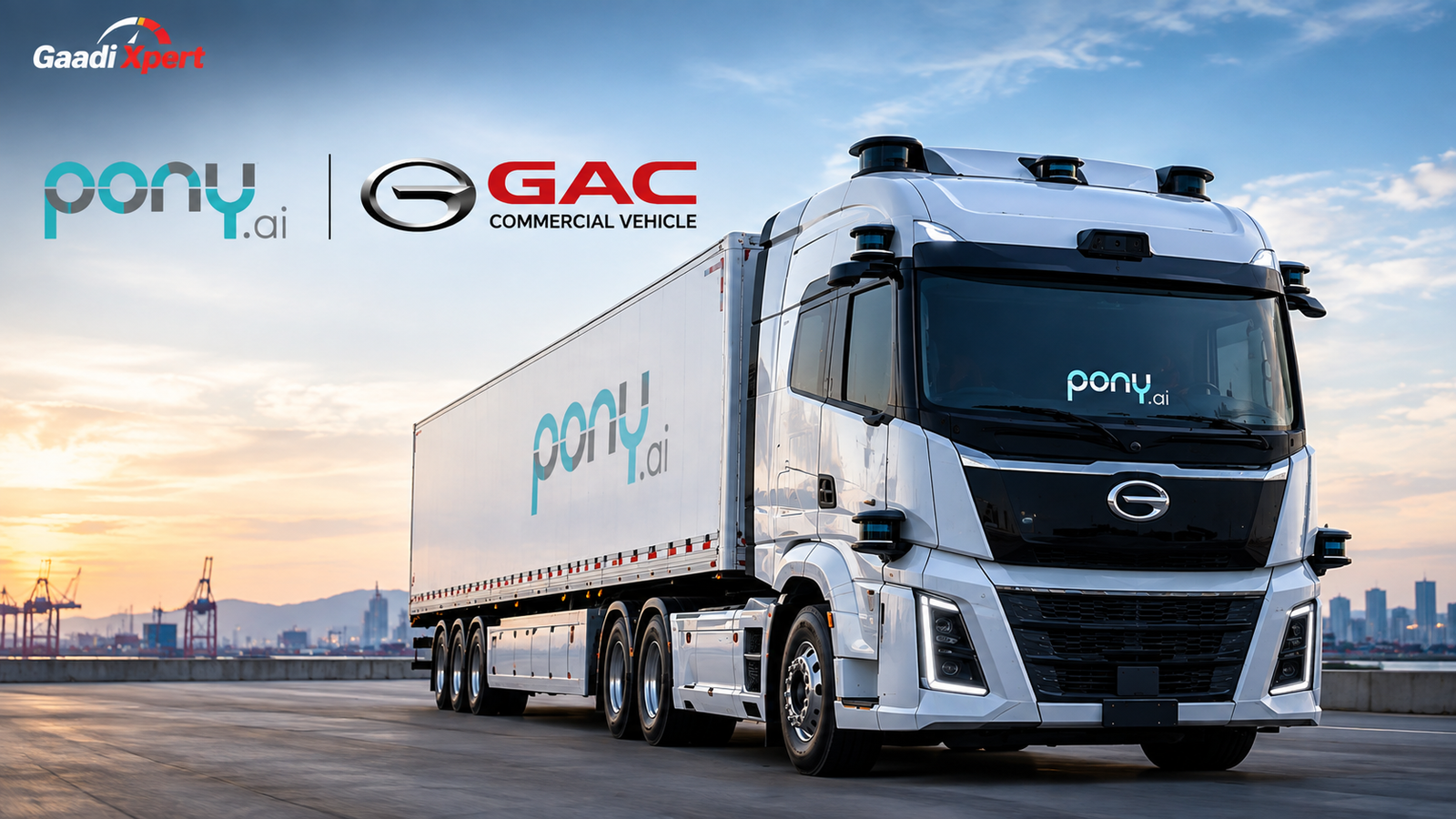
The future of heavy-duty trucking is moving another step closer to reality. Pony.ai and GAC Commercial Vehicle have unveiled a new Gen-4 Level 4 Robotruck at IAA Transportation 2026 in Hannover, Germany.
The new truck combines GAC Commercial Vehicle’s T9 electric heavy-duty truck platform with Pony.ai’s latest autonomous-driving technology. Rather than being presented simply as a technology demonstrator, the companies are developing it with commercial freight operations in mind, with volume production planned for later in 2026.
The partnership is particularly interesting because the two companies moved from cooperation to a global vehicle debut in only a few months. Pony.ai and GAC Commercial Vehicle signed their strategic cooperation agreement in April 2026, and Pony.ai says testing and validation were completed within around five months.
Here is everything the companies have officially revealed about the new Robotruck so far.
Pony.ai Gen-4 Robotruck Makes Global Debut
The new Robotruck made its global debut on September 14, 2026, at IAA Transportation 2026.
It is based on the GAC T9 battery-electric heavy-duty truck platform and uses Pony.ai’s Gen-4 autonomous-driving system.
The companies are targeting commercial applications rather than private or passenger use. The initial focus includes long-haul freight, dedicated-route logistics and port transportation.
That focus makes sense for Level 4 autonomous driving. These operations can often involve defined routes and controlled environments, making them more suitable for autonomous commercial vehicles than completely unrestricted road use.
Pony.ai says volume production of the new Robotruck is planned for the later part of 2026.
Level 4 Autonomous Driving Is the Main Highlight
The biggest talking point is, naturally, the truck’s Level 4 autonomous-driving capability.
Pony.ai describes the vehicle as an L4 Robotruck, meaning the autonomous system is designed to handle the driving task within its intended operating conditions without requiring continuous human control.
However, Level 4 should not be confused with a truck that can drive anywhere, under all conditions, without restrictions. Autonomous operation remains dependent on the vehicle’s approved operating domain, routes, regulations and deployment conditions.
For commercial trucking, the advantage is potentially significant. A vehicle that can handle a large part of a freight journey autonomously could help operators improve utilisation while reducing some of the limitations associated with traditional long-distance trucking.
25 Sensors Give the Robotruck 360-Degree Coverage
Pony.ai has equipped the Gen-4 Robotruck with a substantial sensor package.
The system includes:
- 9 LiDAR sensors
- 3 millimetre-wave radars
- 13 cameras
Together, these sensors provide the vehicle with 360-degree environmental sensing, according to Pony.ai.
The combination is important because no single sensor type can provide all the information required for autonomous driving.
LiDAR helps create a three-dimensional understanding of the surroundings, cameras provide visual information, while millimetre-wave radar helps detect objects and measure their movement and distance.
For a large heavy-duty truck, this kind of multi-sensor setup is particularly important because of its size, stopping distance and large surrounding blind areas.
Built Around the GAC T9 Electric Truck Platform
Instead of developing an entirely new truck from the ground up, Pony.ai and GAC Commercial Vehicle have combined their respective strengths.
The GAC T9 provides the electric heavy-duty vehicle platform, while Pony.ai supplies the autonomous-driving technology.
This approach could help speed up commercialisation because the autonomous system is being integrated into an existing commercial-vehicle architecture rather than creating an entirely new vehicle platform.
Pony.ai says the new Robotruck also uses a fully redundant drive-by-wire architecture. This is an important part of an autonomous vehicle because the system needs reliable electronic control over functions such as steering and braking.
Same Domain Controller Architecture as Pony.ai’s Gen-7 Robotaxi
Another interesting detail is the use of the same domain-controller architecture found in Pony.ai’s Gen-7 Robotaxi.
The company is using a common hardware and software approach across its autonomous-driving products.
Pony.ai says this has helped reduce the bill of materials for the Gen-4 autonomous-driving kit by 70% compared with the previous generation.
That figure refers to the autonomous-driving kit itself. It should not be interpreted as a 70% reduction in the price of the complete truck.
For an autonomous trucking business, lowering the cost of the self-driving hardware could become increasingly important as companies move from pilot projects to larger fleets.
Pony.ai Claims Up to 10% Lower Energy Consumption
Efficiency is another area where Pony.ai says the new Robotruck can offer an advantage.
According to the company, the combination of the truck’s aerodynamic design and autonomous-driving technology could reduce energy consumption by up to 10% compared with conventional trucks.
The GAC T9 platform has a reported 0.4 Cd drag coefficient, which contributes to its aerodynamic efficiency.
However, the 10% figure should currently be treated as a company claim or target rather than an independently verified real-world result. Actual energy consumption will depend on factors such as payload, speed, route, weather and operating conditions.
Transportation Costs Could Fall by Around 30%
Pony.ai is also making a larger economic argument for autonomous trucking.
The company says the Robotruck could help reduce transportation costs by around 30% on a per-tonne-kilometre basis.
If achieved in real-world fleet operations, such a reduction could be significant for freight operators.
Still, this is another figure provided by Pony.ai and should not be treated as a confirmed saving for every operation. The final economics of an autonomous truck will depend on factors such as vehicle utilisation, charging costs, maintenance, insurance, regulatory requirements and fleet deployment.
Production Planned for Later in 2026
Pony.ai says the Gen-4 Robotruck is scheduled to enter volume production in the latter part of 2026.
The companies have not, however, publicly disclosed a specific production start date or detailed annual production target in the announcement.
The next stage will therefore be important. Moving from a global unveiling to large-scale commercial deployment will require further testing, regulatory approvals and operational validation in the markets where the truck will be used.
What About the Price?
This is one area where there is currently no official figure.
Pony.ai and GAC Commercial Vehicle have not announced a selling price for the Gen-4 Robotruck.
The official unveiling provides technical and business information about the vehicle, but it does not list an MSRP or customer purchase price.
So, for now:
Official Price: Not Announced
There is also no India price or India launch announcement available from the companies.
Any estimated price circulating online should therefore be treated as speculation unless Pony.ai or GAC officially confirms it.
Where Will the Robotruck Be Used?
The companies are focusing on commercial freight operations.
The main applications announced so far include long-haul freight, dedicated logistics routes and port transportation.
These areas could provide a practical starting point for Level 4 autonomous trucking because they can offer more predictable operating environments compared with general road transport.
Pony.ai is also looking beyond its initial market. The company says it plans to expand its Robotruck business into Europe and the Middle East over the next two years.
That does not mean the truck has already been approved or launched across those markets. Local regulations and autonomous-driving requirements will determine how and when commercial deployment can take place.
Pony.ai + GAC Gen-4 Robotruck: Key Official Details
| Detail | Information |
|---|---|
| Vehicle | Gen-4 Robotruck |
| Technology Partner | Pony.ai |
| Truck Partner | GAC Commercial Vehicle |
| Base Platform | GAC T9 |
| Powertrain | Battery Electric |
| Autonomous Driving | Level 4 |
| LiDAR | 9 |
| Millimetre-Wave Radar | 3 |
| Cameras | 13 |
| Sensing | 360-degree |
| Drive-by-Wire | Fully redundant |
| Drag Coefficient | 0.4 Cd |
| AD Kit Cost Reduction | 70% vs previous generation |
| Claimed Energy Saving | Up to 10% |
| Claimed Transport Cost Reduction | Around 30% per tonne-kilometre |
| Production | Planned for later 2026 |
| Price | Not announced |
| India Launch | Not announced |
What Makes This Robotruck Important?
The significance of the new Pony.ai and GAC Robotruck is not just its Level 4 label.
The more interesting part is the attempt to combine electric heavy-duty trucking, autonomous driving and commercial-scale production into one package.
Pony.ai is also trying to bring down the cost of its autonomous-driving hardware. A reported 70% reduction in the autonomous-driving kit’s bill of materials compared with the previous generation could become important if the technology is eventually deployed across large fleets.
At the same time, the GAC T9 platform gives the project a dedicated heavy-duty electric vehicle base rather than treating autonomy as a standalone experiment.
There is still a long way to go, though. Real-world fleet performance, operating costs, regulatory approvals and customer adoption will ultimately determine whether the Robotruck can deliver on the promises being made around efficiency and cost savings.
Gaadi Xpert Verdict
The Pony.ai + GAC Gen-4 Robotruck is one of the more interesting autonomous commercial-vehicle developments showcased at IAA Transportation 2026.
Its combination of Level 4 autonomous driving, an electric heavy-duty truck platform, 25 sensors and a fully redundant drive-by-wire system gives it a strong technical foundation.
More importantly, Pony.ai and GAC are targeting actual freight applications rather than presenting the vehicle only as a future concept.
However, some important information is still missing. The companies have not announced the truck’s price, battery capacity, driving range, payload capacity or detailed production volume in the official announcement.
Therefore, it is too early to judge the Robotruck purely on its claimed efficiency or cost savings.
For now, the most important takeaway is simple: Pony.ai and GAC are moving Level 4 autonomous trucking closer to commercial production, with the first Gen-4 Robotrucks planned for volume production later in 2026.
Gaadi Xpert Verdict: A promising step toward commercial autonomous trucking, but real-world deployment will be the true test.





1 Comment