

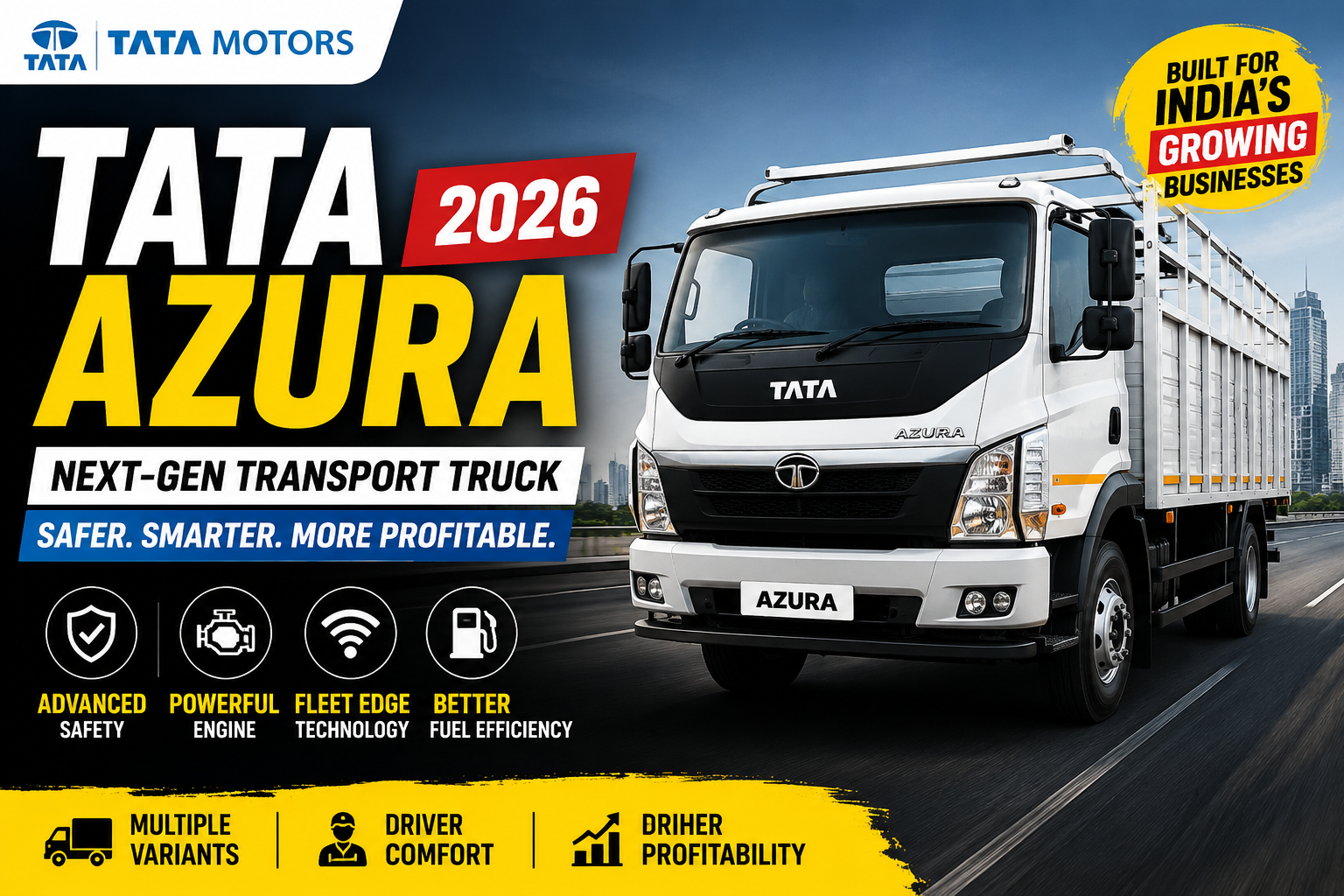
TATA Azura : India’s logistics and transportation sector continues to expand rapidly, creating a growing demand for commercial vehicles that can deliver better efficiency, enhanced safety and lower operating costs. Responding to these evolving requirements, Tata Motors has introduced the all-new Tata Azura truck range as part of its next-generation commercial vehicle portfolio.
Positioned in the Intermediate and Light Commercial Vehicle (ILMCV) segment, Tata Azura has been developed to meet the needs of modern transport businesses by combining improved performance, advanced safety systems and connected fleet management technologies.
Rather than being a conventional model update, Tata Azura represents a fresh product strategy focused on increasing productivity while improving driver comfort and long-term business profitability.
According to Tata Motors, the new platform has been engineered to support multiple industries, including logistics, e-commerce, FMCG distribution, industrial transportation and regional cargo operations.
Designed for Modern Transportation Businesses
The transportation industry has changed significantly over the last few years. Fleet owners are now prioritising fuel efficiency, digital connectivity and lower maintenance costs alongside payload capacity.
Tata Azura has been developed with these priorities in mind. The vehicle aims to help businesses reduce operational expenses while maintaining high levels of reliability.
The truck is suitable for a wide range of applications, including:
- E-commerce deliveries
- Parcel and courier operations
- FMCG distribution
- Agricultural transportation
- Construction material movement
- White goods transportation
- Industrial cargo operations
- Regional logistics services
Its versatility allows fleet operators to deploy the vehicle across different business sectors without compromising efficiency.
Tata Azura Variants : –
Tata Motors has introduced multiple configurations within the Azura lineup to cater to different transportation requirements.
The currently announced variants include:
Tata Azura 710 :-
The Tata Azura 710 has been engineered to cater to urban distribution and regional transport requirements while maintaining a strong balance between payload capacity and operational efficiency. Positioned in the Intermediate and Light Commercial Vehicle (ILMCV) segment, the truck offers a Gross Vehicle Weight (GVW) of 7,490 kg and a payload capacity of approximately 4,135 kg, making it suitable for businesses involved in e-commerce, FMCG distribution, parcel services and industrial cargo transportation.
Powering the Tata Azura 710 is Tata Motors’ 4SPCR diesel engine that produces 99 hp at 2,800 rpm and generates 300 Nm of peak torque. The engine is paired with a GB400 5-speed manual gearbox, which has been tuned to deliver smooth performance in both city and regional transport operations.
To improve driving comfort, the truck comes equipped with tilt and telescopic power steering, allowing drivers to adjust the steering position according to their preference. Tata Motors has also focused on ride quality by using a parabolic leaf spring suspension setup at the front and a semi-elliptical leaf spring suspension at the rear.
The Tata Azura 710 is available in multiple load-body configurations, including 10 ft, 12 ft, 14 ft and 17 ft options, giving fleet operators the flexibility to choose a body size that best matches their business requirements. The cabin is designed to accommodate the driver and two additional passengers, making it practical for day-to-day commercial operations.
Depending on the selected body configuration, the braking system also varies. The 10 ft and 12 ft variants are equipped with hydraulic brakes, while the larger 14 ft and 17 ft variants use an air brake system to provide enhanced stopping performance under heavier load conditions.
{ Also Read TATA Sierra EV Review }
Tata Azura 1212 :-
The Tata Azura 1212 has been developed for medium-duty logistics and regional transport operations. Built on Tata Motors’ new-generation ILMCV platform, the truck offers a Gross Vehicle Weight (GVW) of 11,990 kg and a payload capacity of around 7.3 tonnes, making it suitable for FMCG distribution, e-commerce deliveries, industrial cargo and agricultural transportation.
Power comes from Tata Motors’ 4SPCR diesel engine, which produces 123 hp and 360 Nm of peak torque, paired with a GB550 MK II gearbox for smoother performance under heavy loads. To improve driver comfort, the truck features tilt and telescopic power steering along with an ergonomic cabin layout.
The Tata Azura 1212 is available with multiple load-body options ranging from 17 ft to 24 ft and comes equipped with an air brake system for enhanced stopping performance. Tata Motors also integrates Fleet Edge connected technology, helping fleet owners monitor vehicle health, fuel efficiency and overall operational performance more effectively.
Tata Azura 1918 :-
The Tata Azura 1918 has been designed for heavy-duty regional logistics and long-haul transportation operations. Built on Tata Motors’ next-generation ILMCV platform, the truck is aimed at businesses involved in industrial cargo movement, construction materials, agricultural goods and large-scale distribution networks.
Power comes from Tata Motors’ 3.6-litre BS6 Phase-2 diesel engine, which produces up to 180 PS of power and 600 Nm of peak torque, paired with a 6-speed manual transmission for improved load-carrying performance. The truck also features a stronger chassis structure, enhanced suspension setup and an ECE R29 compliant cabin that prioritises driver safety and comfort.
Tata Motors has integrated Fleet Edge connected technology to help operators monitor vehicle health, fuel usage and service schedules in real time. With its higher payload capability and advanced digital features, the Tata Azura 1918 is positioned as a practical solution for businesses looking to improve operational efficiency and long-term profitability.
Engine and Performance :-
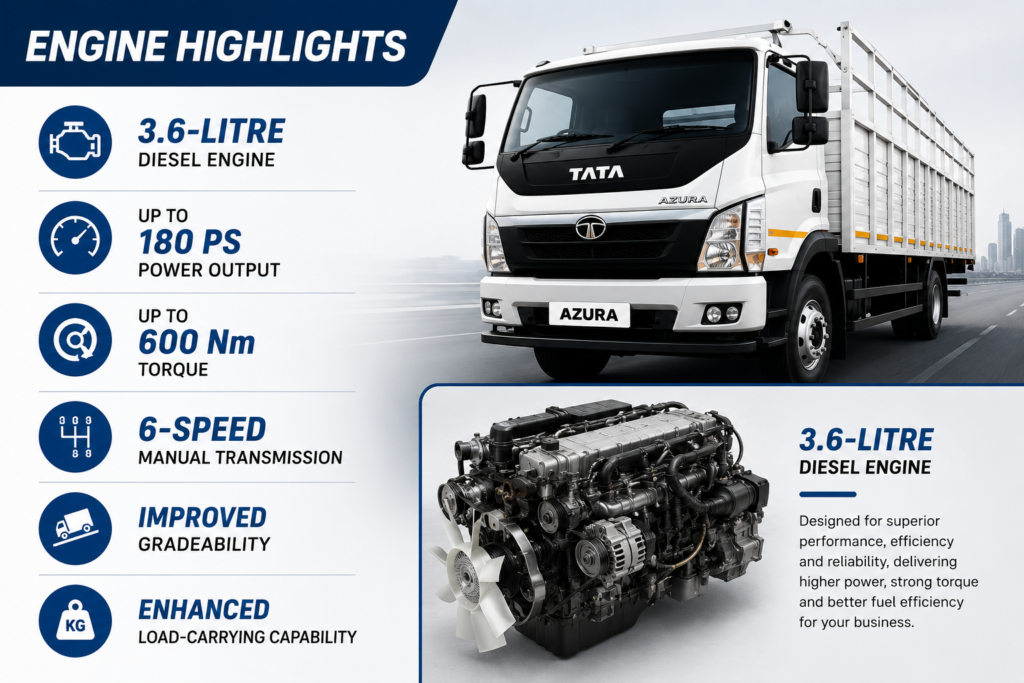
Under the cabin, Tata Azura is powered by Tata Motors’ newly developed 3.6-litre BS6 Phase-2 compliant diesel engine.
The engine has been designed to deliver a balance between performance and fuel efficiency.
Engine Highlights
- 3.6-litre diesel engine
- Up to 180 PS power output
- Up to 600 Nm torque
- 6-speed manual transmission
- Improved gradeability
- Enhanced load-carrying capability
Tata Motors states that the powertrain has been optimised to support long working hours while maintaining lower running costs.
The company has also focused on improving restart capability and drivability under demanding conditions.
Safety Receives Major Attention :-
Safety has become one of the most important factors in commercial vehicle development, and Tata Azura introduces significant upgrades in this area.
The truck has been built to comply with ECE R29 European cabin safety standards, which are designed to enhance occupant protection during impact situations.
Key safety improvements include:
- Reinforced cabin structure
- Improved driver protection
- Enhanced visibility
- Better ergonomics
- Stronger overall construction
These upgrades are intended to improve both driver confidence and operational safety during long-distance transportation.
Enhanced Driver Comfort
Commercial vehicle operators spend several hours behind the wheel every day. Recognising this, Tata Motors has focused on improving the overall driving experience.
The cabin has been redesigned to offer:
- Better seating comfort
- Improved cabin space
- Enhanced accessibility
- Reduced driver fatigue
- Ergonomically positioned controls
Improved driver comfort can contribute to higher productivity and better operational efficiency over extended periods.
Fleet Edge Connected Technology :-
One of Tata Azura’s major highlights is the integration of Tata Motors’ Fleet Edge connected vehicle platform.
Fleet Edge enables operators to monitor various vehicle parameters in real time.
The system provides access to:
- Vehicle health information
- Fuel consumption data
- Driver behaviour insights
- Route monitoring
- Service reminders
- Vehicle uptime analysis
These digital tools allow businesses to make informed decisions and improve overall fleet management.
Business Benefits of Tata Azura :-
For transport businesses, profitability depends on multiple factors beyond payload capacity.
Tata Azura has been designed to address several key business priorities.
Improved Fuel Efficiency
Lower fuel consumption can significantly reduce operating expenses over time.
Reduced Downtime
Predictive maintenance support can help minimise unexpected vehicle breakdowns.
Higher Productivity
Efficient performance allows operators to maximise cargo movement.
Better Fleet Monitoring
Connected technologies provide greater control over daily operations.
Enhanced Driver Satisfaction
Improved cabin comfort can help reduce fatigue during long journeys.
Together, these factors can contribute to better long-term returns for transport operators.
Final Verdict :-
Tata Azura represents Tata Motors’ next step towards building smarter and more efficient commercial vehicles for India’s growing logistics sector.
Instead of focusing solely on payload figures, the company has adopted a broader approach by integrating safety, driver comfort, digital connectivity and business productivity into a single platform.
For businesses planning to modernise their fleet in 2026, Tata Azura could emerge as one of the most practical choices in the ILMCV category.
Its combination of operational efficiency, advanced technology and modern safety standards positions it as a strong contender in India’s evolving commercial vehicle market.

2 Comments