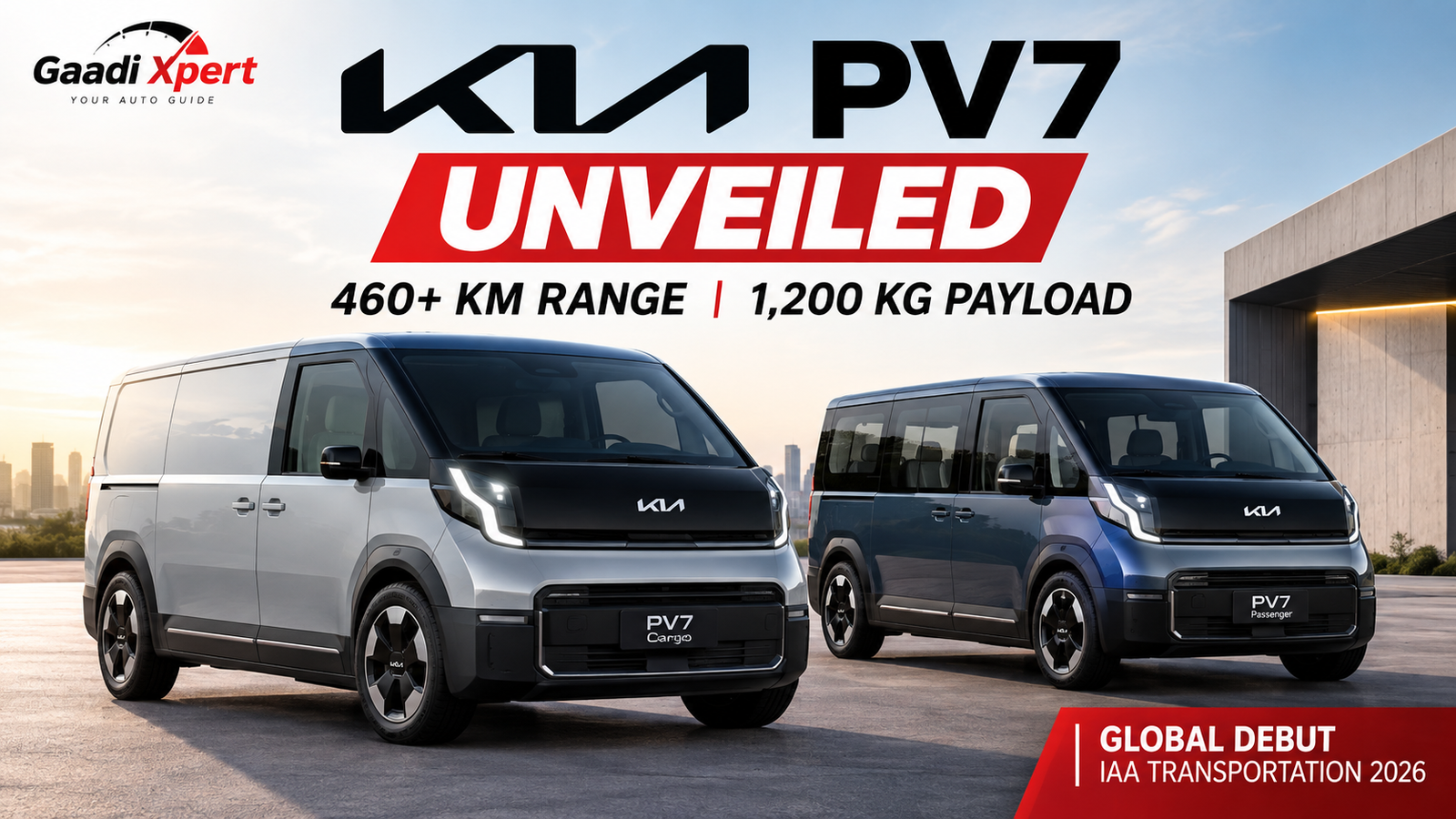
Kia has officially unveiled the Kia PV7 at IAA Transportation 2026 in Hannover, Germany, expanding its electric commercial vehicle strategy beyond the smaller PV5. The new PV7 is Kia’s second dedicated all-electric Platform Beyond Vehicle (PBV) after the PV5 and has been developed for businesses, fleet operators, passenger transport and other commercial applications.
Unlike a conventional electric van, the PV7 is designed as a flexible mobility platform. Kia is offering the model in Cargo and Passenger configurations, while the company plans to expand the PV7 family to as many as 23 variants, including different body styles and conversion models.
The new electric PBV gets a dedicated E-GMP.S architecture, battery options of 71.5 kWh and 96.2 kWh, up to 200 kW of power, 420 Nm of torque and an 800V charging system. The Long Range Cargo version is targeted to deliver more than 460 km of WLTP range, while fast charging from 10 to 80 percent is claimed to take around the mid-20-minute range with a suitable 350 kW DC charger.
However, there is an important point for Indian buyers: Kia has not yet officially announced an India launch for the PV7. The company’s confirmed initial launch markets are Korea and Europe in the second half of 2027.
Kia PV7 Global Debut: What Has Kia Actually Unveiled?
The Kia PV7 global debut took place on September 14, 2026, during the press day of IAA Transportation 2026 in Hannover.
IAA Transportation is one of the major global commercial vehicle events, making it a logical venue for Kia to introduce its larger PBV model to international markets. Kia is using the event to showcase not only the PV7 but also several PV5 derivatives and its wider PBV ecosystem.
The public exhibition runs from September 15 to September 20, 2026.
For Kia, the PV7 is important because the company is moving from a single PBV model towards a broader family of purpose-built electric vehicles.
The PV5 already established Kia’s entry into the dedicated PBV space. The PV7 now moves the brand into a larger light commercial vehicle category with more cargo capacity, higher payload capability and more flexible passenger configurations.
Kia PV7 Design: Large One-Box Electric Commercial Vehicle
The Kia PV7 follows a typical one-box commercial vehicle silhouette, but Kia has attempted to give it a more modern identity than a traditional van.
The front and rear feature Kia’s latest lighting signature, while the tall body and flat-floor architecture are designed primarily around practicality.
Kia had already shown the PV7 in teaser images before the global debut. Those images highlighted its upright proportions, black hood and pillar elements and distinctive front and rear lighting graphics.
The design is therefore less about creating a conventional passenger-car appearance and more about maximizing usable space.
That becomes particularly important in the Cargo version, where every millimetre of interior volume can directly affect the vehicle’s commercial usefulness.
PV7 Dimensions
The preliminary specifications released by Kia list the Long Passenger and Long Cargo versions with:
- Length: 5,350 mm
- Width: 1,995 mm
- Height: 1,990 mm
- Wheelbase: 3,500 mm
The width figure excludes the outside mirrors and door handles. Kia notes that the overall width including the door handle is 2,030 mm.
This places the PV7 firmly in the large electric van/PBV category rather than the compact commercial vehicle segment.
Kia PV7 Cargo: Built Around Payload and Usable Space
The PV7 Cargo is arguably the most important version for commercial operators.
Kia has developed the Cargo model around its “Tool Box” concept, meaning the vehicle is intended to work as a flexible business tool rather than simply as an electric transport vehicle.
Depending on the body configuration, the PV7 Cargo can offer up to 8.0 cubic metres of cargo volume.
The Long Cargo version provides up to 6.1 cubic metres of cargo space under the VDA measurement standard, while the High Roof version can increase this to as much as 8.0 cubic metres.
Kia PV7 Payload Capacity
Payload is another major highlight.
The PV7 Cargo is rated for:
- Long: up to 1,165 kg
- Compact: up to 1,200 kg
Kia has also developed a dedicated Heavy-Load Driving Mode, which adjusts vehicle performance according to the load being carried.
This is important because electric commercial vehicles face a unique challenge: carrying a heavier load can significantly influence energy consumption and driving range.
Kia’s approach is therefore not simply about putting a large battery into a van. The company is attempting to integrate the electric powertrain with the vehicle’s commercial operating requirements.
Cargo Practicality: Low Loading Height and Multiple Door Solutions
For a commercial vehicle, range alone is not enough.
Loading and unloading can have a direct impact on operating efficiency, which is why Kia has focused heavily on accessibility.
The PV7 Long Cargo has a 550 mm loading height, while the vehicle can accommodate up to three Euro pallets measuring 800 × 1,200 mm.
Kia also offers different tailgate solutions.
One option is a full-open twin-swing tailgate, designed to make loading easier where space around the vehicle is limited. A conventional lift-up tailgate is also available depending on configuration.
The Cargo version can also feature a load-through bulkhead, allowing longer objects to extend into the cabin area in the three-seat configuration.
Kia PV7 Battery and Electric Powertrain
The Kia PV7 gets two battery options:
- 71.5 kWh
- 96.2 kWh
Both are NCM high-voltage battery packs.
The electric motor produces up to:
- Maximum power: 200 kW
- Maximum torque: 420 Nm
The initial configuration uses front-wheel drive, while Kia says an AWD version is planned for a later stage.
This gives the PV7 considerably more performance potential than a basic city-focused electric commercial van.
Of course, the final performance and range will depend on body style, battery, load, wheels, configuration and market-specific specifications.
Kia PV7 Range: Over 460 Km Claimed
Range is one of the biggest talking points around the new electric PBV.
Kia says the Long Range Cargo version can deliver more than 460 km of all-electric range under the WLTP cycle.
This figure is based on Kia’s internal testing and remains subject to WLTP homologation.
That distinction matters.
The 460+ km figure should not be treated as a guaranteed real-world range, particularly when the PV7 is heavily loaded or driven at sustained highway speeds.
For fleet operators, however, the headline figure still suggests that Kia is targeting long-distance commercial operations rather than limiting the PV7 to short urban delivery routes.
Kia PV7 Charging: 800V Architecture
The PV7 uses an 800V charging architecture, giving it a significant advantage when connected to high-power DC charging infrastructure.
Kia says the vehicle can charge from 10 to 80 percent in the mid-20-minute range when using a 350 kW DC fast charger.
The vehicle also introduces an interesting charging solution for Kia.
The PV7 can be equipped with two charging ports:
- Front AC/DC charging port
- Optional rear-side AC charging port
The idea is simple but practical. A commercial vehicle may often have to park in different orientations depending on the charging location.
Having more than one charging access point can therefore make fleet operations easier.
Kia PV7 Passenger: Up to 9 Seats Globally
The PV7 is not limited to cargo operations.
The PV7 Passenger has been designed for applications such as:
- Crew transport
- Shuttle services
- Rental operations
- Tourism
- Family use
Kia says the global version can accommodate up to nine occupants, while the Korean-market configuration can go up to 11 occupants.
The Passenger version is available with different seating configurations.
The 7-seat version gets a Long-Rail Easy Remove Seat System, allowing seats to be moved or removed to change the balance between passenger space and cargo flexibility.
The 9-seat version can also be configured with or without a fourth row.
This is where the PBV concept becomes more interesting than a traditional van.
Instead of designing one fixed cabin layout, Kia is trying to create a platform that can be adapted according to the customer’s use case.
Kia PV7 Interior and Technology
The PV7 uses a flat-floor architecture to maximize interior space.
Kia says the cabin has generous headroom and allows movement between the front and rear areas, while flexible seating arrangements can be used depending on the configuration.
For Passenger models, additional comfort features include rear climate control and USB-C charging ports.
But the bigger story is the software.
Kia wants the PV7 to function as part of a connected business ecosystem rather than as an isolated vehicle.
Pleos Connect and Gleo AI
The PV7 incorporates Kia’s software strategy through technologies including Pleos Connect and Gleo AI.
Pleos Connect is intended to provide an open software ecosystem through which features and services can continue to evolve.
Meanwhile, Gleo AI is Kia’s generative AI-based assistant, allowing users to interact with the vehicle through voice.
For commercial operators, however, fleet management could be even more important than the AI assistant.
Fleet Management System: Kia PV7 Is More Than an Electric Van
Kia is positioning the PV7 as a complete business solution.
Its Fleet Management System (FMS) can provide information such as:
- Vehicle location
- Battery status
- Driver behaviour
- Fleet data
- Vehicle operational information
Kia also plans connected vehicle data APIs and dedicated uptime services.
These systems can help fleet operators monitor vehicles and potentially reduce downtime through predictive diagnostics and proactive maintenance.
For a commercial customer, this can be more valuable than having another flashy infotainment feature.
A fleet operator ultimately wants vehicles that spend more time working and less time waiting for charging, maintenance or repairs.
Kia PV7 Flexible Body System
Another major part of the PV7 strategy is Kia’s Flexible Body System (FBS).
The architecture is designed to allow Kia to create different body configurations using a common vehicle foundation.
That means the PV7 can eventually be offered in multiple lengths, heights and applications without developing an entirely new vehicle for every use case.
Kia plans to offer:
- PV7 Cargo Compact
- PV7 Cargo Long
- PV7 Cargo High Roof
- PV7 Passenger Compact
- PV7 Passenger Long
- Chassis Cab
- Multiple conversion models
The company says the broader PV7 family is planned to reach 23 variants.
Kia PV7 Safety and Driver Assistance
Kia has developed the PV7 around its modern EV and PBV architecture, while driver-assistance technologies are available depending on model, derivative, specification and market.
However, Kia’s global announcement does not provide a single universal list of every ADAS feature that will be standard across all PV7 variants.
Therefore, it would be incorrect to claim that every PV7 will receive the same safety equipment globally.
Final equipment will depend on the market and variant.
Kia PV7 Launch Date: When Will It Go on Sale?
The global unveiling and market launch are two different things.
The Kia PV7 has already been globally unveiled, but customers cannot simply order it globally from September 2026.
Kia currently plans to launch the PV7 in Korea and Europe during the second half of 2027. Additional markets and derivatives will follow later.
This means the PV7 is currently a globally unveiled vehicle, not a globally launched retail model.
What About India?
At the time of this report, Kia has not officially announced the PV7 for the Indian market.
Therefore, any claim that the PV7 is “launching in India” should currently be treated as speculation unless Kia India makes an official announcement.
This is particularly important because commercial EV requirements, charging infrastructure, pricing and homologation can vary significantly from one market to another.
Kia PV7 Price: How Much Will It Cost?
Kia has not announced an official production price for the PV7.
Therefore, there is no verified Kia PV7 price that should be quoted for India or other markets at this stage.
The final price will likely vary according to:
- Battery size
- Cargo or Passenger configuration
- Body length
- Roof height
- Market
- Equipment level
- Conversion package
For now, any India-specific price figure would be an estimate rather than official information.
Kia PV7 vs PV5: What’s the Difference?
The PV7 sits above the PV5 in Kia’s PBV family.
The PV5 is positioned around compact and medium-duty applications, while the PV7 brings significantly greater size, cargo volume and payload capability.
The PV7 also offers a larger battery option, higher power output and more passenger/cargo flexibility.
In simple terms:
PV5 = smaller, more urban-focused PBV
PV7 = larger, higher-capacity PBV for demanding commercial and passenger applications
Kia is ultimately building a PBV family rather than relying on one vehicle.
The company has already planned the PV9 for 2029, which will sit further up the range.
Why Kia PV7 Matters in the Global EV Commercial Vehicle Market
The commercial vehicle industry is undergoing a major shift.
Businesses are increasingly looking at electric vans because operating costs, emissions regulations and urban restrictions are changing the economics of commercial transportation.
But commercial customers do not necessarily want a passenger EV converted into a van.
They need:
- High payload
- Large cargo volume
- Fast charging
- Reliable fleet management
- Flexible body configurations
- Low downtime
- Easy loading
- Long operating range
The Kia PV7 has been designed around exactly these requirements.
Its biggest strength may therefore be the combination of hardware + software + fleet services, rather than any single specification.
Kia PV7: Key Specifications
| Specification | Kia PV7 |
|---|---|
| Vehicle type | Electric PBV / LCV |
| Global debut | September 14, 2026 |
| Debut venue | IAA Transportation 2026, Hannover |
| Platform | E-GMP.S |
| Battery | 71.5 kWh / 96.2 kWh |
| Max power | 200 kW |
| Max torque | 420 Nm |
| Drive | FWD initially |
| AWD | Planned |
| Range | 460+ km WLTP target, Long Range Cargo |
| Charging architecture | 800V |
| DC fast charging | 10–80% in mid-20-minute range |
| Maximum cargo volume | Up to 8.0 m³ |
| Maximum payload | Up to 1,200 kg |
| Passenger capacity | Up to 9 globally / 11 in Korea |
| Long version length | 5,350 mm |
| Width | 1,995 mm |
| Height | 1,990 mm |
| Wheelbase | 3,500 mm |
| Initial market launch | Korea & Europe |
| Planned launch | Second half of 2027 |
| India launch | Not officially announced |
| Price | Not announced |
Specifications are preliminary and may vary by market, variant and production timing.
Kia PV7: Pros and Cons
Pros
- 460+ km claimed WLTP range for Long Range Cargo
- Large 96.2 kWh battery option
- 800V fast-charging architecture
- Up to 1,200 kg payload
- Up to 8.0 m³ cargo capacity
- Multiple Cargo and Passenger configurations
- Up to nine seats globally
- Fleet management and connected services
- Future AWD option
- 23 planned variants and conversions
Cons
- India launch not confirmed
- Official price not announced
- Real-world range will depend heavily on load and driving conditions
- Several specifications vary by market
- 2027 launch means customers still have to wait
- 350 kW charging capability depends on suitable charging infrastructure
Should You Wait for the Kia PV7?
If you are a fleet operator looking for a large electric commercial vehicle, the Kia PV7 is certainly a model worth watching.
Its combination of a large battery, 460+ km WLTP target, 1,200 kg payload, fast charging and connected fleet services makes it more than just another electric van.
However, Indian buyers should wait for an official announcement from Kia India before considering the PV7 as an upcoming India launch.
At present, Kia has officially confirmed Korea and Europe for the second half of 2027, while additional markets will follow later.
Gaadi Xpert Verdict
The Kia PV7 is an important step in Kia’s global electric commercial vehicle strategy.
What makes it interesting is not simply the 96.2 kWh battery or the 460+ km range. The bigger story is the way Kia has designed the vehicle around different business requirements.
Cargo operators can choose different body configurations, passenger operators can configure the cabin for different applications, and fleet managers can use connected systems to monitor vehicles and improve operational efficiency.
The planned 23-variant PV7 ecosystem also shows that Kia is treating PBVs as a long-term business rather than a single electric van project.
For now, though, there are two things readers should remember:
Kia PV7 has been globally unveiled — but it has not yet launched in India.
And while Kia has announced a second-half 2027 launch for Korea and Europe, India remains unconfirmed.
For Gaadi Xpert, the PV7 is therefore best described as a new globally unveiled electric PBV that could become an interesting future commercial EV if Kia expands the model to India.
Frequently Asked Questions
Is the Kia PV7 launched?
The Kia PV7 has been globally unveiled, but its retail launch is planned for Korea and Europe in the second half of 2027.
What is the Kia PV7 range?
The Long Range Cargo version is targeted to deliver more than 460 km of WLTP range.
What is the Kia PV7 battery capacity?
Kia offers 71.5 kWh and 96.2 kWh NCM battery options.
How much can the Kia PV7 carry?
The Cargo version offers up to 1,200 kg payload, depending on configuration.
How many people can sit in the Kia PV7?
The global Passenger version can accommodate up to nine occupants, while the Korean version can offer up to 11 seats.
Is Kia PV7 coming to India?
Kia has not officially announced an India launch yet.
What is the PV7 price in India?
No official India price has been announced.
When will PV7 launch?
Kia plans to launch the PV7 in Korea and Europe in the second half of 2027, followed by additional markets and derivatives.