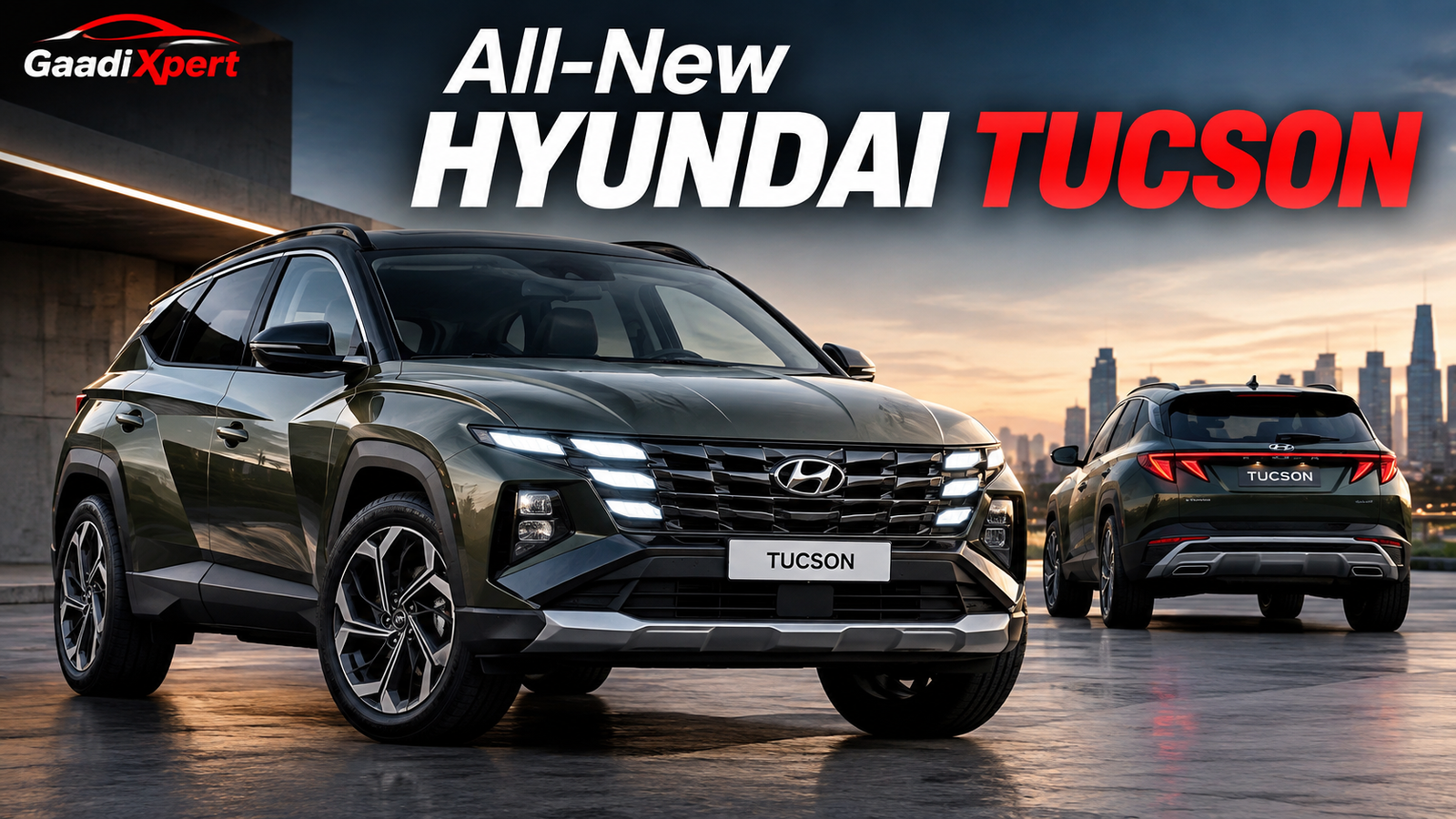
Hyundai has officially unveiled the all-new Hyundai Tucson at its global premiere in New York, introducing a completely redesigned SUV with a stronger exterior identity, a more spacious cabin, next-generation hybrid technology and a new connected infotainment platform.
The new Tucson made its world premiere on October 1, 2026, against the Manhattan skyline. Hyundai describes the new model as its “boldest SUV” yet, built around the company’s new “Art of Steel” design philosophy.
More importantly, this is not simply a styling update. Hyundai has increased the SUV’s dimensions, introduced a new-generation hybrid system, added Pleos Connect with Gleo AI, and introduced the adventure-focused Tucson XRT PRO for selected markets.
All-New Hyundai Tucson Global Reveal: What Has Changed?
The new-generation Hyundai Tucson gets a substantially redesigned body. Hyundai says the long-wheelbase version is now 4,700 mm long, 1,905 mm wide and 1,685 mm tall.
Compared with the previous generation, the long-wheelbase model has grown by:
- 60 mm in length
- 40 mm in width
- 20 mm in height
- 30 mm in wheelbase
The wheelbase now measures 2,785 mm.
This larger footprint has also helped Hyundai create more space inside the cabin. The company says the new Tucson offers improved passenger accommodation while retaining its SUV character.
New Hyundai Tucson Design: Art of Steel
The biggest visual change comes from Hyundai’s new Art of Steel design language.
Instead of relying on complicated surface detailing, the new Tucson uses muscular fenders, stronger proportions and sharper body lines. Hyundai says the design draws inspiration from the structural strength and tension of steel.
The front gets a new H-Edge lighting signature. It combines indirect centre lighting with edge lighting to create a wider-looking front profile.
At the rear, the SUV receives new Prism Rear Lamps, which use a sculptural lighting pattern integrated into the rear design.
The new Tucson can also be equipped with Micro Pixel Lighting, which uses 25,600 individual LED pixels. The Hyundai says this system supports precision beam patterns along with rain-guide and welcome/farewell lighting functions.
Hyundai Tucson Colours
Hyundai has introduced a new nature-inspired colour palette for the new Tucson.
Depending on market and specification, the colours include:
- Serenity White Pearl
- Ranger Green Pearl
- Kodiak Blue Pearl
- Driftwood Gray Metallic
- Red Rock Orange Pearl
Availability will vary between markets and individual versions.
New Tucson Interior: Bigger and More Comfortable
The interior follows a completely different approach from the previous model.
Hyundai has designed the dashboard around a two-layer architecture, with a horizontal upper section and an open storage tray below it.
The company has also focused on reducing visual clutter. The steering wheel is paired with a 9.9-inch slim display, while frequently used functions such as HVAC and audio receive physical controls below the main screen.
This approach is important because Hyundai has not moved every function into the touchscreen. The company says the layout aims to keep frequently used controls easy to operate while driving.
The long-wheelbase Tucson offers:
- Front headroom: 1,036 mm
- Rear legroom: 1,064 mm
- Front shoulder room: 1,470 mm
- Five-seat configuration
- 6:4 split-folding rear seats in North America and Korea
Cargo capacity is listed at up to 1,067 litres under the domestic SAE measurement.
17-Inch Display and Pleos Connect
One of the biggest technology upgrades is the new Pleos Connect infotainment system.
Depending on configuration, the Tucson gets a 17-inch or 12.9-inch primary touchscreen, along with a 9.9-inch slim display.
The system is based on Android Automotive OS and supports features such as:
- Split-screen functionality
- Three-finger gesture controls
- Online navigation updates
- Built-in applications
- Third-party entertainment and productivity services
- Over-the-air updates
The 17-inch display can also show multiple functions simultaneously, allowing navigation and other applications to remain visible together.
Gleo AI Makes the Tucson More Connected
Hyundai has also introduced Gleo AI as part of the Pleos Connect ecosystem.
The system is designed to understand natural-language conversations and context instead of requiring drivers to navigate through multiple menus.
For example, Hyundai says users can make contextual requests such as finding a hiking trail with parking within a specified time.
Gleo AI can also understand follow-up requests and support functions such as navigation, music and vehicle controls.
The system can receive OTA updates, meaning Hyundai can continue improving the digital experience after the vehicle reaches customers.
New Hyundai Tucson Hybrid Powertrain
The powertrain is another major part of the new Tucson story.
Hyundai has introduced its Next-generation Hybrid System, designed around what the company calls “Intelligent Efficiency”.
The hybrid system uses dual electric motors and manages their power delivery in real time.
For the North American 2WD model with 17-inch wheels, Hyundai is targeting up to 42 mpg.
Hyundai also claims a 0–60 mph time of 8.5 seconds for the hybrid version.
For the Korean market, the hybrid system is listed with an output range of 236–245 PS, depending on configuration.
The standard petrol range includes a 1.6-litre turbocharged engine, while Hyundai’s technical information also lists a 2.0-litre MPI engine for certain markets.
The 1.6T-GDI version is rated at 184 hp in the US specification, while Korean-market specifications list outputs between 150 and 193 PS depending on the engine and configuration.
Hyundai Tucson Plug-in Hybrid
The new Tucson will also be offered as a Plug-in Hybrid in selected markets.
The PHEV combines a 1.6-litre turbocharged petrol engine with a plug-in hybrid system.
Hyundai lists:
- 292 PS combined output
- 38.7 kgf·m combined torque
- 17.1 kWh battery
- Up to 81 km estimated electric range
- 7.2 kW onboard charger
The PHEV is intended to allow many everyday trips to be completed using electric power while retaining the petrol engine for longer journeys.
Hybrid Stay Mode
One interesting feature is HEV Stay Mode.
It allows the vehicle to keep selected functions running while the petrol engine remains switched off.
These functions include:
- Air conditioning
- Heating
- Audio
- Device charging
This gives the hybrid Tucson some of the stationary comfort normally associated with an EV.
New Tucson Safety and Driver Assistance
Hyundai has also strengthened the new Tucson’s structural and electronic safety package.
The SUV uses hot-stamped high-strength steel in key structural areas, while reinforced centre pillars help improve structural rigidity.
The new Tucson also gets an In-Cabin Monitoring Unit that monitors driver eye activity and drowsiness.
Other technologies include:
- Intelligent Speed Limit Assist
- Navigation-Linked Smart Cruise Control
- Driver and occupant monitoring
- Child Presence Detection
- Rear Occupant Alert
- Lane Following Assist
- Emergency Stop functionality
Hyundai’s technical sheet also lists a broad airbag system, including front, side and curtain airbags, with availability varying by market.
Tucson XRT PRO: The Rugged Version
For buyers looking for more off-road capability, Hyundai has introduced the Tucson XRT PRO.
This version moves beyond cosmetic changes.
It gets:
- All-wheel drive
- All-terrain tyres
- Front recovery hooks
- Increased ground clearance
- More aggressive approach and departure angles
- Additional lower-body protection
- Smart Terrain Assist
Ground clearance increases to 210 mm, which is 30 mm more than the standard model.
The XRT PRO also gets a more aggressive exterior treatment with larger cladding and dedicated wheel designs.
Smart Terrain Assist
The new Tucson introduces Hyundai’s first Smart Terrain Assist system.
The system analyses terrain difficulty, traction and wheel-slip conditions and provides visual guidance through a “stuck score”.
Hyundai also introduces Target Speed Control, which can manage acceleration and braking between 2 and 25 km/h during low-speed off-road driving.
Other available technologies include:
- Ground View Monitor
- Memory Reversing Assist
- Trailer Reverse Assist
The exact availability depends on market and trim.
Hyundai Tucson Dimensions and Specifications
| Specification | All-New Tucson |
|---|---|
| Length | 4,700 mm |
| Width | 1,905 mm |
| Height | 1,685 mm |
| Wheelbase | 2,785 mm |
| Standard ground clearance | 180 mm |
| XRT PRO ground clearance | 210 mm |
| Seating | 5 |
| Maximum wheel size | 20-inch |
| Cargo capacity | Up to 1,067 litres |
| Hybrid output | 236–245 PS* |
| PHEV output | 292 PS* |
| PHEV electric range | Up to 81 km* |
*Specifications vary by market and configuration.
Hyundai Tucson India Launch: What We Know
The global reveal does not mean that the new Tucson has been confirmed for immediate India launch.
Hyundai’s official announcement says the new Tucson will launch in Korea later in 2026, followed by North America, Europe and other global markets in 2027. Hyundai has not provided a specific India launch date in the global reveal announcement.
Therefore, an India launch timeline should not be presented as confirmed until Hyundai India officially announces it.
When Will the New Tucson Go on Sale?
The first market to receive the new Tucson will be Korea later this year.
North America, Europe and other global markets are scheduled to follow in 2027.
Hyundai has not yet published complete market-wise pricing for the new-generation SUV.
Final Conclusion
The all-new Hyundai Tucson represents a major step forward for Hyundai’s global SUV lineup.
The new generation brings a much stronger design through the Art of Steel philosophy, a larger body, a redesigned cabin, the new Pleos Connect digital platform and Gleo AI.
However, the biggest technical change is the new hybrid system. Hyundai is targeting up to 42 mpg for the North American 2WD hybrid, while the plug-in hybrid offers 292 PS and an estimated 81 km of electric range in selected markets.
The introduction of the XRT PRO also gives Tucson a more serious adventure-oriented identity, with 210 mm ground clearance, all-terrain tyres, AWD and Smart Terrain Assist.
For India, the important point is that Hyundai has not yet officially confirmed an India launch date for this generation. The global reveal is confirmed, while Indian-market specifications, pricing and launch timing remain to be announced.
Official Hyundai
Also Read About TATA SIERRA Dark Edition