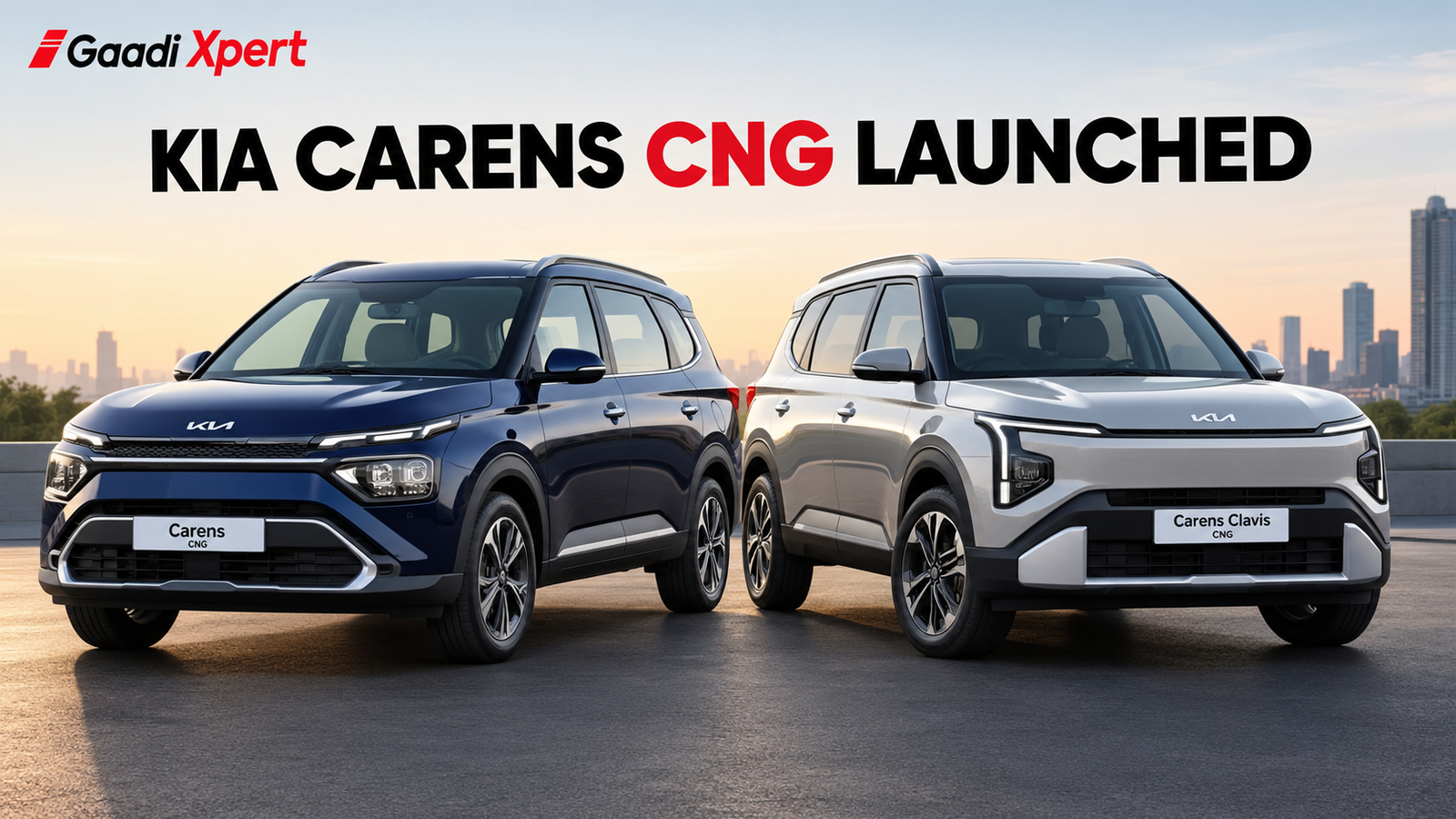
Kia Carens CNG and Kia Carens Clavis CNG have officially been launched in India with factory-fitted CNG technology. The new versions bring a dual-fuel petrol-CNG option to Kia’s three-row MPV range, giving buyers another powertrain choice alongside the existing petrol, diesel and electric options available across the broader Carens family.
The Kia Carens CNG starts at ₹12.11 lakh, while the Kia Carens Clavis CNG starts at ₹12.38 lakh, with both prices ex-showroom. The Carens CNG is available in a single Premium (O) variant, whereas the Carens Clavis CNG is offered in HTE and HTE (O) trims.
More importantly, these are not dealer-installed CNG conversions. Kia has integrated the CNG system at the factory and made several mechanical and electronic changes to accommodate the additional hardware. These include CNG-specific engine calibration, revised suspension tuning, larger front disc brakes, a dedicated CNG fuel-change switch and CNG-specific distance-to-empty information in the instrument display.
The new Kia Carens CNG and Carens Clavis CNG therefore represent more than simply adding a CNG cylinder to an existing MPV. Kia has worked on the powertrain and chassis setup to accommodate the additional weight while retaining the three-row configuration and spare wheel.
Here is everything you need to know about the new Kia Carens CNG and Carens Clavis CNG.
Kia Carens CNG and Carens Clavis CNG: What’s New?
The biggest change is the introduction of a factory-fitted CNG powertrain.
Both MPVs use Kia’s Smartstream G1.5 naturally aspirated petrol engine with a CNG system integrated alongside the existing petrol fuel system. In CNG mode, the engine produces 96 PS of maximum power and 123 Nm of peak torque.
The engine is paired with a 6-speed manual transmission.
Kia has also introduced dedicated CNG hardware and software changes. The CNG versions receive a fuel-change switch, while the 4.2-inch colour TFT MID gets CNG-specific Distance To Empty logic.
The company has additionally revised the suspension and braking setup to deal with the additional weight associated with the CNG system.
This is particularly important for a three-row MPV because these vehicles can regularly carry several passengers and luggage. Therefore, simply fitting a CNG tank without chassis-related changes would not be an ideal approach.
Kia says the factory-fitted configuration has been engineered around the existing vehicle package while retaining the spare tyre.
Kia Carens CNG Price in India
The Kia Carens CNG is currently offered in one variant.
| Variant | Engine | Transmission | Ex-showroom Price |
|---|---|---|---|
| Carens Premium (O) CNG | Smartstream G1.5 CNG | 6MT | ₹12,11,800 |
The rounded starting price is ₹12.12 lakh ex-showroom.
This makes the factory-fitted CNG version approximately ₹1 lakh more expensive than the corresponding petrol-manual version.
The limited variant strategy is worth noting. Kia has not launched the Carens CNG across the complete range. Instead, the CNG option is currently restricted to the Premium (O) trim.
For buyers, that means the decision is not only about choosing between petrol and CNG. It also depends on whether the available CNG variant provides the desired equipment level.
Kia Carens Clavis CNG Price in India
The newer Kia Carens Clavis gets two CNG variants.
| Variant | Engine | Transmission | Ex-showroom Price |
|---|---|---|---|
| Carens Clavis HTE CNG | Smartstream G1.5 CNG | 6MT | ₹12,38,800 |
| Carens Clavis HTE (O) CNG | Smartstream G1.5 CNG | 6MT | ₹13,34,800 |
The rounded prices are ₹12.39 lakh and ₹13.35 lakh, respectively.
The two Carens Clavis CNG variants give buyers slightly more choice than the regular Carens CNG.
The HTE (O) version sits above the HTE version and carries a higher price because of its additional equipment. However, the fundamental CNG powertrain remains the same.
Kia Carens CNG and Clavis CNG Engine and Performance
The heart of the new CNG models is Kia’s Smartstream G1.5 naturally aspirated engine.
In CNG mode, the engine develops:
- Maximum power: 96 PS
- Peak torque: 123 Nm
- Transmission: 6-speed manual
- Fuel system: Petrol + CNG
- CNG tank: 60 litres
These figures are officially reported for the CNG configuration.
Compared with the petrol configuration of the same naturally aspirated engine, CNG operation results in lower output. The petrol version produces around 115 PS and 144 Nm, while the CNG setup produces 96 PS and 123 Nm.
That difference is expected with a CNG powertrain. The important point for buyers is that Kia has specifically recalibrated the engine for CNG operation rather than simply treating the system as an aftermarket conversion.
The 6-speed manual gearbox is currently the only transmission offered with the factory-fitted CNG models.
There is no CNG automatic option announced for the Carens or Carens Clavis at launch.
CNG Mileage: What Has Kia Officially Confirmed?
This is one area where buyers should be careful.
Kia has not announced an official certified fuel-efficiency figure for the Carens CNG or Carens Clavis CNG.
Several automotive reports have mentioned an estimated efficiency figure in the region of 22–25 km/kg. However, because this figure is not an official certified figure from Kia, it should not be treated as the final mileage number.
At Gaadi Xpert, we prefer to keep such information clearly separated from manufacturer-confirmed specifications.
Therefore, until Kia publishes a certified CNG efficiency figure, the correct statement is:
Official CNG mileage: Not announced by Kia yet.
Real-world efficiency will also depend on traffic, passenger load, tyre pressure, driving style, air-conditioning use and the availability of CNG infrastructure.
60-Litre CNG Tank
One of the major technical highlights of the new models is the 60-litre CNG tank.
Kia has integrated the CNG tank alongside the existing petrol fuel system, creating a dual-fuel configuration. This means owners can use both petrol and CNG rather than depending exclusively on one fuel.
The factory integration is significant because the vehicle has been engineered around the additional CNG hardware.
Another practical feature is the retention of the spare wheel.
Kia has managed to retain the spare tyre despite installing the CNG system, which is useful for buyers who regularly travel long distances or use the vehicle for family trips.
Boot Space and CNG Packaging
The CNG system does have an impact on luggage capacity.
According to launch information, boot capacity with all three rows in use drops from 216 litres to 116 litres on the CNG versions.
That is a reduction of 100 litres.
For a three-row MPV, this is an important consideration.
With all three rows occupied, the available luggage area is already more limited than in a five-seat SUV or sedan. The CNG installation reduces this further.
However, the CNG packaging has one major advantage: the three-row seating arrangement is retained.
The spare wheel is also retained through the factory packaging.
Therefore, buyers have to balance two things: lower running-cost potential through CNG and reduced luggage capacity behind the third row.
For families who generally use the third row occasionally, the reduced boot space may be less significant. For families that regularly carry seven passengers and substantial luggage, it becomes a more important ownership consideration.
Suspension Changes for the CNG Models
The addition of a 60-litre CNG tank increases the vehicle’s weight and changes the load distribution.
Kia has therefore modified the suspension setup of the CNG versions.
The suspension has been retuned to accommodate the additional CNG hardware and maintain the vehicle’s intended driving characteristics.
This is an important engineering change because the Carens and Carens Clavis are family-oriented three-row vehicles.
A vehicle carrying seven occupants already operates under substantially different load conditions compared with an empty vehicle. Adding a CNG system makes suspension tuning even more important.
Rather than treating the CNG system as an aftermarket addition, Kia has incorporated the necessary changes into the factory-built configuration.
Brakes and Wheels
Kia has also made changes to the braking hardware.
The CNG variants receive 16-inch front disc brakes, along with R16 wheels.
The revised braking setup is part of the changes made to accommodate the additional weight of the CNG system.
This is another reason why the factory-fitted CNG system is different from a conventional aftermarket conversion.
The vehicle’s powertrain, suspension and braking systems have been considered together as part of the factory configuration.
CNG Fuel Change Switch
Another CNG-specific feature is the dedicated CNG fuel-change switch.
Since the vehicles use a dual-fuel setup, the driver can operate the vehicle using CNG or petrol.
This provides flexibility during everyday driving.
For example, an owner may prefer CNG during regular city commuting where CNG stations are convenient, while petrol remains available when CNG availability becomes an issue.
The exact driving experience will depend on the fuel mode, vehicle load and road conditions, but the dual-fuel configuration gives owners an additional layer of flexibility.
4.2-Inch Colour TFT MID With CNG DTE
Kia has also made changes to the instrument display.
The CNG versions get a 4.2-inch colour TFT MID with CNG Distance To Empty logic.
This is useful because CNG vehicles require drivers to keep track of the available gas separately from petrol.
The CNG-specific distance-to-empty information provides the driver with a clearer idea of how much CNG remains.
It is a relatively small feature, but it can make everyday CNG ownership easier.
Third-Row Comfort Improvements
The CNG versions also receive a modified third-row seat-back frame.
Kia has changed the frame to improve the recline angle of the third-row seats.
This is particularly relevant for a vehicle like the Carens or Carens Clavis because the third row is an important part of its identity.
The CNG system could have been developed purely around the powertrain and fuel tank. Instead, Kia has also addressed the seating package.
That keeps the family-oriented nature of the MPVs intact.
Seven-Seat Configuration
The CNG variants continue with a three-row, seven-seat configuration.
This is an important distinction because the main reason buyers choose the Carens family over a conventional compact SUV is its ability to accommodate more passengers.
The introduction of CNG does not turn the vehicles into five-seaters.
Instead, Kia has retained the three-row layout while adapting the vehicle’s packaging to accommodate the CNG system.
For family buyers, this means the fundamental use case remains unchanged: daily commuting, school runs, family trips and longer journeys with multiple passengers.
Factory-Fitted CNG vs Dealer-Fitted CNG
The biggest significance of this launch is perhaps the transition from dealer-level CNG installation to a factory-fitted CNG system.
Earlier, CNG installations for the Carens were associated with dealer-level fitment. The new models are different because Kia itself integrates the CNG system into the production vehicle.
Factory integration allows the manufacturer to consider the CNG system while calibrating the engine, suspension and braking hardware.
It also gives buyers a vehicle that has been developed and sold as a CNG model rather than as a petrol vehicle subsequently converted to another fuel.
For a family MPV, that distinction can be particularly relevant because the vehicle may frequently operate with several passengers.
Features and Equipment
Kia has retained the basic equipment package associated with the corresponding petrol variants while adding CNG-specific equipment.
The important CNG-specific additions include:
- Factory-fitted CNG system
- 60-litre CNG tank
- CNG fuel-change switch
- 4.2-inch colour TFT MID
- CNG Distance To Empty logic
- CNG-specific engine calibration
- Retuned suspension
- R16 wheels
- 16-inch front disc brakes
- Modified third-row seat-back frame
- Spare wheel retained
These changes are in addition to the standard features available with the respective Carens and Carens Clavis trims.
The exact equipment list varies by trim, so buyers should check the variant-specific equipment before booking.
Kia Carens CNG: Who Is It For?
The Carens CNG is primarily aimed at buyers who want a spacious three-row family vehicle but also want to reduce dependence on petrol for regular commuting.
The 96 PS and 123 Nm output is not designed around outright performance. Instead, the focus is on practical family transportation.
For city users who have reliable access to CNG stations, the dual-fuel setup could make sense.
The petrol backup is also important.
Unlike a pure CNG-only vehicle, the Carens CNG does not leave the owner completely dependent on the availability of CNG stations.
The main trade-off is the reduced boot capacity.
Kia Carens Clavis CNG: Who Is It For?
The Carens Clavis CNG follows the same basic formula but is positioned as the newer member of Kia’s three-row MPV family.
The CNG version is available in two trims:
HTE and HTE (O).
This gives customers more choice than the single-variant Carens CNG.
The Clavis CNG uses the same 1.5-litre Smartstream engine, 96 PS output, 123 Nm torque and 6-speed manual transmission.
Therefore, the decision between the Carens CNG and Carens Clavis CNG is not primarily about engine performance.
Instead, it comes down to design, variant equipment, pricing and the buyer’s preference between the two MPVs.
Kia Carens CNG vs Carens Clavis CNG: Key Difference
The most important specifications are almost identical.
| Specification | Kia Carens CNG | Kia Carens Clavis CNG |
|---|---|---|
| Engine | Smartstream G1.5 | Smartstream G1.5 |
| Fuel | Petrol + CNG | Petrol + CNG |
| CNG Power | 96 PS | 96 PS |
| CNG Torque | 123 Nm | 123 Nm |
| Gearbox | 6-speed MT | 6-speed MT |
| CNG Tank | 60 litres | 60 litres |
| Seating | 7 | 7 |
| Spare Wheel | Yes | Yes |
| CNG DTE | Yes | Yes |
| Front Disc Brakes | 16-inch | 16-inch |
| CNG Variants | 1 | 2 |
The biggest difference is the model and trim positioning rather than the basic CNG technology.
Kia Carens CNG vs Rivals
The factory-fitted CNG MPV space in India includes products such as the Maruti Suzuki Ertiga CNG, Maruti Suzuki XL6 CNG and Toyota Rumion CNG.
The Kia products enter this space with a larger 60-litre CNG tank and a three-row family-focused package.
However, price alone does not tell the complete story.
A buyer needs to compare:
- Initial purchase price
- CNG availability
- Claimed and real-world fuel efficiency
- Boot capacity
- Seating comfort
- Variant equipment
- Service network
- Resale expectations
- Insurance and maintenance costs
The Ertiga and Rumion are established CNG options, while the factory-fitted CNG Carens and Clavis bring Kia’s MPV design and equipment package into the same fuel category.
Does the CNG System Affect Performance?
Yes.
The CNG version produces 96 PS and 123 Nm, while the naturally aspirated petrol version produces approximately 115 PS and 144 Nm.
Therefore, buyers should not expect the same performance from the CNG configuration.
The difference will be more noticeable when the vehicle is heavily loaded.
This is especially relevant for a seven-seat MPV. If all seats are occupied and luggage is loaded, the engine has to move considerably more mass.
However, Kia has recalibrated the engine specifically for CNG operation.
The 6-speed manual gearbox also gives the driver direct control over the available power and torque.
For city driving and normal family usage, the focus of this powertrain is practicality rather than performance.
Does the Carens CNG Have an Automatic Gearbox?
No.
At launch, the factory-fitted CNG versions are available only with a 6-speed manual transmission.
The petrol versions of the Carens family offer additional transmission choices, but Kia has not introduced an automatic gearbox with the CNG powertrain.
This could matter for buyers who spend most of their time in heavy traffic.
However, the current CNG lineup keeps the mechanical package relatively straightforward: naturally aspirated engine, CNG system and six-speed manual transmission.
Safety and Structural Considerations
Kia has made specific hardware changes to accommodate the CNG system, including revised suspension and larger front disc brakes.
The company has also retained the spare wheel despite the additional CNG hardware.
However, buyers should distinguish between CNG-specific engineering changes and the complete safety-equipment list of each trim.
Safety equipment can vary by variant, so it is better to check the exact trim’s official equipment list rather than assuming every feature is standard on every CNG version.
At Gaadi Xpert, we would also avoid claiming a specific safety rating for these newly launched CNG variants unless Kia or an independent crash-testing authority publishes a directly applicable result.
Ownership Perspective
The biggest reason someone would consider the new Kia Carens CNG or Carens Clavis CNG is running-cost potential.
CNG can offer a lower fuel cost per kilometre than petrol under suitable fuel-price and consumption conditions.
However, the economics should be calculated using the buyer’s actual monthly running.
For example, a person driving 2,000 km every month will have a very different fuel-cost equation from someone driving only 500 km.
The CNG premium also needs to be considered.
The new CNG variants command approximately a ₹1 lakh premium over their corresponding petrol-manual versions.
Therefore, the buyer should calculate the approximate payback period based on actual monthly kilometres.
There is another important consideration: CNG station availability.
For someone living in an area with easy access to CNG stations, the dual-fuel setup can be convenient.
For someone travelling regularly through areas with limited CNG infrastructure, the petrol backup becomes important.
Boot Space: The Biggest Practical Compromise
The biggest compromise is clearly the boot.
The luggage capacity behind the third row drops from around 216 litres to 116 litres with the CNG setup.
For a seven-seat family vehicle, that is a significant reduction.
If the third row is folded or not used, the situation can be different. But with all seven seats occupied, owners should expect limited luggage space.
This is something prospective buyers should physically check at the dealership before booking.
Take the family’s actual luggage and test the available boot space.
A specification sheet cannot completely explain how practical the remaining luggage area will feel in real use.
What Kia Has Not Confirmed Yet
There are a few areas where information should not be presented as official until Kia releases it.
Official CNG Mileage
Not announced yet.
Real-World Range
Not officially established.
Exact CNG Running Cost
Depends on local CNG and petrol prices as well as real-world efficiency.
Automatic CNG
Not available at launch.
Higher CNG Variants
Kia has currently announced the variants listed above. Future expansion should not be assumed unless officially confirmed.
This distinction matters because several pre-launch reports circulated different specifications and expected pricing before the official announcement.
Kia Carens CNG: Pros and Cons
Pros
- Factory-fitted CNG system
- 60-litre CNG tank
- 96 PS and 123 Nm
- Six-speed manual gearbox
- Dual-fuel flexibility
- Three-row seven-seat configuration
- Spare wheel retained
- CNG-specific DTE display
- Retuned suspension
- Revised braking hardware
- Kia’s established MPV package
Cons
- Official CNG mileage is not yet announced
- Boot space drops to 116 litres with all rows in use
- No automatic CNG option
- CNG currently available only in selected variants
- Lower power and torque than the petrol version
Kia Carens Clavis CNG: Pros and Cons
Pros
- Factory-fitted CNG
- 60-litre CNG tank
- 96 PS and 123 Nm
- Six-speed manual transmission
- Seven-seat layout
- Spare wheel retained
- CNG-specific DTE information
- Revised suspension and brakes
- Two CNG variants
Cons
- No automatic CNG gearbox
- Reduced boot capacity
- CNG output is lower than petrol
- Official certified mileage has not been announced
- CNG availability is limited to selected trims
Should You Consider the Kia Carens CNG?
The new Carens CNG makes the most sense for buyers whose priorities are space, family practicality and regular running on CNG.
The factory-fitted system is a major difference compared with an aftermarket conversion.
At the same time, buyers should not ignore the compromises.
The engine produces less power and torque in CNG mode, the boot becomes smaller, and the transmission is manual-only.
Therefore, the decision should be based on actual usage rather than simply the word “CNG”.
If your family regularly uses all three rows and carries substantial luggage, the reduced boot space deserves serious attention.
If your daily commute is high and CNG is easily available near your home and workplace, the fuel option becomes more relevant.
Should You Consider the Kia Carens Clavis CNG?
The Carens Clavis CNG follows the same basic mechanical formula but provides two trim choices.
Its strongest point is therefore the combination of a modern three-row Kia package with a factory-fitted CNG powertrain.
The HTE and HTE (O) options give buyers some flexibility in choosing equipment.
However, the same limitations remain: manual transmission, reduced boot space and lower CNG-mode output compared with petrol.
The right choice will depend heavily on the buyer’s driving pattern and required equipment.
Gaadi Xpert Verdict
The launch of the Kia Carens CNG and Kia Carens Clavis CNG expands Kia’s three-row MPV portfolio into the factory-fitted CNG space.
The important part is not simply the 60-litre CNG tank.
Kia has made changes across the vehicle, including engine calibration, suspension tuning, braking hardware, instrument-display logic and third-row seat packaging. The company has also retained the spare wheel.
At the same time, this is not a performance-focused powertrain.
The Smartstream G1.5 produces 96 PS and 123 Nm in CNG mode, and the only transmission currently available is a six-speed manual. Boot capacity also falls to 116 litres with all three rows in use.
The biggest unanswered question remains the official certified CNG mileage figure.
Until Kia publishes that figure, claims of 22–25 km/kg should be treated as estimates rather than official specifications.
With prices starting at ₹12.11 lakh for the Carens CNG and ₹12.38 lakh for the Carens Clavis CNG, Kia has now given Indian family-car buyers another factory-integrated fuel option.
For buyers who have high monthly running, easy access to CNG and a genuine need for a three-row MPV, the new CNG versions deserve a closer look.
For buyers who prioritise performance, maximum boot space or automatic convenience, the petrol, diesel or EV versions of the Carens family may remain relevant depending on their requirements.
Ultimately, the new CNG versions are about giving buyers more powertrain choice, rather than changing what the Carens and Carens Clavis fundamentally are: practical three-row family vehicles.
Kia Carens CNG & Carens Clavis CNG: Quick Specifications
| Specification | Carens CNG | Carens Clavis CNG |
|---|---|---|
| Engine | Smartstream G1.5 | Smartstream G1.5 |
| Fuel | Petrol + CNG | Petrol + CNG |
| CNG Power | 96 PS | 96 PS |
| CNG Torque | 123 Nm | 123 Nm |
| Transmission | 6-speed MT | 6-speed MT |
| CNG Tank | 60 litres | 60 litres |
| Seating | 7 | 7 |
| Boot with all rows | 116 litres | 116 litres |
| Spare Wheel | Retained | Retained |
| CNG DTE | Yes | Yes |
| Front Disc Brakes | 16-inch | 16-inch |
| CNG Mileage | Not officially announced | Not officially announced |
| Starting Price | ₹12.11 lakh | ₹12.38 lakh |
| CNG Variants | 1 | 2 |
Prices are ex-showroom India. Specifications are based on Kia-supplied/launch information available at the time of publication.
Frequently Asked Questions
What is the price of the Kia Carens CNG?
The Kia Carens CNG Premium (O) starts at ₹12,11,800 ex-showroom.
What is the price of the Kia Carens Clavis CNG?
The Carens Clavis CNG starts at ₹12,38,800 for the HTE variant and goes up to ₹13,34,800 for the HTE (O), ex-showroom.
What engine does the Kia Carens CNG use?
It uses Kia’s Smartstream G1.5 naturally aspirated petrol engine configured for dual-fuel petrol-CNG operation.
How much power does the Carens CNG produce?
The CNG version produces 96 PS and 123 Nm.
Does the Kia Carens CNG get an automatic gearbox?
No. The CNG versions are currently offered with a 6-speed manual transmission.
What is the CNG tank capacity?
Both the Carens CNG and Carens Clavis CNG use a 60-litre CNG tank.
What is the mileage of the Kia Carens CNG?
Kia has not yet announced an official certified CNG mileage figure. Reported estimates should therefore not be treated as official.
Does the Carens CNG have a spare wheel?
Yes. Kia has retained the spare wheel despite integrating the CNG system.
How much boot space does the CNG Carens have?
With all three rows in use, the boot capacity is reported at 116 litres, compared with 216 litres for the standard configuration.
Is the Kia Carens CNG factory-fitted?
Yes. The new Carens CNG and Carens Clavis CNG use factory-fitted CNG systems integrated with the vehicle’s petrol fuel system.
Is the Carens Clavis CNG available in multiple variants?
Yes. It is available in HTE and HTE (O) CNG variants.
Is the Carens CNG available in multiple variants?
Currently, the Carens CNG is offered in the Premium (O) variant.
What are the main CNG-specific changes?
The CNG models receive a 60-litre tank, CNG-specific engine calibration, revised suspension, R16 wheels, 16-inch front disc brakes, a CNG fuel-change switch, CNG Distance To Empty information and a modified third-row seat-back frame.