Hyundai Bayon India Launch : Hyundai Bayon India launch is scheduled for October 26, 2026, bringing a new technology-focused SUV to the Indian market. Hyundai Motor India has already revealed the India-spec Bayon and opened bookings for ₹11,000. The upcoming SUV combines a 1.5-litre petrol engine, dual 12.3-inch displays and a generative AI voice assistant.
The Hyundai Bayon will target buyers who want modern styling, everyday practicality and connected technology in one package. With its position between the Venue and Creta, the new SUV could give customers another option in India’s competitive SUV market. Hyundai will announce the official prices at the launch.
Hyundai Bayon India Launch Date and Booking Details
Hyundai Motor India has confirmed that the Bayon will launch in India on October 26, 2026. The company has already unveiled the India-spec model, so the upcoming event is expected to bring the official price announcement and final purchase details.
Customers can book the Hyundai Bayon through Hyundai’s official website or an authorised dealership by paying an initial booking amount of ₹11,000. The company has also indicated that deliveries will begin during the festive season.
Here are the key details:
- India launch date: October 26, 2026
- Booking amount: ₹11,000
- Engine: 1.5-litre naturally aspirated petrol
- Transmission: 6-speed manual and IVT automatic
- Expected price: Not officially announced
- Deliveries: Scheduled to begin during the festive season
Buyers should wait for Hyundai’s official announcement before making a decision based on the final variant-wise prices.
Hyundai Bayon Exterior Design: A Distinctive SUV Look
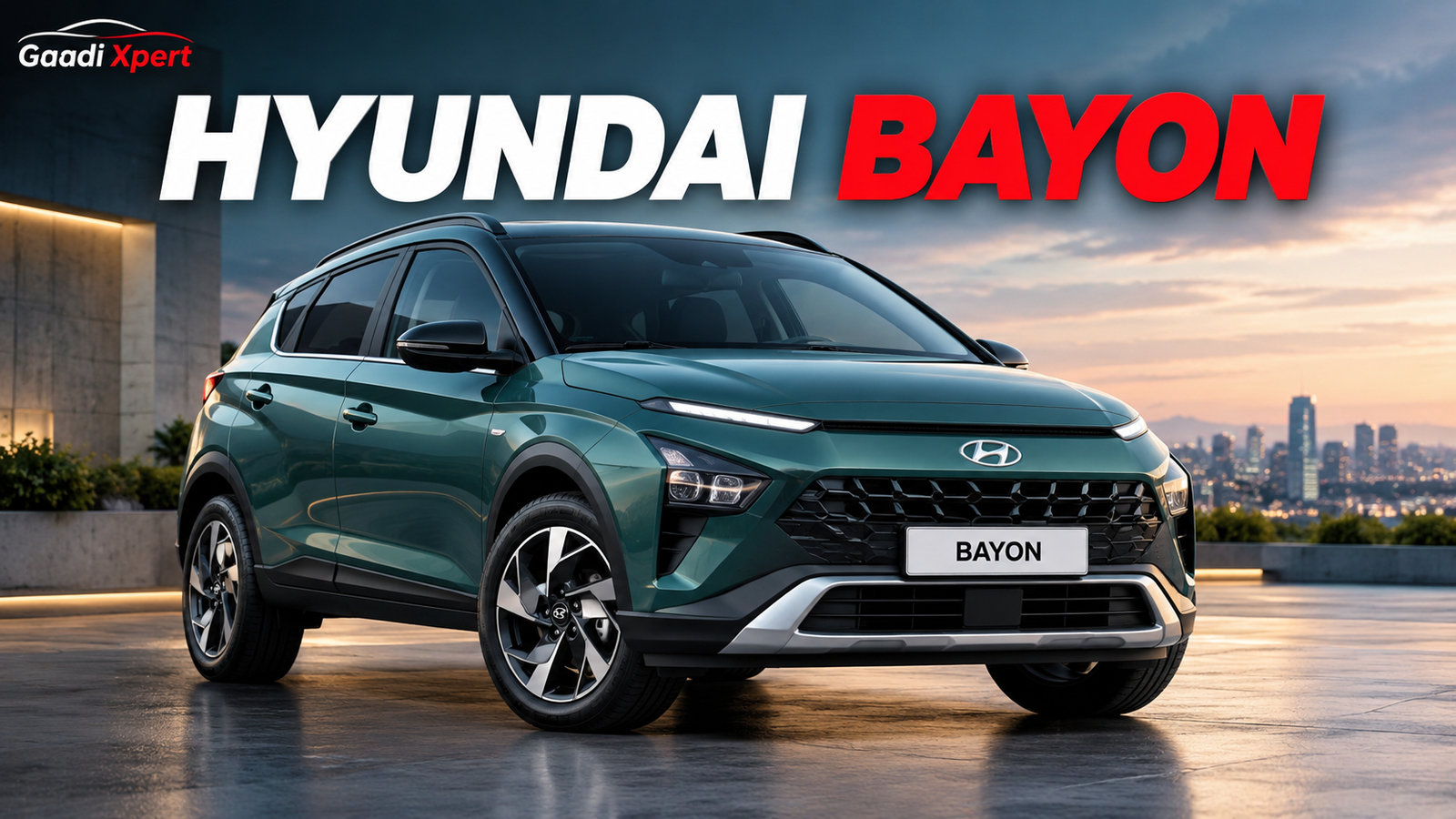
The Hyundai Bayon features a modern design that separates it from conventional compact SUVs. Its exterior combines sharp body lines, a sculpted bonnet and a wide front appearance.
At the front, the SUV features slim LED daytime running lights and a split-headlamp layout. The lower bumper incorporates prominent styling elements, while the geometric wheel arches give the vehicle a stronger SUV character.
The side profile features pronounced body cladding, distinctive alloy-wheel styling and roof rails. At the rear, the Bayon gets vertically oriented tail-lamp elements, bold BAYON lettering on the tailgate and a sculpted bumper.
Overall, the design gives the Bayon a crossover-inspired appearance. Its styling could appeal to buyers who want something different from the familiar shapes of other SUVs on Indian roads.
Hyundai Bayon Interior and Features
The cabin is one of the biggest highlights of the Hyundai Bayon. Hyundai has focused on digital technology, connected services and features designed to make everyday driving easier.
The dashboard houses two curved 12.3-inch displays. One serves as the digital instrument cluster, while the other handles infotainment and connected functions. Together, they create a wide digital cockpit.
Key technology highlights include:
- Dual 12.3-inch curved panoramic displays
- Generative AI voice assistant
- NVIDIA-accelerated Connected Car Navigation Cockpit (ccNC)
- Hyundai Bluelink with more than 70 connected features
- Online navigation and split-screen functionality
- Over-the-air updates for supported vehicle controllers
- Multi-language interface supporting 10 regional and two international languages
- More than 500 embedded voice commands, including English, Hindi, Hinglish, Tamil, Bengali and Telugu
The generative AI voice assistant is particularly important. Hyundai says the system combines technology from Perplexity and SoundHound AI to support more natural conversations and intelligent in-car assistance.
Drivers can use supported voice functions to access information and interact with vehicle systems. However, the availability of individual functions may depend on connectivity, system settings and the final specifications.
The connected-car package also supports remote vehicle functions and smartphone and smartwatch connectivity.
Hyundai Bayon Engine and Performance
Hyundai has confirmed a 1.5-litre, four-cylinder, naturally aspirated MPi petrol engine for the India-spec Bayon.
The engine produces 115 PS of maximum power and approximately 144 Nm of peak torque. Buyers can choose between a six-speed manual gearbox and Hyundai’s Intelligent Variable Transmission (IVT).
| Engine detail | Specification |
|---|---|
| Engine type | 1.5-litre, four-cylinder MPi petrol |
| Maximum power | 115 PS |
| Peak torque | Approximately 144 Nm |
| Manual gearbox | 6-speed MT |
| Automatic gearbox | Intelligent Variable Transmission (IVT) |
| Diesel option | Not announced for launch |
Hyundai has also highlighted additional driving technologies for the IVT version. These include Dash Boost Mode, Sporty Drive Tech, paddle shifters and Eco, Normal and Sport drive modes.
The naturally aspirated petrol engine prioritises smooth power delivery and everyday usability. The manual gearbox may appeal to drivers who prefer direct control, while the IVT should suit buyers who want a more convenient driving experience in traffic.
Hyundai has not confirmed a diesel or turbo-petrol option for the initial launch. Buyers should also wait for official ARAI-certified fuel-efficiency figures before comparing the Bayon with its rivals.
Hyundai Bayon Safety and Platform
Hyundai has built the India-spec Bayon on its Global K Enhanced Platform. The company says the platform has been engineered for five-star Indian safety standards.
That statement describes Hyundai’s engineering objective; it should not be treated as an independently awarded crash-test rating.
The SUV’s safety package and available driver-assistance technologies will be important factors for buyers. However, customers should check the final variant-wise equipment list and independent crash-test results before drawing conclusions about its overall safety performance.
Hyundai’s connected technology and software-update capability also add another layer to the ownership experience. Still, connected features do not replace essential safety equipment or responsible driving.
Hyundai Bayon Expected Price in India
Hyundai has not officially announced the Bayon’s India price. Some automotive media reports have suggested a starting price around ₹9 lakh to ₹10 lakh, but these figures remain estimates until the company releases its price list.
The final price will play a major role in determining the SUV’s appeal. A competitive entry price could attract buyers looking for a feature-rich petrol SUV, while higher variants will need to justify their cost through equipment, comfort and technology.
Customers should compare the ex-showroom price with the on-road price, which includes applicable taxes, registration, insurance and other charges.
Hyundai Bayon Rivals: Which SUVs Will It Challenge?
The Hyundai Bayon will enter a crowded market where buyers already have several established SUV options.
Depending on the final price and positioning, its alternatives could include:
- Maruti Suzuki Victoris
- Maruti Suzuki Grand Vitara
- Hyundai Creta
- Kia Seltos
- Honda Elevate
- Volkswagen Taigun
- Skoda Kushaq
The Bayon’s main selling points could be its dual-screen cockpit, generative AI voice assistant and familiar 1.5-litre petrol engine.
However, buyers should also consider rear-seat comfort, luggage space, fuel efficiency, ride quality, safety equipment and service costs. The strongest option will depend on the final pricing and the features offered in each variant.
Should You Wait for the Hyundai Bayon?
The Hyundai Bayon is worth considering if you want a petrol SUV with a modern design and an emphasis on in-car technology. Its dual 12.3-inch displays, connected services and generative AI voice assistant give it a distinctive technology package.
The 1.5-litre petrol engine and two transmission choices should also make it relevant to buyers with different driving preferences.
However, the final verdict depends on the launch price, variant-wise features, fuel-efficiency figures and real-world driving performance. Buyers who prioritise diesel power, a turbo-petrol engine or a confirmed CNG option should wait for further official announcements rather than assume these options will arrive.
Hyundai Bayon India Launch: Final Verdict
The Hyundai Bayon India launch on October 26, 2026, is an important development for buyers seeking a technology-focused petrol SUV. Hyundai has already confirmed the engine, transmission choices, booking amount and major cabin technologies.
Its generative AI voice assistant and dual 12.3-inch displays stand out in the current market. At the same time, the final price will determine whether the Bayon offers convincing value against established rivals.
Our verdict: The Hyundai Bayon has the potential to attract buyers who prioritise modern technology, distinctive styling and everyday petrol-powered usability. However, its value-for-money position will become clear only after Hyundai announces the official prices and variant details.