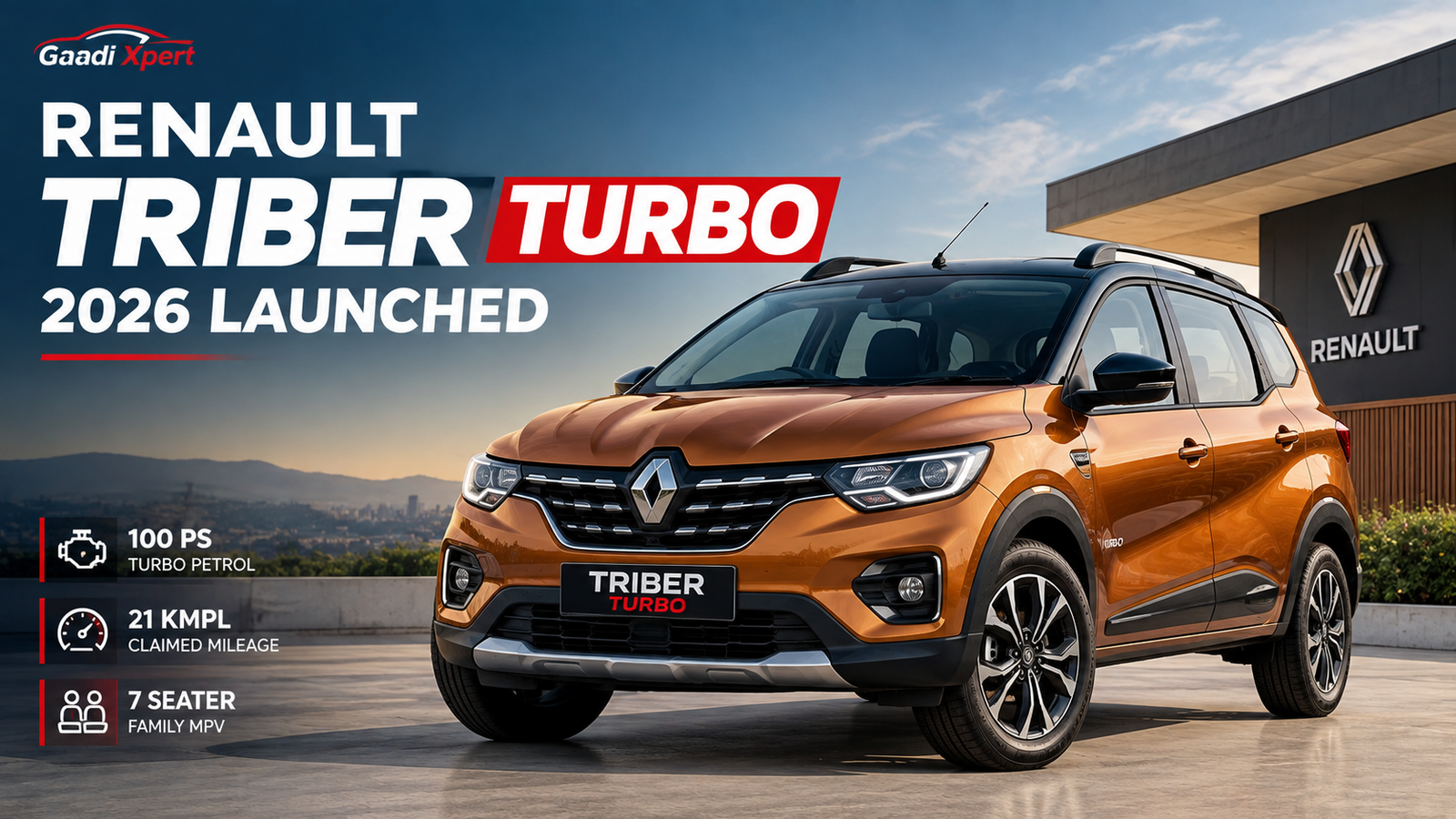
Renault Triber Turbo 2026 : Renault India has finally introduced a more powerful version of its popular compact MPV. The Renault Triber Turbo 2026 has been launched in India at an introductory starting price of ₹7.84 lakh (ex-showroom), bringing a 100 PS turbo-petrol engine to the brand’s affordable seven-seater lineup.
For years, the Triber has attracted Indian families with its compact dimensions, flexible seating arrangement and relatively accessible pricing. However, its naturally aspirated petrol engine has offered limited performance when the vehicle is fully loaded or driven on highways.

The new turbocharged version directly addresses that limitation. With 180 Nm of torque, a five-speed manual gearbox and a claimed fuel efficiency of 21 kmpl, Renault is attempting to make the Triber more capable without changing its core family-friendly character.
The new Renault Triber Turbo is available in Evolution, Techno and Emotion variants, with prices reaching ₹8.99 lakh for the top-end model. Bookings have opened at ₹11,000.
Here is a closer look at what the new MPV brings to the Indian market, including its engine, pricing, equipment, practicality and the changes that matter to buyers.
Renault Triber Turbo 2026: Price and Variants

The Renault Triber Turbo is positioned above the corresponding naturally aspirated petrol variants. Renault has not introduced the turbo engine in the entry-level Authentic trim, keeping the new powertrain limited to three higher variants.
| Variant | Ex-showroom price |
|---|---|
| Triber Turbo Evolution | ₹7.84 lakh |
| Triber Turbo Techno | ₹8.53 lakh |
| Triber Turbo Emotion | ₹8.99 lakh |
The prices are introductory and ex-showroom. The turbo range starts approximately ₹1.11 lakh above the entry-level naturally aspirated Evolution manual, while the top-end Emotion turbo is priced above the standard petrol Emotion.
This means buyers are not simply paying for a cosmetic package. The additional amount brings a different engine, substantially higher torque and mechanical changes to support the turbocharged powertrain.
For someone who mostly drives in city traffic with fewer passengers, the standard petrol Triber may continue to meet everyday requirements. However, buyers who frequently travel with a full family or carry luggage will have a stronger reason to consider the turbo version.
New 1.0-Litre Turbo-Petrol Engine: 100 PS and 180 Nm

The biggest change in the Renault Triber Turbo is under the bonnet. The MPV receives a 1.0-litre, three-cylinder TCe turbo-petrol engine that produces 100 PS of maximum power and 180 Nm of peak torque.
These figures represent a considerable increase over the standard Triber’s naturally aspirated petrol engine, which produces 72 PS and 96 Nm.
| Specification | Turbo-petrol | Naturally aspirated petrol |
|---|---|---|
| Engine | 1.0L, 3-cylinder turbo | 1.0L, 3-cylinder |
| Power | 100 PS | 72 PS |
| Torque | 180 Nm | 96 Nm |
| Gearbox | 5-speed manual | 5-speed MT / 5-speed AMT |
The turbo engine is related to the unit used in the Renault Kiger, although its application and calibration are specific to the Triber.
Why the Additional Torque Matters
For a compact seven-seater, engine performance is not just about acceleration figures. The amount of torque available during everyday driving can make a noticeable difference to how easily the vehicle carries passengers and luggage.
The standard Triber’s 96 Nm of torque can require more frequent gear changes when climbing hills, overtaking or driving with all three rows occupied.
The turbo engine’s 180 Nm output should provide greater flexibility in these situations. Drivers can expect stronger mid-range performance and less need to push the engine hard during ordinary acceleration.
This is particularly relevant for Indian families who use their vehicle for weekend trips, highway journeys and airport transfers with luggage.
However, the Triber remains a compact family MPV rather than a performance-oriented vehicle. Its turbo engine is primarily intended to improve everyday drivability and loaded performance.
Five-Speed Manual Gearbox at Launch
Renault has paired the turbo-petrol engine with a five-speed manual gearbox. This is the only transmission currently announced for the turbo variants.
The naturally aspirated range continues to offer a five-speed AMT on the Emotion trim, but that automatic option is not currently available with the turbo engine.
This is an important consideration for urban buyers who spend considerable time in stop-and-go traffic. The turbo manual should offer stronger performance, but drivers who specifically want an automatic turbo MPV will need to wait for further announcements.
Renault has not officially confirmed the launch date of a turbo automatic or CVT version.
Mileage: Renault Claims 21 kmpl
Fuel efficiency is an important consideration for buyers choosing an affordable family car, especially when it will be used for daily commuting as well as longer journeys.
Renault claims a fuel efficiency figure of 21 kmpl for the Triber Turbo manual. This is the company’s certified claim, not a guarantee of real-world mileage.
The actual fuel economy will depend on traffic, road conditions, passenger load, air-conditioning use and driving style.
A fully occupied seven-seater driven through congested city traffic will naturally have different fuel consumption from a lightly loaded vehicle cruising on a highway.
The key point is that Renault has introduced a more powerful engine while continuing to position the Triber as a relatively economical family vehicle. Independent real-world mileage tests will help establish how the turbo version performs under everyday Indian driving conditions.
Exterior Design: Familiar Triber Looks with Turbo Identity
The Renault Triber Turbo does not introduce a completely new exterior design. It builds on the updated Triber introduced earlier in 2026, retaining the compact proportions and practical body shape that define the model.
The front continues to feature Renault’s updated grille, sculpted bonnet, LED lighting and redesigned bumper. The overall shape remains focused on maximising cabin space within a compact footprint.
The turbo version receives distinctive Turbo badging, helping distinguish it from the naturally aspirated variants.
Renault has concentrated on the powertrain rather than making extensive cosmetic changes. This approach keeps the turbo version visually connected to the existing Triber lineup while giving buyers a more powerful mechanical option.
The familiar design also means existing Triber owners will recognise the vehicle immediately. The real difference becomes apparent in the engine specification and the way the vehicle is intended to perform.
Interior and Features: A Practical Seven-Seater for Families

The Triber Turbo retains the cabin layout of the updated 2026 Triber. Rather than redesigning the interior around the new engine, Renault has carried forward the existing equipment package and flexible seating arrangement.
The cabin features a dual-tone dashboard, an 8-inch floating touchscreen infotainment system, a digital instrument cluster and wireless smartphone connectivity.
Higher variants offer additional convenience features, including automatic air conditioning, cruise control, rain-sensing wipers and electrically adjustable and foldable ORVMs.
The Emotion variant sits at the top of the turbo lineup and is intended for buyers who want the more powerful engine alongside the higher equipment level.
Flexible Seating and Boot Space

One of the Triber’s strongest selling points remains its flexible seven-seat layout.
The vehicle offers a 2+3+2 seating arrangement, with a removable third row that allows owners to prioritise passenger capacity or luggage space.
With the third row removed, Renault claims up to 625 litres of boot space in the five-seat configuration. Folding the second row further expands the available cargo area, with a maximum claimed capacity of 1,065 litres in the appropriate configuration.
This flexibility makes the Triber useful for families who occasionally need seven seats but usually travel with fewer passengers and additional luggage.
The compact body also makes it easier to manoeuvre through narrow streets and park in crowded urban areas compared with larger three-row MPVs.
The turbo engine adds a performance improvement to this existing practical package without changing the fundamental seating concept.
Suspension, Braking and Safety
The Triber Turbo also receives mechanical revisions intended to accommodate its additional performance.
These include revised suspension tuning, anti-roll bars and braking hardware, along with updates to the vehicle’s thermal management and structural components.
The electronic safety systems have also been revised for the turbo application.
The updated Triber’s safety package includes six airbags, ABS with EBD, electronic stability control, traction control and other driver-assistance features, with equipment availability depending on the variant.
These systems are particularly relevant in a seven-seater, where passenger load can influence braking distances and vehicle behaviour.
However, the additional engine performance should not be interpreted as a change in the vehicle’s fundamental safety category. Buyers should consider the complete safety package and available crash-test information when evaluating the MPV.
Renault has not announced a separate new crash-test rating specifically for the Triber Turbo.
Renault Triber Turbo vs Standard Triber: Which One Makes Sense?
The decision between the turbo and naturally aspirated versions comes down to how the vehicle will be used.
| Buying consideration | Standard Triber | Triber Turbo |
|---|---|---|
| Engine performance | 72 PS, 96 Nm | 100 PS, 180 Nm |
| Automatic option | Available on Emotion | Not announced at launch |
| Entry-level price | Lower | Starts at ₹7.84 lakh |
| Highway driving | Suitable for relaxed driving | Additional torque for loaded journeys |
| Best suited to | Budget-focused family use | Buyers prioritising stronger performance |
The standard Triber continues to make sense for buyers who prioritise affordability and want an automatic transmission.
The turbo version is more relevant for families who regularly travel with several passengers, drive on highways or want greater flexibility when accelerating and overtaking.
The price difference is meaningful, so the decision should be based on actual driving requirements rather than the higher power figure alone.
Gaadi Xpert Verdict
The Renault Triber Turbo 2026 is an important development for Renault’s Indian lineup because it improves an area where the existing MPV has faced limitations.
The new 100 PS engine and 180 Nm of torque give the compact seven-seater a substantially stronger powertrain, while its flexible seating, practical cabin and affordable positioning remain intact.
At an introductory starting price of ₹7.84 lakh, the turbo version adds another choice for families who need seven-seat flexibility but do not want to move to a larger and more expensive MPV.
The main limitation at launch is the absence of an automatic transmission with the turbo engine. For buyers who prefer an automatic, the existing naturally aspirated AMT remains the available option within the Triber range.
Overall, the Triber Turbo is a meaningful mechanical upgrade rather than just another cosmetic variant. Its long-term appeal will depend on real-world mileage, ownership costs and how effectively the additional performance translates into everyday family driving.
Frequently Asked Questions
1. What is the price of the Renault Triber Turbo 2026?
The introductory ex-showroom price starts at ₹7.84 lakh for the Evolution variant and goes up to ₹8.99 lakh for the Emotion variant.
2. What engine does the Renault Triber Turbo use?
It uses a 1.0-litre, three-cylinder TCe turbo-petrol engine producing 100 PS and 180 Nm of torque.
3. What is the claimed mileage of the Triber Turbo?
Renault claims 21 kmpl for the turbo-petrol manual version. Actual mileage will vary with driving conditions.
4. Is the Triber Turbo available with an automatic gearbox?
At launch, it is available with a five-speed manual gearbox. Renault has not officially confirmed a turbo automatic launch date.
5. Is the Renault Triber Turbo a seven-seater?
Yes. It retains the Triber’s flexible seven-seat layout, with removable third-row seats and configurable luggage space.