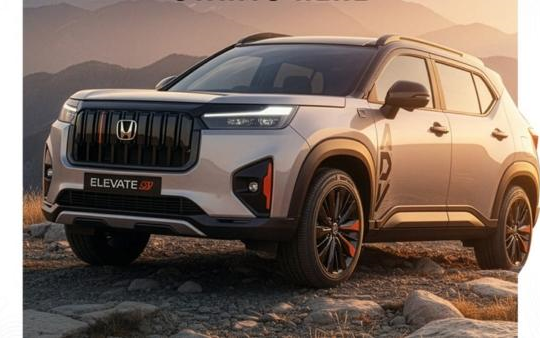
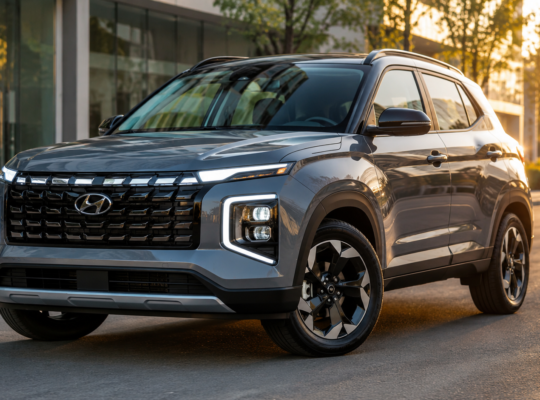
The Honda Cars India has given the Elevate its first major update since the SUV arrived in India in 2023. The 2026 Honda Elevate facelift has now been launched in India with a sharper exterior, a significantly more premium cabin and several features that were missing from the original SUV.
And Honda has taken an interesting approach.
Instead of changing the engine or turning the Elevate into a hybrid, the company has focused on the areas where modern buyers increasingly expect more — design, comfort, technology, parking convenience and cabin experience.
The new Elevate starts at ₹11.80 lakh (ex-showroom, Delhi) and goes up to ₹18.40 lakh for the range-topping ZX+ Black CVT. India is also the first market globally to receive the updated Elevate.
So, is this facelift enough to make the Elevate a stronger challenger against the Hyundai Creta, Kia Seltos, Maruti Grand Vitara, Toyota Hyryder and Volkswagen Taigun?
Let’s take a closer look.
Honda Elevate Facelift 2026: What’s New?
The 2026 Honda Elevate is not an all-new SUV. Honda has retained the basic platform, dimensions and petrol engine.
However, the facelift changes the personality of the SUV considerably.
The biggest updates include:
- New Bold Mesh Grille
- New Tri-Bar LED position lights
- Connected LED tail lamps
- Revised gloss-black exterior elements
- New 17-inch dual-tone alloy wheels
- New Nordic Forest Pearl colour
- Ivory-black premium interior
- Front and rear ventilated seats
- 8-way driver and 4-way passenger power seats
- 360-degree surround-view camera
- Front parking sensors
- PM2.5 air-quality display
- USB Type-C ports
- Ambient lighting
- Updated cabin detailing
- Low-Speed Follow function for Honda SENSING
- New ZX+ and ZX+ Black variants
Most importantly, Honda has retained the 1.5-litre naturally aspirated petrol engine, six-speed manual and CVT automatic combination.
That decision tells us something important about Honda’s strategy: this is primarily a product refresh rather than a mechanical transformation.
Honda Elevate Facelift Price in India
Honda has priced the new Elevate aggressively at the entry level.
The official ex-showroom Delhi prices are:
| Variant | Manual | CVT |
|---|---|---|
| SV | ₹11.80 lakh | — |
| V | ₹12.29 lakh | ₹13.79 lakh |
| VX | ₹13.93 lakh | ₹15.39 lakh |
| ZX | ₹15.39 lakh | ₹16.89 lakh |
| ZX+ | ₹16.80 lakh | ₹18.30 lakh |
| ZX+ Black | ₹16.90 lakh | ₹18.40 lakh |
These are ex-showroom Delhi prices announced by Honda. Additional charges apply for pearl and dual-tone exterior colours.
The new ZX+ Black variant sits at the top of the range and gets the Crystal Black Pearl exterior treatment.
The important part is that Honda has not pushed the starting price dramatically upward despite adding equipment.
That could become one of the Elevate facelift’s biggest strengths.
A More Aggressive Honda Elevate
The original Elevate was never an SUV that tried too hard to look futuristic.
Its design was clean, upright and mature.
Honda has now added more visual aggression.
At the front, the facelift introduces a new Bold Mesh Grille with gloss-black elements. The Honda logo has also been repositioned as part of the redesigned front-end treatment.
The biggest visual change, however, comes from the new Tri-Bar Signature LED Position Lights.
These elements give the Elevate a wider and more distinctive face.
The front bumper has also been revised, while gloss-black treatment has been added around the lower front area, side and fender garnishes.
Honda has also changed the roof-rail finish.
The result is a more rugged-looking SUV without completely abandoning the original Elevate’s design identity.
And that was probably the right decision.
Honda did not need to make the Elevate look like a completely different vehicle. It needed to make it look new enough to attract customers walking into a showroom in 2026.
The facelift does that.
New 17-Inch Alloy Wheels
The new Elevate gets freshly designed 17-inch dual-tone milling alloy wheels finished in Berlina Black with a dark-clear treatment.
They complement the darker exterior elements and give the SUV a more premium appearance.
Honda has also retained the Elevate’s overall proportions.
The SUV measures:
- Length: 4,312 mm
- Width: 1,790 mm
- Height: 1,650 mm
- Wheelbase: 2,650 mm
- Ground clearance: 220 mm
The 220 mm ground clearance remains an important advantage for Indian road conditions.
Rather than chasing an extremely low crossover stance, Honda has retained the upright SUV character.
That should appeal to buyers who want a vehicle that looks substantial on Indian roads.
Connected LED Tail Lamps
The rear gets perhaps the most obvious visual change after the front.
The new Elevate receives a full-width connected Signature LED tail lamp design.
It gives the rear a wider appearance and brings the SUV visually closer to the latest design trend in the segment.
Honda has also added gloss-black treatment to the rear lower bumper garnish.
This combination of connected lighting and darker styling elements makes the facelift look considerably more contemporary than the outgoing version.
New Honda Elevate Colour
Honda has introduced a new colour called Nordic Forest Pearl.
It is available as a single-tone finish as well as with a Crystal Black Pearl roof for the dual-tone configuration.
The complete colour palette now includes seven options:
- Nordic Forest Pearl
- Obsidian Blue Pearl
- Radiant Red Metallic
- Lunar Silver Metallic
- Platinum White Pearl
- Meteoroid Grey Metallic
- Crystal Black Pearl
Radiant Red Metallic and Platinum White Pearl are also offered with dual-tone combinations.
The new Nordic Forest Pearl is particularly important because it gives the facelift a colour that visually separates it from the previous model.
Honda Elevate Facelift Interior
This is where the facelift starts making a much stronger case.
The original Elevate already had a practical cabin, but its equipment list left some buyers asking why certain features were missing.
Honda has listened.
The facelift gets a Premium Dual-Tone Ivory-Black interior with soft-touch elements and gloss-black detailing.
There is also Active Orange wrap-around ambient lighting, new interior decoration elements and Piano Black air-vent trims.
The overall cabin should now feel more premium than before.
Honda has also introduced premium leather upholstery on the updated model.
But the biggest upgrade is not something you see immediately.
It is something you feel.
Ventilated Front and Rear Seats
Honda has added an Active Ventilation System for both front and rear seats.
That is a significant upgrade for a car being sold in India, where summer temperatures can make a ventilated seat much more than a luxury feature.
The front seats are also power adjustable.
The driver gets 8-way power adjustment, while the front passenger gets 4-way power adjustment.
For rear passengers, ventilation is an especially interesting addition.
It pushes the Elevate towards a more premium comfort proposition and directly addresses one of the areas where feature-loaded competitors have been stronger.
360-Degree Camera Finally Arrives
This is probably the most important practical feature added to the 2026 Elevate.
The new SUV gets a 360-degree Surround Vision Camera.
The original Elevate could be equipped with camera-related accessories, but the facelift brings a proper factory-integrated 360-degree surround-view system.
Honda has also added front parking sensors, alongside rear parking sensors and camera assistance.
For an SUV with a fairly upright body and urban usage in crowded parking areas, this is a genuinely useful upgrade.
It is not a feature added simply for a brochure.
It can make everyday driving easier.
10.25-Inch Touchscreen Continues
The Elevate retains its 26.03 cm (10.25-inch) floating IPS HD touchscreen.
The system supports:
- Wireless Apple CarPlay
- Android Auto
- Bluetooth
- USB connectivity
- WebLink
- 360-degree camera display
- Multi-angle rear-view camera
- LaneWatch view
- Customisable shortcuts
Honda has also added USB Type-C charging ports at the front and rear.
There is an 8-speaker premium surround system with four speakers and four tweeters.
The combination makes the new Elevate feel considerably better equipped for modern users.
Digital Instrument Display
The Elevate continues with its 7-inch HD full-colour TFT multi-information display integrated into the digital-analogue instrument cluster.
It can show information such as:
- Fuel consumption
- Trip information
- Outside temperature
- G-Meter
- Clock
- Vehicle settings
- Honda SENSING settings
It is not a completely digital dashboard, and Honda has clearly chosen function over flashy presentation.
That actually fits the Elevate’s character.
Honda Elevate Engine and Performance
Here is where the story gets interesting.
Despite the facelift, Honda has not changed the powertrain.
The 2026 Elevate continues with the familiar 1.5-litre i-VTEC DOHC naturally aspirated petrol engine.
It produces:
121 PS at 6,600 rpm
and
145 Nm at 4,300 rpm.
Transmission choices remain:
- 6-speed manual
- CVT automatic with sporty 7-speed paddle-shift functionality
The engine’s character therefore remains familiar to existing Elevate owners and Honda enthusiasts.
There is no hybrid powertrain on the facelift, despite hybrid technology becoming increasingly important in this segment.
That is one area where the Elevate continues to differ from SUVs such as the Maruti Grand Vitara and Toyota Hyryder.
Honda Elevate Mileage
Honda claims fuel-efficiency figures of:
15.31 km/l — Manual
16.61 km/l — CVT
for the new model under the applicable certification process.
The numbers are respectable for a naturally aspirated petrol SUV.
However, buyers looking specifically for maximum fuel economy still have hybrid alternatives in the segment.
Honda’s strategy is different.
The Elevate continues to focus on a conventional petrol powertrain with a relatively straightforward ownership proposition.
No Hybrid: Weakness or Strategy?
This is probably going to be the biggest discussion around the new Elevate.
In 2026, customers in the mid-size SUV segment have become increasingly aware of hybrid technology.
Maruti and Toyota have already established strong hybrid offerings.
So why didn’t Honda introduce a hybrid with the facelift?
The answer is simple: Honda chose not to make this facelift a mechanical redesign.
The company has retained its proven petrol setup and invested heavily in design, comfort, technology and safety.
That keeps the product simpler.
But it also means the Elevate cannot compete directly with strong-hybrid rivals purely on fuel-efficiency credentials.
For buyers who drive primarily in cities and cover high annual kilometres, this could matter.
For buyers who value a conventional petrol engine, predictable performance and a familiar transmission setup, it may not.
Honda SENSING ADAS Gets Better
Safety has always been one of the strongest arguments for the Elevate.
The facelift continues with Honda SENSING, Honda’s advanced driver-assistance technology.
The system includes:
- Collision Mitigation Braking System
- Adaptive Cruise Control
- Road Departure Mitigation
- Lane Keeping Assist System
- Lead Car Departure Notification System
- Auto High-Beam
The big addition is Low-Speed Follow, available with CVT variants.
This is particularly useful in slow-moving traffic because the system can provide additional assistance during low-speed driving.
Honda is therefore improving the ADAS package without changing the fundamental safety philosophy of the vehicle.
Safety Equipment
The new Elevate comes with a comprehensive safety package.
Key equipment includes:
- Six airbags
- ABS with EBD
- Brake Assist
- Vehicle Stability Assist
- Agile Handling Assist
- Hill Start Assist
- Electric Parking Brake
- Auto Brake Hold
- Front parking sensors
- Rear parking sensors
- 360-degree camera
- Multi-angle rear camera
- ISOFIX mounts
- ACE body structure
- Honda SENSING ADAS
The CVT variants also get all-wheel disc brakes according to Honda’s specifications.
The addition of the 360-degree camera makes the safety and convenience package feel much more complete than before.
Honda Elevate Variants
The 2026 Elevate is offered in five manual grades:
SV, V, VX, ZX and ZX+
The CVT automatic is available with:
V, VX, ZX and ZX+
Honda has also introduced the ZX+ Black version at the top of the range.
This broader variant structure allows Honda to target customers across a wider price range.
The base SV is clearly aimed at buyers who want the Elevate’s fundamentals without paying for premium equipment.
The upper ZX and ZX+ grades, meanwhile, are where the facelift’s additional features become much more relevant.
Which Honda Elevate Variant Makes the Most Sense?
For a buyer looking at value rather than simply buying the cheapest Elevate, the VX or ZX variants deserve the most attention.
The base SV keeps the entry price attractive, but higher variants bring more of the equipment that makes the facelift different from the outgoing SUV.
The CVT is also the obvious choice for someone who spends most of the week in city traffic.
The top ZX+ variants make sense for buyers who want the full premium experience, including the upgraded comfort and technology package.
The ZX+ Black is more about appearance and exclusivity than fundamentally different mechanical performance.
Honda Elevate vs Hyundai Creta
The Hyundai Creta remains one of the strongest names in India’s mid-size SUV segment.
Compared with the Creta, the Elevate continues to differentiate itself through its naturally aspirated petrol engine, upright SUV proportions, Honda SENSING and a relatively straightforward mechanical package.
The Creta, however, offers a broader range of powertrain choices and a very strong technology-oriented feature list.
The facelift narrows the equipment gap.
Honda’s new 360-degree camera, ventilated seats, connected lighting and upgraded cabin make the Elevate considerably more competitive.
But Creta remains a formidable benchmark.
Honda Elevate vs Kia Seltos
The Kia Seltos has traditionally played the premium-feature card very aggressively.
The Honda Elevate Facelift now answers that challenge with its own upgraded technology and comfort package.
Honda’s advantage remains its mature SUV proportions, naturally aspirated petrol engine and safety package.
Kia’s advantage lies in its wide range of features and powertrain choices.
This comparison will largely come down to buyer priorities.
Honda Elevate vs Grand Vitara and Hyryder
This is perhaps the most important comparison.
The Maruti Grand Vitara and Toyota Hyryder have a major advantage in the form of hybrid powertrain options.
The Honda Elevate Facelift does not.
However, Honda counters with its updated styling, premium cabin, ventilated seating, ADAS package and 360-degree camera.
Therefore, the decision becomes less about which SUV has the biggest feature list and more about what kind of ownership experience the buyer wants.
What Honda Got Right
The biggest success of the facelift is that Honda has addressed several complaints without disturbing the basic formula.
The Elevate was already known for:
- Spacious cabin
- Strong road presence
- 220 mm ground clearance
- Naturally aspirated petrol engine
- Good visibility
- Practical SUV design
- Honda SENSING
- Straightforward driving experience
Now it adds:
- Better styling
- 360-degree camera
- Ventilated seats
- Power seats
- Ambient lighting
- Connected rear lighting
- New colour
- Better parking assistance
- Low-Speed Follow
That is exactly what a facelift should ideally do.
What Honda Could Have Done Better
The absence of a hybrid remains the obvious limitation.
A hybrid powertrain would have transformed the Elevate’s positioning and given Honda a direct answer to Toyota and Maruti’s hybrid SUVs.
The power output also remains unchanged.
There is no major performance upgrade and no new engine.
So anyone expecting a dramatically faster or more fuel-efficient Elevate will be disappointed.
The facelift is fundamentally about refinement and equipment, not performance.
Honda Elevate Facelift : Warranty
Honda is offering a 3-year/unlimited-kilometre standard warranty from the date of purchase.
Customers can also opt for extended warranty coverage up to seven years/unlimited kilometres.
Honda’s Anytime Warranty can be extended up to 10 years/1,20,000 km, subject to the applicable renewal conditions.
That adds another layer of reassurance for long-term buyers.
Should You Buy the Honda Elevate Facelift ?
If your priority is a comfortable, practical and safety-focused petrol SUV, the new Elevate deserves serious consideration.
The facelift has fixed some of the original model’s biggest feature-related weaknesses.
The 360-degree camera is useful.
The ventilated seats are useful.
The power seats are useful.
The upgraded cabin makes the SUV feel more premium.
And the new exterior gives the Elevate a much fresher identity.
However, buyers who want a hybrid or a wide selection of turbocharged engines will still find alternatives better suited to those requirements.
The Elevate is not trying to win every category.
Instead, Honda has strengthened the areas where the SUV already had a solid foundation.
Final Verdict
The 2026 Honda Elevate facelift is a classic example of a manufacturer choosing evolution instead of revolution.
Honda hasn’t thrown away the formula.
It has refined it.
The new front end makes the SUV look tougher. The connected rear lighting brings it into line with current design trends. The Ivory-Black cabin adds a more premium atmosphere. Ventilated front and rear seats improve comfort. The 360-degree camera finally gives buyers the parking assistance they expect from a modern SUV.
And underneath it all sits the same 1.5-litre naturally aspirated petrol engine that has already established itself in the Elevate.
That is both the strength and weakness of the facelift.
For someone who already liked the Elevate but felt it needed more features, the 2026 model makes considerably more sense.
For someone searching for a hybrid SUV, the story is different.
But overall, Honda has made the Elevate more desirable without unnecessarily complicating it.
At ₹11.80 lakh, the new Elevate enters the market with a stronger proposition than the outgoing model. And with India becoming the first global market to receive this update, Honda is clearly betting on the Indian customer to give the SUV its next chapter.
Gaadi Xpert Verdict:
A smarter, sharper and more feature-rich Elevate — but the missing hybrid option remains its biggest weakness.