The New-Generation Bajaj Pulsar has arrived as one of the most important updates to Bajaj Auto’s popular performance motorcycle family. As the Pulsar brand completes 25 years in India, Bajaj has introduced a significantly updated N160 platform with a new four-valve engine, electronic throttle and revised hardware.
The latest update is not limited to cosmetic changes. Bajaj has introduced the Pulsar N160 S and Pulsar N160 SS, giving buyers two new versions of the motorcycle with different levels of equipment. The N160 S focuses on the core riding experience and affordability, while the N160 SS takes the platform further with additional electronic and premium features.
The updated motorcycle continues to target riders who want more performance than a traditional commuter but do not want to move into the higher price bracket of 200cc or larger motorcycles.
With rivals such as the TVS Apache RTR 160 4V, Hero Xtreme 160R 4V and Yamaha MT-15 already offering strong performance and technology, Bajaj has used the new-generation update to make the Pulsar N160 more competitive.
In this first part, we focus on the motorcycle’s launch background, design, dimensions, engine, gearbox, performance, suspension and handling.
New-Generation Bajaj Pulsar 2026 Launch Update
The latest Pulsar update comes as Bajaj celebrates 25 years of the Pulsar brand.
The Pulsar has been one of India’s most recognisable motorcycle nameplates since its introduction. Over the years, Bajaj has expanded the family from traditional 125cc and 150cc motorcycles to more modern N-series models aimed at younger riders.
The 2026 update represents another major step in that evolution.
Instead of simply changing the graphics or adding a new colour, Bajaj has introduced mechanical and electronic changes to the N160 platform.
The updated range includes two new versions:
- Pulsar N160 S
- Pulsar N160 SS
Both use the new four-valve engine, while the SS gets additional premium equipment.
The new-generation approach allows Bajaj to keep the basic Pulsar identity familiar while making the motorcycle more technologically advanced.
Exterior Design: Familiar Pulsar DNA With a Sharper Look
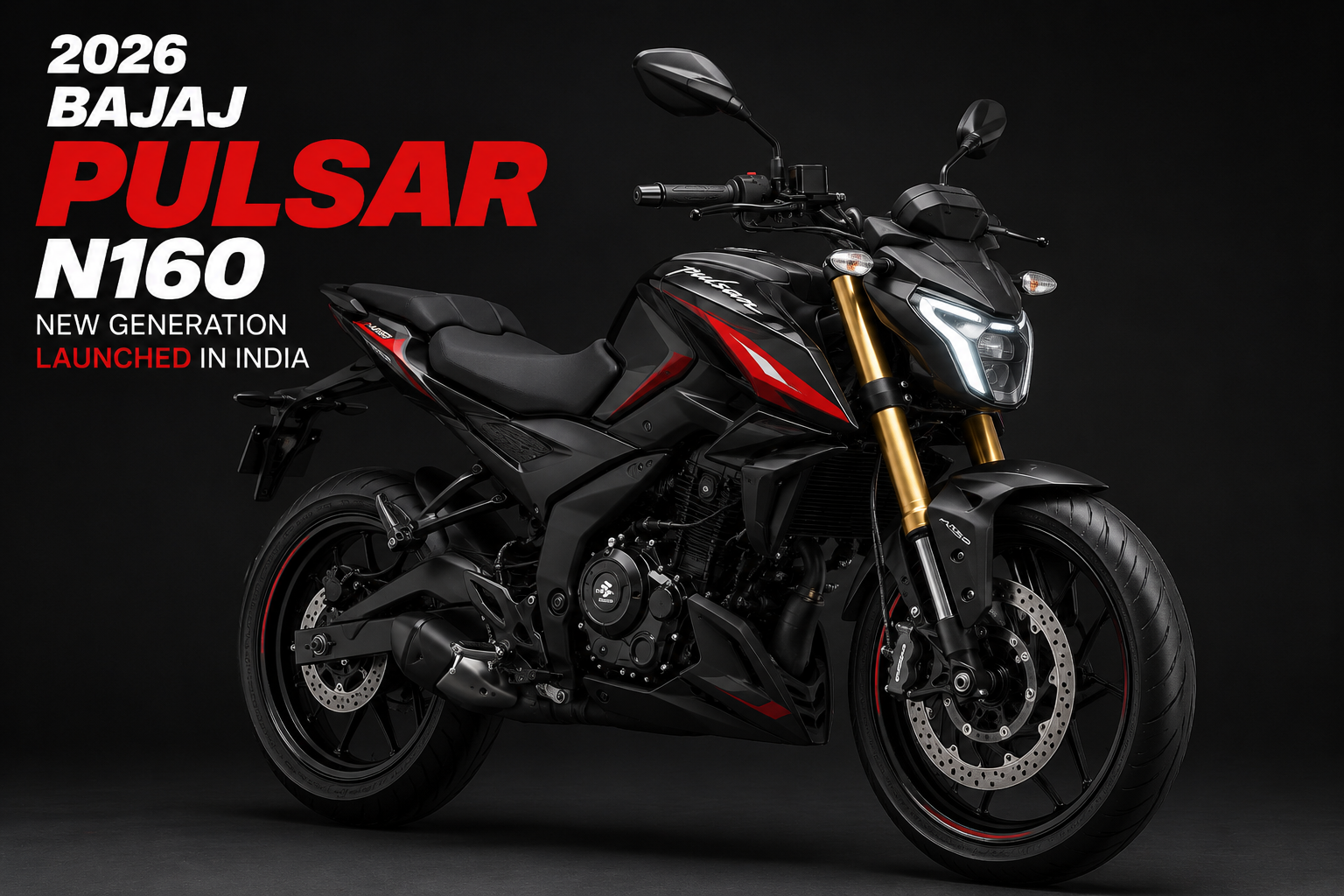
The New-Generation Bajaj Pulsar continues with the muscular streetfighter design that has become a signature of the N-series.
The fuel tank remains one of the most prominent elements of the motorcycle. Its sculpted shape gives the bike a wider and more aggressive appearance from the front.
The tank extensions flow into the side panels, creating a layered design rather than the simple bodywork associated with traditional commuter motorcycles.
At the front, the motorcycle retains an aggressive stance with a compact headlamp arrangement and sharp surrounding bodywork.
The overall design has been developed to make the N160 look sporty without making it unnecessarily extreme.
This is important because the Pulsar is expected to serve two types of riders: daily commuters and enthusiasts who want a motorcycle that looks performance-oriented.
Muscular Fuel Tank
The sculpted fuel tank gives the N160 a strong road presence.
The tank design also provides the rider with useful contact points during cornering and faster riding.
Combined with the sharp side panels, the motorcycle has a compact and muscular profile.
Sporty Rear Section
The rear section follows the same sporty philosophy.
The tail area is relatively compact, helping the motorcycle maintain a streetfighter appearance.
The overall bodywork gives the N160 a more substantial presence than a typical 125cc commuter while keeping the motorcycle visually compact enough for city use.
Dimensions and Road Presence
The N160 remains positioned as a compact performance motorcycle rather than a large touring machine.
Its dimensions are designed around Indian urban riding conditions, where riders frequently need to move through narrow gaps, heavy traffic and crowded roads.
The relatively manageable footprint should make the motorcycle easier to handle at low speeds.
At the same time, the muscular tank and wide stance prevent it from feeling like a small commuter motorcycle.
This balance is important for the N160 because its target customer generally wants a motorcycle that feels substantial without becoming difficult to use every day.
The seating position also contributes to the motorcycle’s streetfighter character.
The rider sits in a relatively upright posture, which should work well for city commuting while still allowing a slightly aggressive riding position when riding faster.
Engine: New 164.5cc Four-Valve Motor
The biggest mechanical change in the updated motorcycle is its engine.
The New-Generation Bajaj Pulsar N160 gets a 164.5cc single-cylinder, four-valve engine.
The move from the earlier two-valve configuration to a four-valve setup is significant because the engine can breathe more efficiently at higher engine speeds.
Bajaj has also introduced an electronic throttle with the new engine.
Electronic throttle technology allows the engine management system to control throttle response electronically rather than relying entirely on a traditional mechanical cable.
This gives Bajaj greater flexibility when calibrating throttle response and integrating electronic riding functions.
The combination of a four-valve head and electronic throttle makes the new N160 considerably more sophisticated than the earlier version.
What Does the Four-Valve Engine Mean for Riders?
A four-valve engine is not automatically faster simply because it has more valves.
The real advantage comes from improved airflow and the way the engine is tuned.
For the N160, the four-valve configuration should help the engine deliver stronger performance as revs rise.
This can be particularly useful during:
- Highway overtaking
- Faster acceleration
- Uphill riding
- Sportier corner exits
- High-speed cruising
At the same time, Bajaj needs to maintain enough low- and mid-range torque for city traffic.
That balance is critical because most N160 owners will spend much more time in urban conditions than at the engine’s maximum RPM.
Electronic Throttle
The addition of electronic throttle technology is another important change.
With a traditional throttle cable, the rider’s wrist directly operates the throttle mechanism. An electronic throttle instead sends an electronic input to the engine management system.
This allows the motorcycle to manage throttle response more precisely.
It also provides the technical foundation for features such as selectable riding modes.
For the rider, the main benefit should be smoother and more controlled response when the system is properly calibrated.
Gearbox
The updated N160 continues to use a five-speed gearbox.
The transmission is designed around the motorcycle’s 160cc performance-commuter positioning.
A five-speed gearbox can provide a useful balance between city acceleration and highway usability without making the motorcycle unnecessarily complicated.
The lower gears are important for quick acceleration in traffic, while the higher gears allow the motorcycle to settle into a more relaxed rhythm once road speeds increase.
The final gearing also plays an important role in determining how the new four-valve engine feels.
Bajaj’s challenge is to ensure that the gearbox keeps the engine within its useful power band during everyday riding.
Performance
The New-Generation Bajaj Pulsar is designed to offer a stronger performance experience than a traditional commuter motorcycle while remaining manageable for everyday riders.
The new four-valve engine should be particularly useful when the rider moves beyond normal city speeds.
Acceleration should feel more purposeful as the revs rise, while the electronic throttle can provide more controlled response.
For city riding, the motorcycle should offer enough performance for quick overtaking and traffic gaps.
On open roads, the additional breathing capacity of the four-valve engine should give the N160 a more enthusiastic character.
However, riders should remember that this remains a 160cc motorcycle. It is designed for everyday performance rather than outright high-speed touring.
City Performance
Urban traffic is where the N160’s balance becomes important.
A motorcycle in this category needs to respond smoothly at low and medium speeds while remaining easy to control.
The updated engine and electronic throttle should help Bajaj deliver predictable acceleration.
The motorcycle’s compact streetfighter dimensions also make it suitable for navigating congested roads.
For daily users, this combination of manageable size and stronger-than-commuter performance is one of the main reasons to consider the N160.
Highway Performance
On highways, the four-valve engine should provide a stronger top-end character than the earlier setup.
The motorcycle should be capable of maintaining normal highway speeds while providing useful acceleration for overtaking.
However, riders planning frequent long-distance touring may still prefer a larger-capacity motorcycle with more relaxed high-speed cruising.
The N160 is better understood as a versatile urban-performance motorcycle that can comfortably handle occasional highway trips.
Suspension Setup
Bajaj has also upgraded the motorcycle’s hardware.
The new N160 uses an updated front suspension setup designed to support its sportier character.
The motorcycle continues with a rear monoshock, maintaining the basic suspension architecture associated with the N160.
The front suspension is particularly important because it determines how the motorcycle reacts to braking, cornering and uneven surfaces.
The updated setup should help provide better front-end control while maintaining enough compliance for Indian roads.
Handling and Cornering
Handling has always been an important part of the Pulsar N-series formula.
The N160’s streetfighter proportions and muscular fuel tank give the rider a planted feel.
The updated hardware should further improve confidence when leaning the motorcycle into corners.
For everyday riding, predictable steering is more important than extreme sharpness.
The motorcycle therefore needs to remain easy to turn at low speeds while becoming stable when ridden faster.
If the suspension and chassis tuning are correctly matched to the new engine, the N160 can offer a good balance between city agility and weekend fun.
Ride Quality on Indian Roads
Indian roads can present everything from smooth highways to broken urban surfaces within a short distance.
The N160’s suspension therefore needs to work across a wide range of conditions.
A setup that is too stiff may feel sporty but become uncomfortable during daily commuting.
A setup that is too soft may provide comfort but reduce confidence during aggressive cornering.
The updated Pulsar aims for a middle ground.
Its suspension and chassis combination is intended to provide enough comfort for everyday use while retaining the controlled feel expected from a sporty motorcycle.
Features & Technology
Bajaj has used the new-generation update to make the Pulsar N160 more sophisticated.
The most important technology change is the electronic throttle, because it provides the foundation for more advanced electronic functions.
The N160 SS takes this further with a premium equipment package that includes a TFT instrument display, connectivity functions, riding modes and traction control.
This makes the motorcycle much more than a traditional performance commuter.
For buyers, the technology is particularly important because the 160cc segment has become increasingly competitive. Riders now expect motorcycles to offer features that were previously limited to much more expensive models.
TFT Instrument Display
The Pulsar N160 SS gets a colour TFT instrument display.
The new display gives the motorcycle a more premium appearance while also providing a larger and more informative interface for the rider.
Depending on the selected functions, the display can show important riding information and connected features.
A TFT screen also gives Bajaj more flexibility to present different information depending on the riding mode or selected function.
For a motorcycle positioned as the premium N160, this is one of the most noticeable upgrades.
The lower N160 S follows a simpler equipment approach, helping Bajaj maintain a more accessible price point.
Smartphone Connectivity
Connectivity has become an increasingly common requirement among younger motorcycle buyers.
The updated N160 SS incorporates smartphone-linked functions, allowing riders to access connected information through the motorcycle’s instrument system.
This can reduce the need to constantly look at a phone mounted separately on the handlebar.
The connected system is particularly useful for riders who use their motorcycle for daily commuting because navigation and notification-related functions can be integrated into the riding experience.
Google Maps Navigation
One of the most useful connected features on the N160 SS is Google Maps navigation support.
Instead of depending completely on a separate phone display, riders can access navigation information through the motorcycle’s instrument interface.
For city users, this can be particularly helpful when travelling to unfamiliar locations.
Navigation is also one of the features that gives the premium N160 a more modern character compared with basic commuter motorcycles.
Riding Modes
The electronic throttle also enables Bajaj to offer four riding modes on the N160 SS.
Riding modes allow the motorcycle’s electronic response to be adjusted according to different riding conditions.
This is an important upgrade because it changes the way riders can interact with the motorcycle.
A smoother setting can be useful in crowded urban traffic, while a more responsive setting can be selected when the rider wants a sharper performance feel.
The availability of multiple riding modes also makes the motorcycle more versatile.
Instead of having one fixed throttle character, the rider can choose a setting depending on the situation.
Traction Control
The N160 SS also receives traction control, adding another layer of electronic safety.
Traction control monitors wheel behaviour and can intervene when excessive wheelspin is detected.
This can be useful when accelerating aggressively or when the road surface provides limited grip.
For everyday city riding, traction control may not activate frequently. However, its presence becomes more valuable when conditions are less predictable.
It also gives the N160 SS a more premium safety package compared with simpler motorcycles in the segment.
Braking & Safety
The braking system is another important part of the updated Pulsar package.
The premium N160 SS gets dual-channel ABS, providing anti-lock protection for both the front and rear wheels.
ABS is particularly useful during emergency braking because it helps prevent the wheels from locking under hard braking.
This can give the rider greater control during sudden stops.
The combination of ABS, improved chassis hardware and traction control makes the top-spec N160 a significantly more technology-oriented motorcycle than the traditional Pulsar models that built the brand’s reputation.
Lighting Technology
The Pulsar’s lighting design remains an important part of its visual identity.
The updated motorcycle continues with modern LED lighting elements, contributing to both its appearance and visibility.
The sharper front-end treatment works with the muscular tank and compact bodywork to create a more aggressive streetfighter profile.
LED lighting also provides a cleaner appearance than traditional halogen systems.
Colours and Visual Personalisation
Bajaj has introduced three colour options for the new N160 S and N160 SS.
The colour choices are designed to complement the motorcycle’s sporty styling rather than give it a conservative commuter appearance.
The graphics and body panels work together to emphasise the muscular fuel tank and sharp side profile.
For buyers, the choice between colours will largely come down to personal preference because the basic design remains the same across the range.
The top-spec SS variant also has a more premium visual character because of its additional equipment.
Mileage and Fuel Efficiency
Mileage is an important factor for any motorcycle in the 160cc segment.
Although the new four-valve engine is designed with stronger performance in mind, buyers will still expect reasonable fuel efficiency for daily commuting.
Actual mileage will depend heavily on riding style, traffic conditions, road speed and maintenance.
Aggressive acceleration and frequent high-RPM riding will naturally consume more fuel than smooth city riding.
For a typical owner, the motorcycle should be viewed as a balance between performance and efficiency rather than a pure mileage-focused commuter.
This is one of the key differences between a 160cc performance motorcycle and a traditional 100-125cc commuter.
Comfort and Riding Position
The N160 uses a relatively upright riding position that works well for everyday use.
The rider does not need to lean heavily over the fuel tank, making the motorcycle more comfortable during regular city journeys.
At the same time, the footpeg and handlebar position provide enough engagement for sporty riding.
This balance is important because the motorcycle is designed to serve multiple purposes.
A commuter may use it for daily office travel, while another owner may use the same motorcycle for weekend rides.
Pillion Comfort
The motorcycle also needs to work for riders who regularly carry a passenger.
The rear section provides a dedicated pillion seating area, while the overall motorcycle proportions give it enough space for everyday two-up riding.
For short and medium city journeys, the pillion arrangement should be practical.
However, riders planning very long-distance trips with a passenger may still prefer a motorcycle specifically designed for touring comfort.
The N160 is primarily a street-performance motorcycle, so its focus remains on the rider.
Everyday City Practicality
The strongest argument for the New-Generation Bajaj Pulsar is its versatility.
It can function as a daily commuter while also providing significantly more performance than a basic commuter motorcycle.
The compact dimensions help in traffic, while the stronger engine gives the rider more confidence when overtaking.
The upright riding position also reduces the fatigue associated with extremely aggressive riding positions.
This makes the motorcycle suitable for riders who do not want to own separate motorcycles for commuting and weekend riding.
Traffic Riding
In heavy traffic, smooth throttle response is extremely important.
The electronic throttle should help provide predictable control, while the motorcycle’s manageable dimensions make lane changes and low-speed manoeuvres easier.
The riding modes on the SS variant add another layer of flexibility.
A rider can choose a smoother response when moving through congested roads and use a more responsive setting when traffic clears.
This makes the electronic package useful rather than simply being a list of premium features.
Weekend Riding
The Pulsar N160 is also designed to appeal to riders who enjoy short weekend trips.
Its sporty styling, four-valve engine and updated handling hardware make it more engaging than a conventional commuter.
The motorcycle can therefore be used for:
- Weekend highway rides
- Short touring trips
- City-to-city journeys
- Twistier roads
- Recreational riding
Its 160cc engine limits its long-distance cruising ability compared with larger motorcycles, but for shorter trips it offers a useful balance of performance and running costs.
Practicality vs Performance
The biggest strength of the updated N160 is that it does not force buyers to choose between practicality and performance.
A pure commuter may deliver better fuel economy but feel less exciting.
A larger performance motorcycle may deliver significantly more power but cost more to purchase and operate.
The Pulsar N160 occupies the middle ground.
It offers enough performance to remain enjoyable while maintaining the everyday usability expected from a Bajaj motorcycle.
New-Generation Bajaj Pulsar Variants
Bajaj has introduced two new variants of the updated N160:
Pulsar N160 S
The N160 S is the more affordable version of the new-generation motorcycle.
It gets the new 164.5cc four-valve engine and electronic throttle, giving buyers access to the latest mechanical package without paying for all the premium equipment of the SS.
The S variant is therefore aimed at riders who want the performance upgrade while keeping the purchase price relatively controlled.
Pulsar N160 SS
The N160 SS sits at the top of the updated N160 range.
It adds premium equipment such as the TFT display, Google Maps navigation, traction control and additional electronic features. The SS is therefore aimed at buyers who want the most complete version of the new Pulsar rather than simply the new engine.
The two variants allow Bajaj to target different types of customers without making the entire range expensive.
New-Generation Bajaj Pulsar Price
The latest N160 variants have been launched at the following ex-showroom Delhi prices:
| Variant | Ex-Showroom Price |
|---|---|
| Pulsar N160 S | ₹1,33,511 |
| Pulsar N160 SS | ₹1,42,585 |
The N160 S starts at around ₹1.34 lakh, while the N160 SS is approximately ₹1.43 lakh ex-showroom Delhi.
The price difference between the two versions is important because the SS adds several technology and safety upgrades.
For buyers mainly interested in the new engine, the S makes more sense.
For buyers who want the complete electronics package, the SS offers considerably more equipment.
Which Variant Offers Better Value?
The N160 S is the value-focused choice.
It gives riders the updated four-valve engine and the new-generation mechanical package without pushing the price as high as the SS.
The N160 SS, meanwhile, is the better choice for buyers who specifically want advanced technology.
Its TFT display, connected navigation and traction-control system make it more attractive to riders who want a motorcycle that feels closer to a premium machine.
So the choice is relatively simple:
Choose N160 S for value.
Choose N160 SS for features and technology.
Maintenance and Ownership
Bajaj motorcycles have traditionally benefited from a wide service network in India.
This is an important advantage for a motorcycle intended for everyday use because owners can generally find authorised service facilities across many cities and towns.
The N160’s established platform should also make routine ownership relatively straightforward.
However, the new-generation versions introduce additional technology, particularly on the SS.
The TFT display, traction control, electronic throttle and other electronic components are more sophisticated than the hardware found on a basic commuter motorcycle.
That does not necessarily mean high maintenance costs, but long-term ownership costs can depend on the price of replacement electronic components outside warranty.
Service Requirements
Regular servicing remains essential for maintaining engine performance and reliability.
Bajaj’s owner documentation specifies periodic maintenance requirements and recommends using the specified engine oil and authorised service network. The existing N160 documentation also lists regular service intervals and maintenance procedures.
Owners should therefore follow the service schedule rather than waiting for symptoms such as unusual engine noise, reduced performance or poor fuel efficiency.
Regular maintenance should include checking:
- Engine oil
- Air filter
- Brake components
- Tyres
- Chain and sprockets
- Brake fluid
- Battery
- Suspension components
Actual service expenses will vary by location, usage and the work required during each service.
Running Cost
The N160 is positioned between conventional commuter motorcycles and larger performance bikes.
That makes its running cost an important part of its appeal.
Its 160cc engine provides substantially more performance than a basic commuter while avoiding the fuel consumption and running-cost expectations associated with larger-capacity motorcycles.
Actual fuel expenditure will depend on riding style.
A rider who uses smooth acceleration and maintains consistent speeds can expect better efficiency than someone who frequently rides at high RPM.
For daily commuting, the N160 should therefore remain a reasonable middle-ground option.
Warranty and Long-Term Ownership
Warranty coverage is another factor buyers should consider.
Bajaj’s existing N160 documentation lists a 5-year or 75,000km warranty, whichever comes first, subject to the applicable terms and conditions.
For the new variants, buyers should verify the exact warranty terms applicable to their motorcycle at the time of purchase.
Following the manufacturer’s maintenance schedule is particularly important because warranty claims can depend on proper servicing and use of recommended consumables.
New-Generation Bajaj Pulsar vs TVS Apache RTR 160 4V
The TVS Apache RTR 160 4V is one of the most direct competitors.
Both motorcycles target riders looking for sporty performance in the 160cc segment.
The Apache has a strong reputation for sporty handling and performance, while the updated Pulsar counters with its new four-valve engine, electronic throttle and premium SS variant.
The decision will ultimately depend on the rider’s preference for styling, engine character, features and pricing.
New-Generation Bajaj Pulsar vs Hero Xtreme 160R 4V
The Hero Xtreme 160R 4V is another major rival.
Hero’s motorcycle focuses on sporty design and performance, making it a natural alternative for younger buyers.
The updated Pulsar’s advantage is its combination of the familiar Pulsar identity and the new technology package.
The N160 SS is particularly interesting because its traction control and connected TFT system give the motorcycle a more premium technology proposition.
New-Generation Bajaj Pulsar vs Yamaha MT-15
The Yamaha MT-15 sits towards the premium end of the 150-160cc segment.
It is known for its sporty design, refined engine and six-speed transmission.
The Pulsar’s strongest argument against the Yamaha is value.
The N160 S starts at around ₹1.34 lakh ex-showroom Delhi, while the N160 SS remains around ₹1.43 lakh.
This makes the Pulsar an attractive alternative for buyers who want modern equipment without moving too far up the price ladder.
Pros of the New-Generation Bajaj Pulsar
- New 164.5cc four-valve engine
- Electronic throttle
- Sporty streetfighter styling
- Updated suspension hardware
- Multiple variants
- TFT display on N160 SS
- Google Maps navigation on SS
- Traction control on SS
- Dual-channel ABS on SS
- Strong Bajaj service network
- Good balance between commuting and performance
Cons of the New-Generation Bajaj Pulsar
- N160 SS is noticeably more expensive than the S
- Premium features are concentrated on the top variant
- Competition in the 160cc segment is extremely strong
- Actual long-term running costs of the additional electronics will become clearer with time
- Buyers seeking maximum highway performance may prefer a larger-capacity motorcycle
Should You Buy the New-Generation Bajaj Pulsar?
The answer is yes, if you want a balanced 160cc motorcycle with modern technology and sporty performance.
The biggest reason to consider the new Pulsar is that Bajaj has upgraded more than just the appearance.
The four-valve engine and electronic throttle give the motorcycle a stronger mechanical foundation, while the SS variant adds features that were previously uncommon in this price category.
For daily commuters, the N160 S is the more sensible option.
For technology-focused buyers, the N160 SS is the more attractive package.
However, buyers should still test ride the motorcycle and compare the final on-road price against the Apache RTR 160 4V, Xtreme 160R 4V and MT-15 before making a final decision.
N160 S or N160 SS: Our Pick
For pure value for money, the N160 S is our pick.
It gives you the important mechanical upgrade without forcing you to pay for every premium feature.
But if budget is less of a concern, the N160 SS is the more complete motorcycle.
The TFT display, connected navigation, traction control and additional electronics make it the more future-ready option.
Our Recommendation
Best Value: Pulsar N160 S
Best Features: Pulsar N160 SS
Best for Technology: Pulsar N160 SS
Best for Budget-Conscious Buyers: Pulsar N160 S
⭐ Gaadi Xpert Verdict
The New-Generation Bajaj Pulsar is a meaningful evolution of the N160 rather than a simple styling update.
The new 164.5cc four-valve engine produces a claimed 18bhp at 9,500rpm and 14.4Nm at 8,000rpm, according to current launch information, while the updated motorcycle also gets electronic throttle technology. The claimed 0-60km/h time is 4.5 seconds.
The real highlight, however, is the way Bajaj has divided the range.
The N160 S provides the new mechanical package at ₹1,33,511, while the N160 SS adds premium technology at ₹1,42,585, both ex-showroom Delhi.
That gives customers a clear choice instead of forcing every buyer to pay for features they may not need.
The SS is particularly impressive because its combination of TFT instrumentation, Google Maps navigation, riding modes and traction control pushes the Pulsar closer to the premium end of the 160cc segment.
Gaadi Xpert Score Card
| Category | Rating |
|---|---|
| Design | ⭐⭐⭐⭐½ |
| Engine & Performance | ⭐⭐⭐⭐½ |
| Features | ⭐⭐⭐⭐⭐ |
| Safety | ⭐⭐⭐⭐½ |
| Comfort | ⭐⭐⭐⭐ |
| Practicality | ⭐⭐⭐⭐½ |
| Value for Money | ⭐⭐⭐⭐½ |
| Overall | 4.5/5 |
Gaadi Xpert Verdict:
The new Pulsar keeps its familiar streetfighter character but adds the technology and performance needed to compete with the latest generation of 160cc motorcycles.
FAQs
What is the price of the New-Generation Bajaj Pulsar N160?
The new N160 S is priced at ₹1,33,511, while the N160 SS costs ₹1,42,585, ex-showroom Delhi.
What engine does the new Pulsar N160 use?
The updated motorcycle uses a 164.5cc single-cylinder four-valve engine with an electronic throttle. It produces a claimed 18bhp and 14.4Nm.
What is the difference between N160 S and N160 SS?
The N160 S is the more affordable version, while the N160 SS adds premium equipment including a TFT display, connected navigation and traction control.
Does the Pulsar N160 SS get traction control?
Yes. The N160 SS gets traction control as part of its upgraded electronics package.
Does the new Pulsar N160 have Google Maps?
The N160 SS gets Google Maps navigation through its connected TFT instrument system.
Which Pulsar N160 variant is best?
The N160 S is the better choice for value-focused buyers, while the N160 SS is the better choice for buyers who want the maximum features and safety equipment.
Who are the main rivals of the New-Generation Bajaj Pulsar?
The major competitors include the TVS Apache RTR 160 4V, Hero Xtreme 160R 4V and Yamaha MT-15.
Is the new Pulsar suitable for daily commuting?
Yes. Its 160cc engine, manageable dimensions, upright riding position and practical street-focused setup make it suitable for everyday city use as well as occasional weekend rides.
Is the New-Generation Bajaj Pulsar worth buying?
Yes, particularly for buyers looking for a balance of performance, technology, safety and everyday practicality. The N160 S is the stronger value option, while the N160 SS is the better choice for buyers who want a more premium feature package.