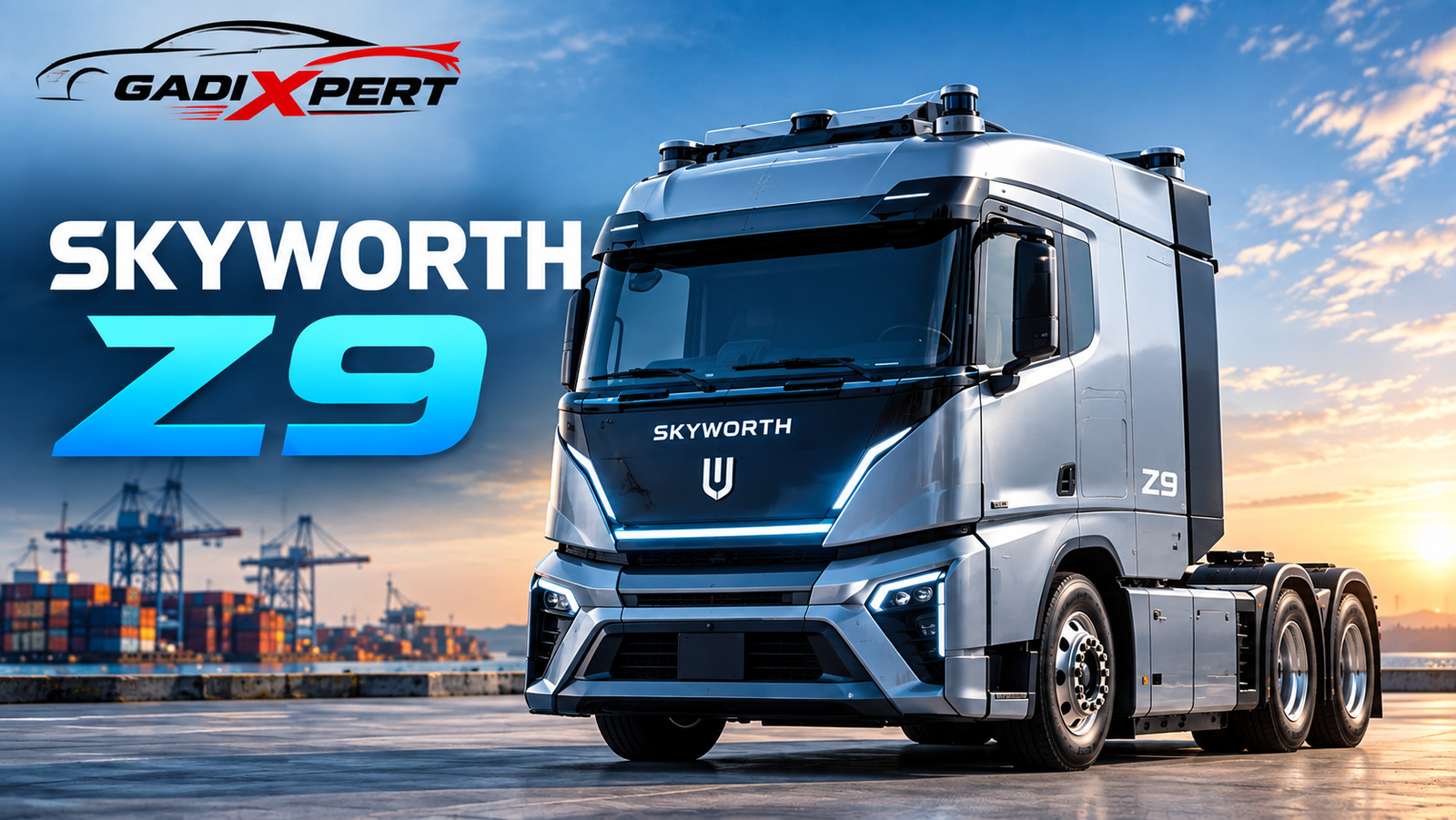
The commercial vehicle industry is moving towards a new generation of electric and autonomous transportation, and the Skyworth Z9 is one of the latest examples of this shift. The heavy-duty electric truck made its world premiere at IAA TRANSPORTATION 2026 in Hannover, Germany, where Skyworth Auto showcased its approach to electric mobility, autonomous driving and connected fleet operations.
Unlike a conventional electric truck designed primarily to replace a diesel powertrain, Skyworth Z9 has been developed around a combination of battery-electric propulsion, Level 4 automated driving and vehicle-to-cloud connectivity.
The truck uses a 400 kWh LFP battery and a dual-motor electric powertrain producing 610 kW. It also uses a 6×4 configuration and has a claimed peak torque output of 1,160 Nm. For autonomous operation, the Z9 uses a sensor package consisting of five LiDAR units, five millimetre-wave radar units and ten HD cameras.
However, Skyworth has not yet announced important commercial figures such as the truck’s official price, driving range, charging time, payload capacity or production schedule. These figures should not be treated as confirmed specifications.
Skyworth Z9: What Is It?
The Skyworth Z9 is a heavy-duty electric semi-truck designed for Level 4 autonomous driving.
Vehicle is being positioned for commercial environments where transportation can follow defined routes and operating conditions. Skyworth specifically identifies applications such as ports, steel mills, rail yards and logistics corridors.
This is important because Level 4 autonomy does not mean that the truck can automatically drive anywhere, under every possible road and weather condition. Level 4 systems are designed to operate autonomously within defined operational conditions.
For the Z9, Skyworth’s focus is therefore not simply on making a driverless truck. The company is combining autonomous driving with fleet management and cloud-based transportation operations.
According to IAA TRANSPORTATION, the Z9 can be integrated into a connected autonomous fleet in which intelligent dispatching, route optimisation and vehicle coordination are part of the overall system. Skyworth says one operator can coordinate up to 18 autonomous vehicles.
Skyworth Z9 World Premiere at IAA TRANSPORTATION 2026
The Skyworth Z9 made its world premiere at IAA TRANSPORTATION 2026 in Hannover.
Skyworth Auto used the event to make its first appearance at the major European commercial vehicle show. Alongside the Z9, the company presented four other commercial vehicles, including the G18 autonomous electric refuse truck, Urban Elf Robobus, HONGTU V9 electric van and HONGTU X range-extended chassis.
The Z9, however, was the main technology highlight of the company’s IAA presentation.
Its combination of a large battery, high electric output and Level 4 autonomous technology makes it significantly different from a conventional electric truck.
Skyworth Z9 Electric Powertrain
At the heart of the Skyworth Z9 is a dual-motor electric powertrain.
The system produces a maximum output of 610 kW. That is equivalent to roughly 818 hp when converted from kilowatts to horsepower.
The truck also has a claimed peak torque output of 1,160 Nm.
For a heavy commercial vehicle, electric power offers one major advantage: strong torque delivery can be available without the need for a conventional multi-speed engine-and-gearbox setup.
However, Skyworth has not published a full performance sheet covering acceleration, maximum speed or gradeability. Therefore, those figures cannot be confirmed at this stage.
Skyworth Z9 Powertrain Specifications
| Specification | Skyworth Z9 |
|---|---|
| Vehicle type | Heavy-duty electric semi-truck |
| Powertrain | Dual-motor electric |
| Maximum output | 610 kW |
| Approx. horsepower | 818 hp |
| Peak torque | 1,160 Nm |
| Drivetrain configuration | 6×4 |
| Battery | 400 kWh |
| Battery chemistry | LFP |
| Driving technology | Level 4 autonomous driving |
These specifications are based on information published by IAA TRANSPORTATION and Skyworth’s presentation for the Z9.
400 kWh LFP Battery
One of the most important components of the Skyworth Z9 is its 400 kWh LFP battery pack.
LFP stands for lithium iron phosphate. This battery chemistry is already widely used in electric vehicles because of its balance of durability, safety characteristics and cost.
For a heavy-duty electric truck, battery capacity is particularly important because the vehicle has to move substantially more mass than a passenger car.
The 400 kWh capacity gives the Z9 a large energy storage system. However, battery capacity should not be confused with driving range.
Skyworth has not officially published a verified range figure for the Z9 in the currently available IAA material. As a result, giving the truck a specific kilometre range would be speculation.
Actual range would depend on factors such as vehicle weight, trailer load, road gradient, temperature, traffic conditions, driving speed and auxiliary energy consumption.
Therefore, until Skyworth publishes an official range figure or a recognised test result, the Skyworth Z9 range remains unconfirmed.
Level 4 Autonomous Driving
The most interesting aspect of the Skyworth Z9 is arguably its autonomous driving technology.
The truck has been developed for Level 4 automated driving.
At Level 4, the automated driving system can perform the driving task without continuous human control within its defined operating conditions. However, this does not mean that the vehicle is capable of unrestricted autonomous driving on every road.
That distinction is particularly important for commercial trucks.
Skyworth is targeting controlled or structured environments such as ports, steel mills, rail yards and logistics corridors. These environments can provide more predictable routes and operating conditions than completely open public-road networks.
This makes the Z9’s approach more practical than simply describing it as a fully driverless truck for all roads.
Skyworth Z9 Sensor Technology
To support its autonomous driving system, the Skyworth Z9 uses a combination of different sensors.
The published specification includes:
- 5 LiDAR sensors
- 5 millimetre-wave radar units
- 10 HD cameras
- 360-degree environmental perception
This multi-sensor setup is designed to provide the vehicle with information about its surroundings.
LiDAR can help create detailed three-dimensional environmental information, while radar can assist with detecting objects and measuring distance. Cameras add visual information for identifying road users, markings and other environmental features.
Using multiple sensor types can also provide redundancy, which is important for autonomous commercial vehicles.
IAA TRANSPORTATION describes the Z9 as having a 360-degree perception system based on these sensors.
6×4 Configuration
The Skyworth Z9 uses a 6×4 configuration.
In simple terms, this is a three-axle truck configuration with four driven wheels.
This type of layout is common in heavy-duty tractor applications because it can provide better traction and support the demands associated with heavy commercial transportation.
The 6×4 layout also makes the Z9 more clearly a heavy-duty commercial vehicle rather than a smaller electric delivery truck.
However, Skyworth has not yet published the full axle-load, gross vehicle weight or payload specifications in the publicly available information.
Therefore, claims about its exact carrying capacity should be avoided until the company releases those figures.
Connected Autonomous Fleet
The Skyworth Z9 is not being presented simply as an autonomous truck.
Skyworth is developing it as part of a connected transportation ecosystem.
The company describes a system involving:
- Intelligent vehicle dispatch
- Route optimisation
- Vehicle-cloud integration
- Multi-vehicle coordination
- Autonomous fleet management
One of the most notable claims is that a single operator can coordinate up to 18 autonomous vehicles.
If successfully deployed at scale, this approach could change how fleet operations are managed.
Instead of having one driver assigned to every vehicle, a smaller number of operators could potentially supervise multiple autonomous trucks within appropriate operating areas.
this should currently be viewed as part of Skyworth’s stated system capability rather than proof that every commercial deployment will operate with one operator for 18 trucks.
Actual staffing requirements would depend on regulations, safety procedures, operating environments and fleet configuration.
Where Will the Skyworth Z9 Be Used?
Skyworth has identified several specific applications for the Skyworth Z9.
Ports
Ports are one of the most logical environments for autonomous heavy trucks.
Vehicles often follow repetitive routes between loading, unloading and storage areas. The controlled nature of many port operations can also make autonomous deployment easier to manage than unrestricted urban driving.
Steel Mills
Steel plants and other industrial facilities also have predictable internal transportation routes.
Autonomous heavy trucks could potentially move materials around large industrial sites while reducing the need for continuous human driving.
Rail Yards
Rail yards can involve repetitive movement between fixed locations.
An autonomous electric truck designed for this type of environment could potentially become part of a larger automated logistics system.
Logistics Corridors
Skyworth also identifies logistics corridors as a target application.
In these environments, autonomous trucks could potentially operate on predefined routes under specific operating conditions.
It is important, however, to distinguish these targeted applications from unrestricted autonomous highway operation. Skyworth’s currently published information does not establish that the Z9 is approved for unrestricted driverless operation on public roads.
Skyworth Z9 Range and Charging
The Skyworth Z9 has a 400 kWh LFP battery, but its official driving range has not yet been disclosed.
Similarly, Skyworth has not published an official charging-time figure in the available launch material.
That means figures such as:
- 500 km range
- 600 km range
- 800 km range
- 1-hour charging
- 30-minute charging
should not be presented as confirmed Z9 specifications unless Skyworth publishes them.
For a commercial truck, charging performance will be just as important as battery size.
Fleet operators need to know how quickly a vehicle can return to work, how much energy it consumes per route and how charging infrastructure affects operating costs.
Those details will become important if and when Skyworth moves the Z9 from demonstration and showcase stages toward wider commercial deployment.
Skyworth Z9 Price
The Skyworth Z9 price has not been officially announced.
There is currently no confirmed European price or India price available from the company’s published Z9 information.
Therefore, Gaadi Xpert’s current position is:
Skyworth Z9 Price: Not Announced
An estimated price would not be reliable because the final cost could depend on battery specification, autonomous hardware, fleet software, market, taxes, configuration and commercial deployment requirements.
As soon as Skyworth announces an official price, it can be added separately.
Is the Skyworth Z9 Coming to India?
At present, there is no confirmed India launch announcement for the Skyworth Z9 in the available information.
Skyworth Auto is using IAA TRANSPORTATION 2026 to expand its international commercial-vehicle presence, with Europe and other international markets among its areas of focus.
However, international presence should not be confused with an India launch confirmation.
Therefore, the Z9 should currently be treated as a global commercial-vehicle technology premiere rather than an India-bound truck.
Skyworth Z9 Design and Technology Focus
The Z9 also introduces Skyworth Auto’s broader design direction for its heavy-truck range.
The company describes its design approach under the “Across the Universe” philosophy.
Inside the vehicle, Skyworth highlights a driver-oriented digital cockpit.
Although autonomous driving is the main technological attraction, the truck is still designed around a conventional heavy-commercial-vehicle architecture rather than being presented simply as a technology prototype.
The combination of electric propulsion, autonomous driving and connected fleet technology is the central theme of the Z9.
What Makes the Skyworth Z9 Different?
Several elements make the Skyworth Z9 notable.
First, it combines a relatively large 400 kWh LFP battery with a 610 kW dual-motor system.
Second, the truck has been designed for Level 4 autonomous operation, rather than only offering conventional driver-assistance features.
Third, Skyworth is connecting the truck to a cloud-based fleet management system.
Finally, the company is targeting specific commercial environments where autonomous operation can potentially provide a stronger business case.
This last point may be particularly important.
The future of autonomous trucks may not begin with every truck driving completely driverless across every highway. Instead, deployment could first grow in controlled environments where routes are repetitive, operating conditions are predictable and fleet efficiency can be measured more easily.
Skyworth Z9 vs Conventional Diesel Heavy Trucks
The Z9 represents a different approach to heavy transportation.
A conventional diesel truck relies on an internal-combustion engine and fuel infrastructure. The Z9 instead uses a large battery and electric motors.
The electric powertrain could provide benefits such as zero tailpipe emissions during operation and potentially lower local noise levels.
At the same time, battery-electric heavy trucks still face challenges.
Charging infrastructure, electricity availability, battery weight, vehicle utilisation and charging downtime are all important factors for fleet operators.
Autonomous driving adds another layer of complexity because the vehicle also requires sophisticated sensors, computing hardware, software and connectivity.
Therefore, the success of the Skyworth Z9 will depend not only on its headline 610 kW output but also on how efficiently the complete system works in real commercial operations.
Skyworth Z9: Confirmed Specifications
| Category | Confirmed information |
|---|---|
| Model | Skyworth Z9 |
| Vehicle type | Heavy-duty electric semi-truck |
| Premiere | IAA TRANSPORTATION 2026 |
| Powertrain | Dual-motor electric |
| Maximum power | 610 kW |
| Approx. horsepower | 818 hp |
| Peak torque | 1,160 Nm |
| Battery capacity | 400 kWh |
| Battery chemistry | LFP |
| Drive configuration | 6×4 |
| Autonomous capability | Level 4 |
| LiDAR | 5 |
| Millimetre-wave radar | 5 |
| HD cameras | 10 |
| Perception | 360-degree |
| Fleet management | Vehicle-cloud integration |
| Maximum vehicles coordinated by one operator | Up to 18 |
| Target applications | Ports, steel mills, rail yards, logistics corridors |
| Price | Not announced |
| Official range | Not announced |
| Charging time | Not announced |
| Payload/GVW | Not announced |
| India launch | Not confirmed |
The confirmed technical data above comes primarily from IAA TRANSPORTATION’s official Z9 material.
What We Still Don’t Know
Despite the detailed technology announcement, several important commercial specifications remain unavailable.
Driving Range
No official range figure has been published.
Charging Time
The company has not yet confirmed how long the 400 kWh battery takes to charge.
Payload
The exact payload capacity has not been announced.
Gross Vehicle Weight
An official GVW figure is currently unavailable in the published Z9 information.
Dimensions
Official length, width, height and wheelbase figures have not been disclosed in the available material.
Price
The Z9 does not currently have an officially announced retail or fleet price.
Production
Skyworth has not provided a confirmed mass-production schedule for the Z9 in the available launch information.
These missing figures are important because they determine how competitive the truck would be in real-world fleet operations.
Why the Skyworth Z9 Matters
The Skyworth Z9 arrives at an important moment for the commercial vehicle industry.
Electric trucks are moving beyond smaller urban delivery applications and increasingly entering the heavy-duty segment. At the same time, autonomous driving is moving from technology demonstrations towards controlled commercial applications.
Skyworth’s approach combines both trends.
Instead of treating electrification and autonomous driving as separate technologies, the Z9 integrates them with cloud-based fleet management.
The company’s CTO Leon Liu has described the wider strategy as combining new-energy vehicles, intelligent driving, digital operations and customised commercial-vehicle solutions.
That approach could become increasingly important as fleet operators focus not just on buying vehicles but on improving total operating efficiency.
Gaadi Xpert Verdict
The Skyworth Z9 is one of the more interesting heavy electric truck premieres at IAA TRANSPORTATION 2026 because it combines three major technologies in one commercial platform: electric propulsion, Level 4 autonomous driving and connected fleet management.
Its headline specifications are impressive. A 610 kW dual-motor system, 1,160 Nm peak torque and 400 kWh LFP battery give the Z9 a strong technical foundation. Meanwhile, five LiDARs, five millimetre-wave radars and ten HD cameras show that Skyworth is taking autonomous perception seriously.
The biggest unanswered questions are its real-world range, charging performance, payload, operating cost, price and commercial production timeline.
Skyworth Z9 is best understood as a Level 4 autonomous electric heavy truck design for specific commercial environments, rather than a conventional road truck that can drive anywhere without a human.
If Skyworth can turn this technology into a reliable and commercially viable fleet product, the Z9 could become an important step in the transition towards smarter heavy-duty transportation.
Frequently Asked Questions
What is the Skyworth Z9?
Skyworth Z9 is a heavy-duty electric semi-truck develop for Level 4 autonomous driving and connect commercial fleet operations.
What is the Skyworth Z9 battery capacity?
The Z9 uses a 400 kWh LFP battery.
How powerful is the Skyworth Z9?
Its dual-motor electric powertrain produces 610 kW, equivalent to approximately 818 hp.
What is the torque of the Skyworth Z9?
The official figure is 1,160 Nm of peak torque.
Is the Skyworth Z9 autonomous?
Yes. Skyworth Z9 has been design for Level 4 autonomous driving.
How many sensors does the Skyworth Z9 use?
The published specification includes five LiDAR sensors, five millimetre-wave radar units and ten HD cameras.
What is the Skyworth Z9 range?
An official driving-range figure has not yet been announc
What is the Skyworth Z9 price?
The price has not yet been officially announc.
Is the Skyworth Z9 coming to India?
There is currently no confirmed India launch announcement for the Z9.
Where is Skyworth Z9 designed to operate ?
Skyworth identifies ports, steel mills, rail yards and logistics corridors as key applications.