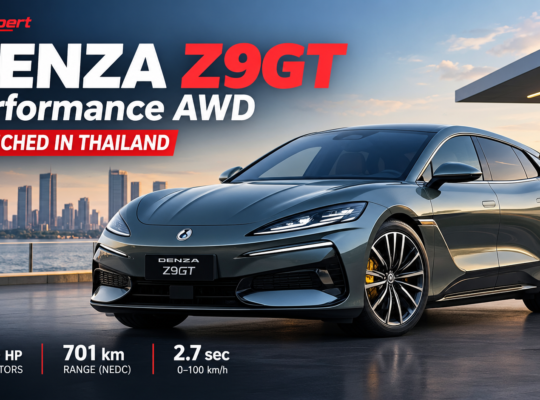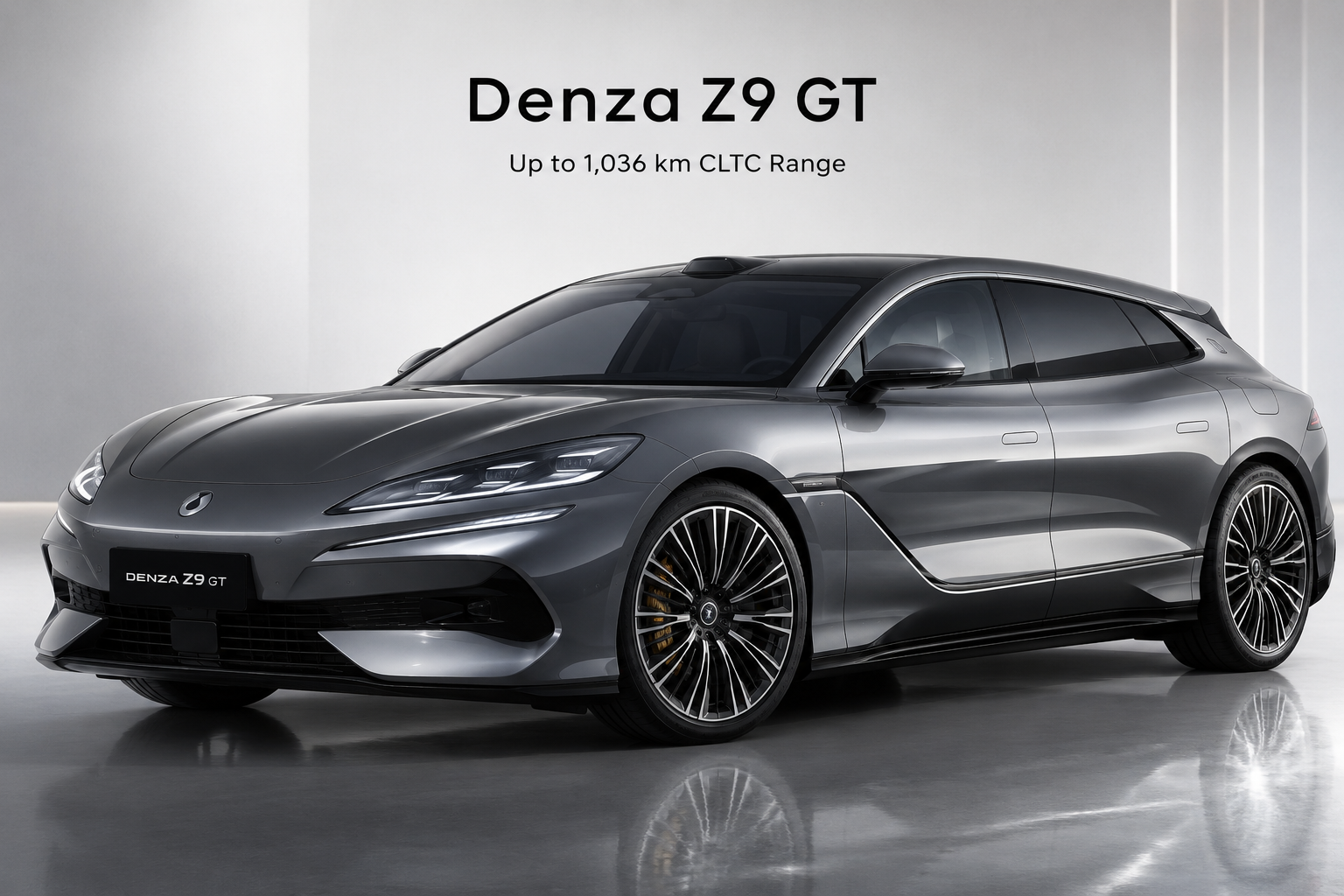
The luxury electric vehicle market is entering a new phase where range, charging speed, performance and advanced technology are becoming just as important as traditional luxury. One of the most interesting examples of this shift is the Denza Z9 GT, a premium shooting-brake developed under BYD’s Denza brand.
Unlike many futuristic EVs that remain at the concept or prototype stage for years, the Denza Z9 GT has already become a production model. The updated 2026 version was launched in China in March 2026, while its international expansion has taken the model into European markets. In Europe, the Z9 GT is offered as a high-end electric shooting brake with a claimed WLTP range of up to 599 km.
The biggest headline, however, comes from the Chinese-market pure-electric version. With the larger 122.5 kWh battery, the Denza Z9 GT claims up to 1,036 km of CLTC range. That figure places the car among the most ambitious long-range EVs currently available in production form.
But the Z9 GT is not simply a long-range EV.
It combines a low-slung shooting-brake body, a luxury-focused cabin, an 800V-class electrical architecture, ultra-fast charging technology and, in its performance version, a three-motor all-wheel-drive system. The top pure-electric variant is listed with 850 kW of peak power, around 1,140 hp, and a claimed 0–100 km/h acceleration time of just 2.7 seconds.
That combination makes the Denza Z9 GT very different from a conventional premium wagon.
It is designed to sit at the intersection of luxury grand touring, high-performance EV and technology flagship.
From BYD Technology to Denza Luxury
Denza is a premium brand under the BYD Group, and the Z9 GT represents one of its most technologically ambitious products. Rather than competing only on price, Denza is attempting to challenge established luxury manufacturers by combining advanced electric powertrain technology with a more sophisticated vehicle design.
The Z9 GT’s body style is particularly important.
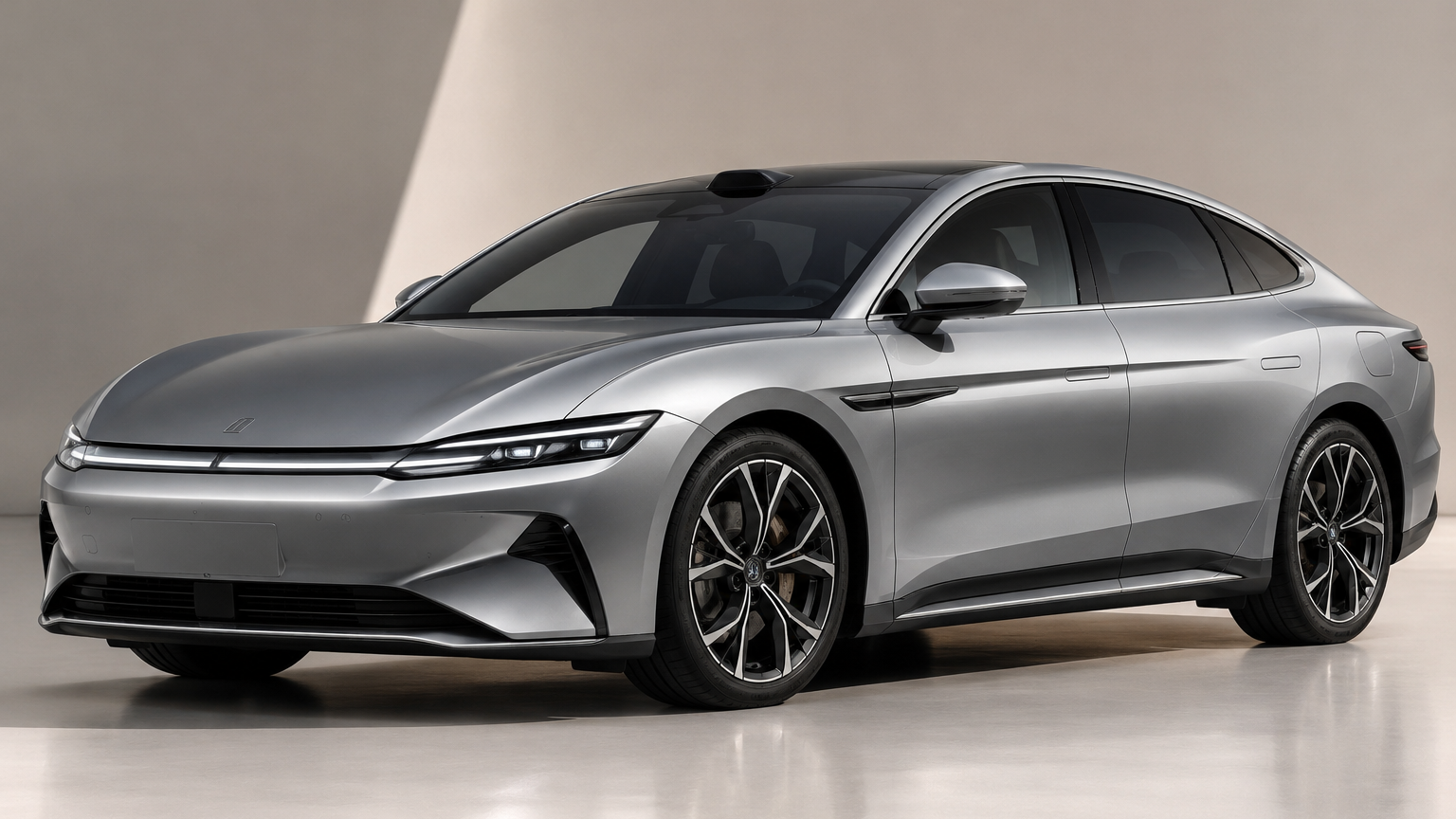
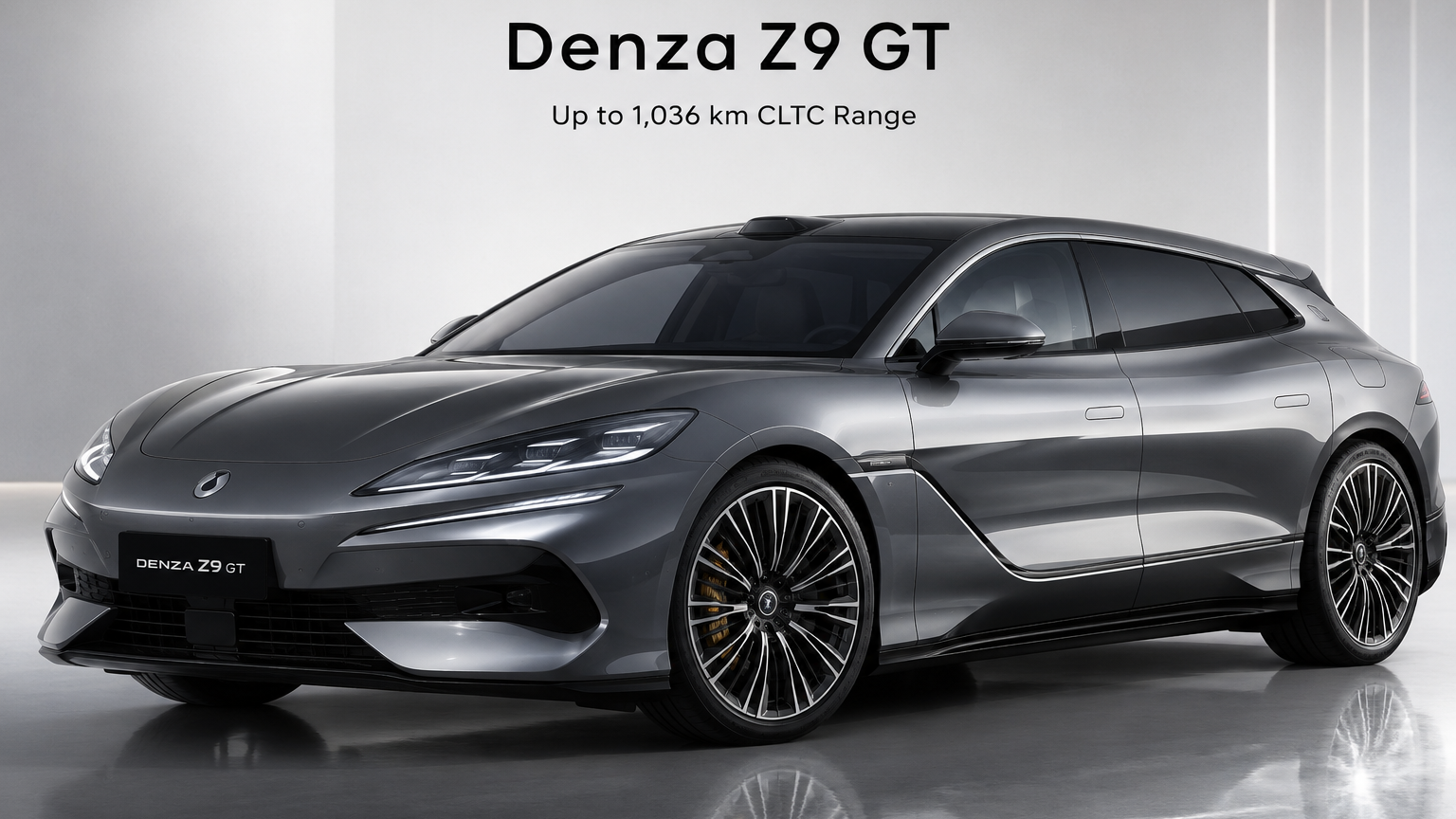
Instead of following the typical SUV shape that dominates the premium EV market, Denza has chosen a shooting-brake/liftback-inspired design. This gives the vehicle a long, low and sporty profile while retaining the practicality expected from a five-door vehicle.
The result is a car that looks more like a high-performance grand tourer than a traditional family EV.
The latest version measures around 5.18 metres in length, 1.99 metres in width and 1.49 metres in height, with a wheelbase of approximately 3.125 metres.
These dimensions immediately put the Z9 GT into a large luxury-car category.
A Global Luxury EV, Not Just a China-Only Model
One of the biggest developments surrounding the Denza Z9 GT is its international expansion.
The car initially established itself in China, where Denza offers multiple powertrain configurations and battery choices. The updated 2026 model range introduced significantly improved specifications, including the new 122.5 kWh battery option and the headline 1,036 km CLTC range.
Denza then expanded the model into Europe.
The European version has been positioned as a premium flagship rather than an affordable Chinese EV. Its specifications differ from the headline Chinese-market figures, particularly when it comes to range certification.
For example, the European pure-electric Z9 GT is rated for up to 599 km under WLTP, which is a more demanding and generally more realistic testing cycle than China’s CLTC system.
This distinction is important when discussing the car’s famous 1,000 km figure.
The 1,036 km number is a Chinese CLTC claim, not a 1,036 km WLTP figure. Buyers in international markets should therefore not interpret the two figures as directly equivalent.
Still, even after accounting for different testing standards, the Z9 GT’s technical package remains impressive.
Why the Denza Z9 GT Is Important
The luxury EV segment has traditionally been dominated by companies such as Porsche, Mercedes-Benz, BMW and Audi. These manufacturers have strong reputations for design, performance and engineering.
However, Chinese automakers have increasingly started competing on another dimension: rapidly developing EV technology.
The Denza Z9 GT is a clear example.
Its technology package combines a large battery, high-voltage electrical architecture, extremely rapid charging capability, multiple electric motors and advanced driver-assistance hardware.
The 2026 pure-electric model is offered with battery capacities of 102.3 kWh and 122.5 kWh, depending on variant. The 122.5 kWh version is the one associated with the 1,036 km CLTC range claim.
Meanwhile, the performance-oriented three-motor version uses a significantly more powerful drivetrain.
The result is unusual: the same model family can be configured around long-distance efficiency or supercar-level acceleration.
That flexibility is one of the strongest aspects of the Z9 GT.
The 1,036 km Range Claim
Range is probably the first specification people notice when they hear about the new Denza Z9 GT.
The updated Chinese-market model offers a 122.5 kWh battery and claims up to 1,036 km of CLTC range in its long-range rear-wheel-drive configuration.
That is an enormous figure for a large luxury performance car.
However, range numbers need context.
CLTC testing can produce significantly higher figures than WLTP because of differences in testing methodology. Therefore, the 1,036 km figure should be treated as a manufacturer-claimed CLTC figure, rather than an expected real-world driving distance.
The European Z9 GT demonstrates this difference clearly.
There, the pure-electric model is rated at up to 599 km WLTP.
Even so, the technical achievement is significant because the Z9 GT combines a large battery with a performance-focused platform rather than creating an ultra-efficient lightweight city car.
For long-distance luxury EV users, this could be one of the vehicle’s strongest selling points.
More Than Just a Range-Focused EV
If the Z9 GT were only about range, it would not be nearly as interesting.
The performance version changes the character of the car completely.
The 2026 Chinese specification lists the top pure-electric variant with three electric motors and all-wheel drive. Combined peak power is listed at 850 kW, equivalent to approximately 1,140 hp, while peak torque is around 1,210 Nm.
The claimed 0–100 km/h acceleration time is 2.7 seconds.
That means the Z9 GT is not merely positioned as a comfortable luxury EV.
It is capable of genuine high-performance acceleration.
The three-motor arrangement also allows Denza to control torque distribution between the front and rear axles in a much more sophisticated way than a conventional single-motor EV.
This becomes particularly important when a large vehicle is expected to deliver both comfort and aggressive performance.
A Shooting Brake With Supercar Ambitions
The exterior design is another major part of the Z9 GT story.
The shooting-brake format gives the vehicle a long roofline and extended rear section while maintaining a low overall stance. Instead of looking like a conventional electric sedan with a larger boot, the Z9 GT has its own identity.
Its proportions are designed around three priorities:
Luxury presence, aerodynamic efficiency and practicality.
The long wheelbase creates more space for passengers, while the five-door liftback layout provides greater flexibility than a traditional three-box sedan.
At nearly 5.2 metres long, the Z9 GT is a substantial vehicle.
Yet its low height helps it maintain a sporty appearance.
This is particularly important for Denza because the company is not simply trying to sell another large EV. It wants the Z9 GT to become a technology showcase for the brand.
The Beginning of a Bigger Global Story
The arrival of the Denza Z9 GT in Europe is also significant from a broader industry perspective.
Denza is trying to establish itself as a premium global brand, and the Z9 GT is one of the vehicles being used to demonstrate what the brand can offer outside China.
The European model is not positioned as a budget alternative.
In fact, pricing is dramatically higher than the Chinese-market starting price. Reports indicate European pricing from around €115,000, while the Chinese-market 2026 Z9 GT EV starts at 269,800 yuan.
That difference shows Denza’s international strategy clearly.
The company is attempting to enter established premium markets rather than simply exporting inexpensive EVs.
And that makes the Z9 GT particularly important.
It is effectively a statement that BYD wants its premium technology to compete in the same conversation as established European luxury brands.
Denza Z9 GT Price and Variants
The Denza Z9 GT is positioned as a premium performance-oriented electric shooting brake, and its pricing reflects that positioning. However, the price varies significantly between China and international markets.
In China, the updated 2026 Denza Z9 GT EV range starts at around ¥269,800, while higher-spec versions move considerably higher depending on the battery and motor configuration.
The major attraction of the Chinese range is that customers can choose between different battery and powertrain combinations rather than being limited to a single configuration.
The pure-electric range includes versions designed around efficiency as well as high-performance variants.
At the top of the EV range sits the powerful three-motor all-wheel-drive version, which combines enormous output with the technology package expected from Denza’s flagship model.
European pricing is considerably higher.
The Z9 GT has been introduced in Europe as a premium luxury EV, with reports putting the starting price at approximately €115,000 in the European market.
This difference is important because it shows that Denza is not positioning the Z9 GT internationally as a value-focused Chinese EV.
Instead, the brand wants to compete in the premium luxury segment.
China vs Europe: Price Positioning
| Market | Model | Starting Price / Position |
|---|---|---|
| China | Z9 GT EV | Around ¥269,800 |
| Europe | Z9 GT EV | Around €115,000 |
| UK | Z9 GT EV | Premium-market positioning |
| India | Z9 GT | No official launch announced |
The Indian market currently does not have an official Z9 GT launch announcement, so any India price would be speculation.
For this reason, the global version of the article should focus on confirmed international markets rather than presenting an expected Indian price as fact.
Exterior Design: A Luxury Shooting Brake With a Different Identity
The exterior is one of the strongest reasons why the Denza Z9 GT stands out.
The car does not follow the increasingly common SUV-coupe formula used by many premium EV manufacturers. Instead, Denza has gone with a shooting-brake body style.
This gives the Z9 GT a long, low and aerodynamic silhouette.
From the front, the car features a wide and modern fascia with slim lighting elements and a smooth EV-focused nose. Since an electric vehicle does not require a large traditional grille, Denza has been able to create a cleaner front-end design.
The headlights are integrated into the overall front design rather than appearing as isolated elements.
This helps give the car a wider visual stance.
The bonnet is long and relatively low, while the windshield flows into a sleek roofline.
That roofline is one of the most important elements of the car’s appearance.
Instead of dropping sharply behind the rear seats like a conventional fastback, it continues towards the back and creates the extended profile associated with a shooting brake.
Long and Low Proportions
The dimensions underline the vehicle’s luxury positioning.
The updated Z9 GT is approximately:
- Length: 5,180 mm
- Width: 1,990 mm
- Height: 1,490 mm
- Wheelbase: 3,125 mm
These dimensions make the Z9 GT a large vehicle by any standard.
The long wheelbase is especially important because it provides the platform for a spacious passenger cabin while also helping create the planted proportions expected from a performance GT.
The car’s width also contributes to its aggressive stance.
Rather than looking tall and bulky like a large SUV, the Z9 GT sits relatively close to the ground.
That low-slung character makes it visually closer to a high-performance grand tourer.
Aerodynamics and Flush-Surface Design
The exterior design also focuses heavily on aerodynamic efficiency.
Like many modern premium EVs, the Z9 GT uses flush-style door handles and carefully shaped body surfaces.
The smooth side profile reduces visual clutter while also supporting the aerodynamic goals of the vehicle.
The roofline flows continuously into the rear section, helping create the distinctive shooting-brake silhouette.
The large wheels further enhance the car’s stance.
Depending on the configuration and market, wheel and trim specifications can differ, so buyers should check local-market equipment rather than assuming every feature shown in Chinese-market images is standard internationally.
Rear Design
The rear is arguably the most distinctive part of the Z9 GT.
The extended roofline ends in a large rear section that combines practicality with sporty styling.
Slim rear lighting elements create a wide visual appearance.
The rear windscreen and tailgate are integrated into the shooting-brake layout, allowing the Z9 GT to offer more usable cargo space than a conventional sedan.
This is one of the main reasons why the shooting-brake format makes sense.
You get the visual character of a performance GT while retaining the everyday practicality of a large five-door vehicle.
For customers who do not want an SUV but still need luggage space, this body style can be particularly attractive.
Interior and Cabin
Step inside the Denza Z9 GT, and the focus shifts from sporty exterior styling to technology and luxury.
The cabin follows the modern premium-EV philosophy, with a clean dashboard layout and a heavy emphasis on digital displays.
Instead of covering the dashboard with numerous physical switches, Denza has integrated multiple screens into the cabin architecture.
This gives the interior a futuristic appearance.
At the same time, the Z9 GT remains a large luxury vehicle, so the cabin is designed around passenger comfort rather than simply chasing a minimalist look.
Multiple Displays
One of the most noticeable elements of the interior is its extensive display setup.
The Z9 GT can feature a large central infotainment screen along with a digital driver’s display and additional screens for other functions.
Depending on specification, the vehicle can also use dedicated displays for the passenger and camera-based exterior systems.
This creates a cockpit that feels more like a technology flagship than a traditional luxury wagon.
The central screen handles key infotainment and vehicle functions, while the driver’s display provides essential driving information.
The passenger-oriented screen adds another layer of digital functionality.
Premium Seating Layout
The large exterior dimensions translate into a spacious cabin.
The long wheelbase provides considerable room for occupants, particularly in the rear.
Denza has positioned the Z9 GT as a luxury GT, so the rear seats are not treated as an afterthought.
Depending on the configuration, premium seating features can include:
- Power-adjustable seats
- Seat ventilation
- Seat heating
- Massage functions
- Premium upholstery
- Multi-zone climate control
- Rear passenger controls
Exact equipment can vary by market and trim.
This is another reason why it is important to distinguish between China-market specifications and European specifications.
A Technology-Focused Cabin
The Denza Z9 GT is clearly designed around the idea that technology should be visible to occupants.
The dashboard has a relatively clean architecture, while screens and digital controls provide most of the information.
The vehicle’s infotainment system is also integrated with the broader electronic architecture.
This allows the car to control everything from climate functions to charging information through its digital interface.
However, Denza has not completely abandoned physical controls.
Some commonly used functions remain accessible without requiring the driver to navigate through multiple menus.
This balance is important in a performance-oriented luxury car because excessive dependence on touchscreens can become distracting while driving.
Premium Audio and Comfort Technology
As expected from a flagship luxury vehicle, the Z9 GT offers a premium audio and comfort package.
High-end variants can feature a multi-speaker premium sound system, while the cabin is designed to provide a quiet environment at highway speeds.
This is particularly important for a grand touring vehicle.
The Z9 GT is not designed solely for short urban trips.
Its large battery, high-speed charging system and spacious cabin make long-distance travel one of its intended use cases.
A quiet cabin therefore becomes an important part of the overall luxury experience.
Large Glass Area and Modern Cabin Feel
The interior also benefits from the large glasshouse created by the shooting-brake design.
Depending on the variant, buyers can get a panoramic glass roof that makes the cabin feel more open.
The long roofline also contributes to the vehicle’s spacious appearance.
Rather than creating an extremely low sports-car cabin, Denza has tried to balance the sporty exterior with enough interior space for everyday usability.
This is particularly noticeable in the rear.
A vehicle measuring more than five metres long with a wheelbase exceeding three metres has enough physical space to deliver a genuine luxury-car experience.
Cargo Space and Practicality
One of the major advantages of choosing the Denza Z9 GT over a conventional luxury sedan is practicality.
The shooting-brake body provides a large rear opening and a more versatile luggage area.
The rear seats can also be folded to increase usable cargo capacity.
This means the Z9 GT can serve as both a performance car and a practical long-distance vehicle.
That combination is relatively uncommon.
Most performance EVs focus heavily on acceleration and styling.
Large luxury SUVs provide practicality but sacrifice the low-slung driving character.
The Z9 GT attempts to sit between these categories.
It provides the performance expected from a high-output EV while maintaining a large rear cargo area.
Technology That Defines the Z9 GT
The biggest difference between the Z9 GT and a traditional luxury wagon is the amount of technology underneath its stylish exterior.
The car uses a high-voltage electrical architecture designed to support fast charging and high power output.
This architecture is particularly important for the high-performance variants.
A vehicle producing hundreds of kilowatts needs a battery and electrical system capable of delivering enormous amounts of power without excessive thermal stress.
Denza has therefore developed the Z9 GT around a modern EV platform rather than adapting an old combustion-car architecture.
Flash Charging Technology
One of the major technological highlights of the updated Z9 GT is its fast-charging capability.
The latest version uses BYD’s advanced high-voltage charging technology, allowing the battery to recover a substantial amount of range in a very short period when connected to a compatible high-power charger.
Reports around the updated model have highlighted a charging system capable of adding hundreds of kilometres of claimed range within minutes under ideal conditions.
However, real-world charging times will depend on:
- Charger output
- Battery temperature
- State of charge
- Charging infrastructure
- Ambient temperature
- Vehicle battery management
So headline charging numbers should always be treated as laboratory or ideal-condition figures.
The Z9 GT Is Designed as a Grand Tourer
This is perhaps the most important point about the vehicle.
The Z9 GT is not simply a performance EV with a large battery.
Its entire design is based around the concept of grand touring.
A grand tourer needs to deliver:
Performance + comfort + range + practicality + technology.
The Z9 GT attempts to bring all five together.
Its long body provides space.
It’s large battery provides long-distance capability.
Its three-motor configuration delivers extreme acceleration.
Its luxury-focused cabin provides comfort.
And its advanced electronic architecture provides the technology expected from a modern flagship.
That combination gives the Z9 GT a unique position in the global EV market.
What Makes the Z9 GT Different?
There are plenty of premium electric cars available today.
But most of them fall into a specific category.
Some are luxury sedans.
Some are high-performance sports sedans.
Others are SUVs.
The Denza Z9 GT is unusual because it combines characteristics from several segments.
It has the practicality of a wagon.
It’as the proportions of a grand tourer.
It has the acceleration of a performance EV.
And it has the technology package of a flagship luxury car.
That is exactly what makes the model interesting from a global perspective.
Battery and Range: The Biggest Z9 GT Talking Point
The battery technology is one of the biggest reasons the Denza Z9 GT has attracted global attention.
The updated pure-electric Z9 GT is available with battery options that go up to 122.5 kWh in the Chinese market. The largest battery is paired with a long-range configuration that claims up to 1,036 km under the CLTC testing cycle.
That number immediately places the Denza Z9 GT among the most ambitious long-range electric vehicles currently available.
However, it is important to understand what the 1,036 km figure actually means.
It is a CLTC-rated figure, not a WLTP or EPA rating. CLTC testing generally produces higher range figures than WLTP because the testing methodology and conditions are different.
This becomes particularly clear when looking at the European version.
The European pure-electric Denza Z9 GT is rated for up to approximately 599 km WLTP, depending on specification.
Therefore, buyers should not expect the car to travel 1,036 km in normal European or real-world driving.
Instead, the headline number demonstrates the potential of the vehicle’s large battery and efficient electric architecture under China’s certification system.
Why the Large Battery Matters
A large battery is particularly useful in a luxury GT because the vehicle is designed for long-distance travel.
Unlike a small city EV, the Denza Z9 GT has enough space and weight capacity to accommodate a large battery pack without compromising its fundamental design.
The result is a vehicle that can theoretically cover very long distances between charging stops.
For highway users, this can be a major advantage.
Long-distance EV travel often depends less on maximum battery size and more on the combination of:
- Battery capacity
- Energy efficiency
- Charging speed
- Charging infrastructure
- Thermal management
- Driving conditions
The Z9 GT attempts to address all of these areas.
800V-Class Electrical Architecture
Another important part of the Denza Z9 GT’s technical package is its high-voltage electrical architecture.
Modern high-performance EVs increasingly use 800V-class systems because higher voltage allows the vehicle to deliver high electrical power while reducing the current required for a given power output.
This has several potential advantages.
A high-voltage system can support:
Faster charging + high motor power + improved electrical efficiency + better packaging.
For a vehicle like the Z9 GT, this is particularly important.
The performance version can produce extremely high power, meaning the electrical system needs to handle significant energy flow.
The same architecture also helps support the car’s rapid charging capability.
Flash Charging: The Technology Behind Faster Road Trips
Charging speed is arguably just as important as battery capacity.
A 1,000-km claimed range is impressive on paper, but long-distance EV ownership becomes much easier when the battery can be replenished quickly.
This is where BYD’s high-power charging technology becomes important.
The updated Z9 GT has been associated with BYD’s advanced flash-charging technology, which is designed to add a substantial amount of range in a short charging session when connected to compatible infrastructure.
The important phrase here is compatible infrastructure.
A vehicle may support extremely high charging power, but the actual charging speed depends on the charger.
If the charger cannot deliver the required power, the vehicle will not be able to achieve its maximum charging rate.
Battery temperature and state of charge also affect charging speed.
In general, the highest charging rates are achieved under controlled conditions and at suitable battery states.
Therefore, advertised charging figures should be viewed as maximum technical capability rather than guaranteed everyday charging performance.
Three-Motor Performance
This is where the Denza Z9 GT becomes genuinely interesting.
The highest-performance pure-electric version uses a three-motor all-wheel-drive configuration.
Instead of using one motor at the front and one at the rear, the system combines:
- One front electric motor
- Two rear electric motors
This configuration allows the car to generate enormous combined power.
The top Chinese-market EV specification is listed with approximately 850 kW of peak power, equivalent to roughly 1,140 hp.
Peak torque is listed at around 1,210 Nm.
These numbers put the Z9 GT firmly into high-performance territory.
0–100 km/h in 2.7 Seconds
The headline acceleration figure is equally impressive.
The top three-motor Denza Z9 GT is claimed to accelerate from 0 to 100 km/h in approximately 2.7 seconds.
For a vehicle measuring more than five metres long, this is a remarkable figure.
The instant torque delivery of electric motors gives the Z9 GT a significant advantage over conventional combustion-powered GT cars.
There is no traditional multi-speed gearbox that needs to shift through gears during hard acceleration.
Instead, electric motors can deliver torque almost immediately.
The three-motor setup further improves traction by distributing power across multiple wheels.
This allows the Z9 GT to launch aggressively while maintaining stability.
Why Three Motors Matter
The three-motor system isn’t only about producing a large horsepower number.
It can also improve vehicle control.
The two rear motors can independently control torque delivery to the rear wheels.
This creates the possibility of highly precise torque vectoring.
During cornering, the vehicle can adjust how much torque each wheel receives.
This can help influence the car’s behaviour through a corner.
Instead of simply sending the same amount of power to both rear wheels, the electronic control system can make extremely rapid adjustments.
This is particularly useful in a large, heavy performance EV.
Advanced Steering Technology
One of the more unusual technologies associated with the Z9 family is its advanced rear-wheel steering system.
Rear-wheel steering can make a large vehicle feel more agile at lower speeds.
At higher speeds, the system can help improve stability.
The basic principle is relatively simple.
At low speeds, the rear wheels can turn in the opposite direction to the front wheels.
This effectively reduces the turning circle.
For a car measuring more than five metres long, this can make parking and tight manoeuvres significantly easier.
At higher speeds, the rear wheels can turn in the same general direction as the front wheels.
This can improve stability during lane changes and fast cornering.
For the Z9 GT, this technology is particularly relevant because its large dimensions could otherwise make the vehicle feel cumbersome.
Crab-Walking Capability
The advanced chassis technology goes even further.
The Z9 platform has been associated with an unusual sideways or diagonal movement capability that allows the vehicle to perform manoeuvres that are difficult for conventional cars.
This is made possible by the combination of independent electric motors, sophisticated steering control and electronically controlled torque distribution.
Such a feature is more than a gimmick from an engineering perspective.
It demonstrates how electric drivetrains can fundamentally change vehicle dynamics.
A conventional combustion car generally has a mechanical drivetrain connecting the engine to the wheels.
An EV can instead control each motor electronically.
That gives engineers far more freedom in managing wheel torque and vehicle movement.
Suspension and Ride Comfort
Performance is only one side of the denza Z9 GT’s character.
As a luxury grand tourer, it also needs to provide a comfortable ride.
The vehicle therefore uses an advanced suspension setup designed to balance ride quality with handling.
Large luxury EVs face a particular challenge.
Their battery packs add significant weight to the vehicle.
That weight can improve stability but can also make the car feel heavy during direction changes.
Sophisticated suspension tuning is therefore essential.
The Z9 GT’s chassis electronics work alongside its suspension system to control body movement.
The goal is to keep the vehicle comfortable during normal driving while maintaining control during aggressive manoeuvres.
Handling: Can a 5.2-Metre EV Really Feel Sporty?
This is one of the most interesting questions surrounding the Denza Z9 GT.
At approximately 5.18 metres long, this is not a small sports car.
It is a large luxury GT.
However, its long wheelbase and wide stance provide a stable platform.
The low roof and relatively low centre of gravity created by the battery placement also help.
The battery pack sits low within the vehicle floor, lowering the overall centre of gravity.
This is a major advantage of EV architecture.
A lower centre of gravity reduces body roll and can make a large vehicle feel more planted through corners.
The three-motor powertrain then adds another layer of control.
Performance vs Efficiency
One of the clever aspects of the Denza Z9 GT range is that not every variant is designed around maximum power.
The long-range version is aimed more at efficiency.
The performance version prioritises acceleration and all-wheel-drive capability.
This distinction is important because maximum performance generally comes with an energy penalty.
More motors and higher output mean more potential energy consumption during aggressive driving.
Therefore, buyers who prioritise maximum range may prefer a lower-output configuration.
Those who want the full performance experience can choose the three-motor version.
This makes the Z9 GT range more versatile.
Thermal Management
Thermal management is another critical part of a high-performance EV.
When a vehicle produces hundreds of kilowatts of power, the motors, battery and power electronics generate considerable heat.
If temperatures become too high, the vehicle may reduce output to protect its components.
For that reason, a high-performance EV needs an effective cooling system.
The Denza Z9 GT’s high-voltage electrical architecture and battery management system are designed to handle high power demands.
This becomes especially important during:
- Repeated acceleration runs
- High-speed driving
- Fast charging
- Hot weather
- Long-distance highway use
A good thermal management system helps maintain consistent performance while also protecting long-term battery health.
Advanced Driver Assistance Systems
The technology story does not end with the drivetrain.
The Denza Z9 GT is also equipped with advanced driver-assistance technology.
Depending on market and specification, the vehicle can use a combination of:
- Cameras
- Radar sensors
- LiDAR
- Ultrasonic sensors
- High-performance computing hardware
These systems work together to provide the vehicle with information about its surroundings.
LiDAR is particularly important because it can generate detailed three-dimensional information about nearby objects.
This can complement cameras and radar.
LiDAR and Intelligent Driving
The use of LiDAR places the Denza Z9 GT firmly within the current generation of high-tech Chinese EVs.
Modern driver-assistance systems need to understand:
Vehicles + pedestrians + road boundaries + traffic conditions + obstacles.
Using multiple sensor types allows the vehicle to build a more comprehensive understanding of the environment.
However, it is important to understand that advanced driver assistance does not mean fully autonomous driving in every situation.
Drivers are still responsible for monitoring the vehicle and the road.
The exact functions available also depend on local regulations, software versions and market-specific equipment.
Denza Z9 GT Highway Driving Assistance
On suitable roads, advanced assistance systems can help with tasks such as maintaining a set speed, keeping the vehicle within its lane and assisting with certain lane changes.
These systems can reduce driver workload during long journeys.
That fits perfectly with the Z9 GT’s grand-touring philosophy.
A vehicle designed to travel long distances benefits greatly from sophisticated driver assistance.
However, these technologies should be treated as driver assistance, not as a replacement for an attentive driver.
Denza Z9 GT Safety Technology
The Denza Z9 GT’s safety package combines active and passive protection systems.
Active safety technologies are designed to help prevent collisions, while passive systems protect occupants when a crash occurs.
Depending on market and specification, the vehicle can include systems such as:
- Automatic emergency braking
- Forward collision warning
- Lane departure warning
- Lane keeping assistance
- Adaptive cruise control
- Blind-spot monitoring
- Rear cross-traffic assistance
- Parking assistance
- Surround-view cameras
The exact availability can differ between Chinese and European versions.
Why the Technology Package Matters
The real strength of the denza Z9 GT isn’t any single specification.
It is the combination.
Consider what the vehicle offers as a complete package:
Large battery → long-distance capability
800V-class architecture → high-power charging
Three motors → extreme performance
Independent torque control → advanced handling
Rear-wheel steering → improved manoeuvrability
Advanced suspension → comfort and stability
LiDAR and sensors → sophisticated driver assistance
That combination makes the Z9 GT more than just another fast electric car.
China Range vs European Range: A Crucial Difference
For international readers, this deserves special attention.
The headline 1,036 km range applies to the Chinese-market long-range configuration using the CLTC testing cycle.
The European model is rated at up to approximately 599 km WLTP.
These figures should never be directly compared as though they were measured under the same conditions.
WLTP generally gives a more conservative figure than CLTC.
Real-world range can be lower still depending on:
- Highway speed
- Weather
- Temperature
- Wheel size
- Passenger load
- Air-conditioning use
- Driving style
Therefore, the correct way to describe the Z9 GT is:
Up to 1,036 km CLTC range in China, while the European version offers up to around 599 km WLTP.
That wording avoids misleading readers while still highlighting the vehicle’s impressive long-range capability.
Denza Z9 GT Performance: Key Figures
| Specification | Top EV Version |
|---|---|
| Power | Up to 850 kW |
| Approx. Horsepower | Around 1,140 hp |
| Torque | Around 1,210 Nm |
| Motors | 3 |
| Drive | All-Wheel Drive |
| 0–100 km/h | Approx. 2.7 sec |
| Largest Battery | 122.5 kWh |
| Maximum China Range | Up to 1,036 km CLTC |
| European Range | Up to 599 km WLTP |
| Body | Shooting Brake |
Figures vary by market and variant. China CLTC and European WLTP range ratings use different testing methods.
Denza Z9 GT vs Global Luxury EV Rivals
The Denza Z9 GT enters a segment that has traditionally been dominated by established European luxury manufacturers. However, its approach is quite different.
Instead of being a conventional luxury sedan, it combines the practicality of a shooting brake with the performance of a high-output EV.
That makes direct comparison slightly complicated.
The Z9 GT can be viewed alongside performance-oriented models from Porsche, Mercedes-Benz, BMW and Audi, but it does not perfectly copy any one of them.
Its closest competition depends on what the buyer values most.
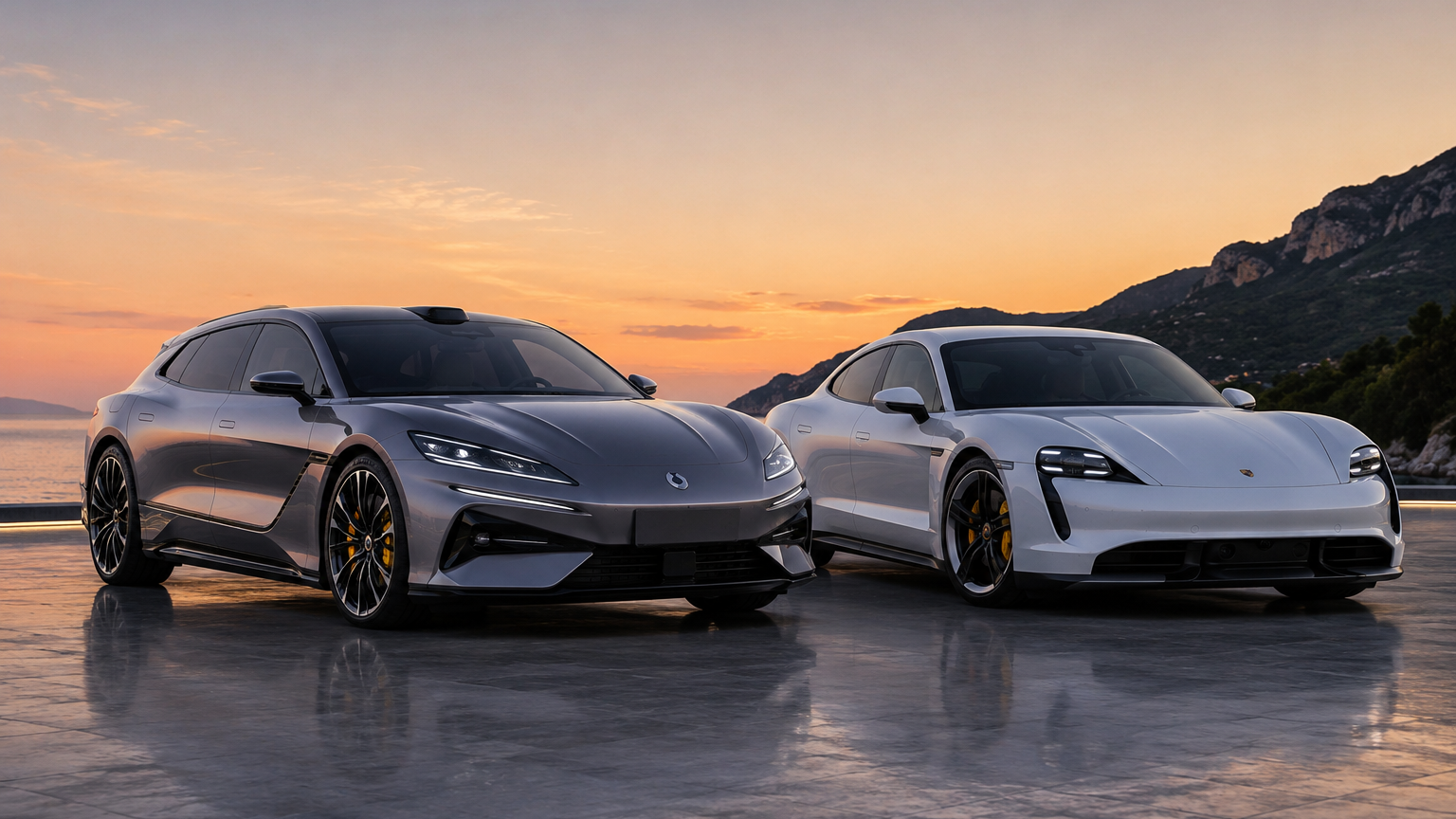
For someone looking for electric performance, cars such as the Porsche Taycan are relevant.
For luxury and technology, premium Mercedes-Benz and BMW electric models become alternatives.
For practicality, high-performance electric wagons and fastbacks are more appropriate comparisons.
The Z9 GT’s biggest advantage is that it tries to combine all of these characteristics into one product.
Denza Z9 GT vs Porsche Taycan
The Porsche Taycan is one of the most established high-performance electric cars in the world.
Its biggest strengths are:
- Precise handling
- Strong performance
- Premium cabin
- Established luxury-brand reputation
- Excellent high-speed dynamics
The Z9 GT approaches the same broad performance category from a different direction.
It focuses more heavily on:
- Battery range
- Interior technology
- Rear-seat space
- Shooting-brake practicality
- Advanced electric drivetrain technology
The Z9 GT’s three-motor version is particularly impressive on paper, with up to 850 kW of power and a claimed 0–100 km/h time of around 2.7 seconds.
However, outright acceleration is not enough to determine which car is better.
Porsche’s strength remains chassis tuning and driving dynamics, while Denza’s strongest argument is its combination of technology, range and practicality.
Denza Z9 GT vs Mercedes-Benz
Mercedes-Benz has traditionally built luxury vehicles around comfort, refinement and technology.
The Z9 GT shares some of those priorities.
Its long wheelbase, premium cabin and advanced driver-assistance systems make it suitable for long-distance travel.
But the Z9 GT’s approach is more aggressively performance-focused.
Its three-motor configuration provides an enormous power reserve.
At the same time, the shooting-brake body gives it a distinctive appearance compared with conventional Mercedes luxury sedans.
The major difference is brand heritage.
Mercedes-Benz has decades of experience building luxury cars and a massive global dealer network.
Denza is still establishing itself internationally.
Therefore, Denza’s technology may attract buyers, while established luxury brands still have an advantage in brand recognition and after-sales confidence.
Denza Z9 GT vs BMW
BMW’s performance philosophy has traditionally focused on driver engagement.
The Z9 GT is technologically advanced, but its character is somewhat different.
Instead of trying to replicate a traditional rear-wheel-drive performance sedan, Denza uses multiple electric motors and sophisticated electronic torque control.
This allows the vehicle to produce huge amounts of power while maintaining all-wheel-drive traction.
The result is a modern interpretation of performance.
The BMW advantage remains its established chassis engineering and global luxury-car reputation.
The Denza advantage is its aggressive approach to EV technology.
What Makes the Denza Z9 GT Different?
The biggest difference is that the Denza Z9 GT does not try to become another conventional luxury sedan.
It has a distinct identity.
It offers:
Shooting-brake practicality
The large rear section provides more flexibility than a conventional sedan.
Extreme electric performance
The three-motor version offers supercar-level acceleration.
Large battery capacity
The biggest battery reaches 122.5 kWh in the Chinese market.
Long claimed range
Up to 1,036 km CLTC is available on the long-range Chinese configuration.
High-speed charging
The vehicle supports BYD’s high-power charging technology.
Advanced chassis technology
Rear-wheel steering and sophisticated torque management improve manoeuvrability.
Modern driver assistance
LiDAR and multiple sensors are available depending on specification.
This combination gives the car its identity.
Is Denza Z9 GT Coming to India?
This is one of the most important questions for Indian readers.
At present, the Denza Z9 GT does not have an officially announced India launch date.
That means it would be incorrect to describe the Z9 GT as an upcoming India launch with a confirmed launch schedule.
However, the possibility of Denza entering India makes the question relevant.
BYD has already established itself in the Indian EV market, and the company has been expanding its premium ambitions globally.
Denza is positioned above BYD’s mainstream passenger-car range.
If the brand expands its Indian portfolio in the future, premium products such as the Z9 GT could become candidates.
But for now, there is a clear difference between possibility and confirmation.
Current India Status
| Item | Status |
|---|---|
| Z9 GT China launch | Officially launched |
| European rollout | Yes |
| Global production model | Yes |
| India launch | Not officially confirmed |
| India launch date | Not announced |
| India price | Not announced |
| India booking | Not announced |
Therefore, Indian readers should treat any claimed launch date or expected price as unofficial unless Denza or BYD announces it directly.
Could the Denza Z9 GT Make Sense for India?
Technically, yes.
India’s premium EV market is growing, and luxury customers are becoming increasingly interested in high-performance electric cars.
The Z9 GT could appeal to a niche audience because of its unusual combination of:
- Performance
- Range
- Technology
- Luxury
- Practicality
However, several challenges would need to be addressed.
The biggest one is charging infrastructure.
A vehicle capable of extremely high charging power needs compatible high-output charging stations to take full advantage of that capability.
India’s premium EV charging network is improving, but infrastructure availability varies significantly between cities and highways.
Another challenge would be pricing.
The Z9 GT is positioned as a premium luxury product internationally.
If introduced into India as a fully imported vehicle, taxes and import duties could push the price significantly higher.
That could make it difficult to compete with locally assembled luxury EVs.
Pros and Cons of Denza Z9 GT
Pros
1. Extremely Powerful Electric Drivetrain
The top three-motor version’s 850 kW output is one of the strongest specifications in its segment.
2. Huge Battery
The 122.5 kWh battery provides substantial energy capacity.
3. 1,036 km CLTC Range Claim
The headline range gives the Z9 GT a major marketing advantage in China.
4. Fast Charging Technology
The high-voltage electrical architecture supports very rapid charging under compatible conditions.
5. Unique Shooting-Brake Design
The Z9 GT looks different from the large number of luxury electric SUVs and sedans.
6. High Technology Content
LiDAR, multiple displays, advanced driver assistance and sophisticated chassis electronics make it a technology-heavy vehicle.
7. Practical Body Style
The large rear hatch gives it more everyday practicality than many performance sedans.
8. Strong Performance
A claimed 0–100 km/h time of approximately 2.7 seconds makes the top variant genuinely fast.
Cons
1. Large Physical Size
At more than five metres long, the Z9 GT is not an easy car for every urban environment.
2. Heavy Vehicle
Large batteries and a luxury-car structure inevitably add weight.
3. Range Figures Vary by Testing Cycle
The 1,036 km headline figure is CLTC, while the European version’s rating is much lower under WLTP.
4. Limited Global Brand Recognition
Denza is still relatively unknown compared with BMW, Mercedes-Benz, Porsche and Audi.
5. Charging Infrastructure Dependency
The fastest charging performance requires compatible high-power charging infrastructure.
6. India Availability Is Uncertain
Indian buyers currently cannot officially purchase the Z9 GT through a confirmed Denza India launch programme.
Should You Buy the Denza Z9 GT?
For buyers in markets where the Z9 GT is officially available, the answer depends heavily on priorities.
If you want a conventional luxury car from an established European brand, the Z9 GT may not be the obvious choice.
Brand reputation, dealership network and long-term ownership experience still matter significantly in the luxury segment.
But if you want something different, the Z9 GT becomes extremely interesting.
It combines a futuristic electric drivetrain with a practical shooting-brake body.
It offers enormous performance without sacrificing its grand-touring character.
And it brings technology that is usually associated with much more futuristic concept cars into a production vehicle.
The long-range configuration is particularly attractive for buyers who prioritise road-trip capability.
Meanwhile, the three-motor version is aimed at customers who want maximum performance.
Who Should Consider the Z9 GT?
You should consider it if:
- You want a premium EV with a unique design.
- You prefer a shooting brake over an SUV.
- Long-distance range is important.
- You want extremely strong acceleration.
- You enjoy advanced automotive technology.
- You want something different from mainstream European luxury cars.
You may want to look elsewhere if:
- Brand heritage is your biggest priority.
- You need a large global dealer network.
- You regularly drive in areas with limited charging infrastructure.
- You prefer a smaller luxury vehicle.
- You want a traditional sports-car driving experience.
Denza Z9 GT: Global Strengths at a Glance
| Category | Rating |
|---|---|
| Exterior Design | 9/10 |
| Interior Technology | 9/10 |
| Performance | 9.5/10 |
| Claimed Range | 9.5/10 |
| Charging Technology | 9.5/10 |
| Practicality | 9/10 |
| Luxury Appeal | 8.5/10 |
| Innovation | 9.5/10 |
| Global Brand Recognition | 7/10 |
| India Availability | Not Confirmed |
Overall Gaadi Xpert Score: 9.1/10
⭐ Gaadi Xpert Verdict
The Denza Z9 GT is one of the most interesting examples of how quickly the global luxury EV market is changing.
It is not simply another Chinese electric car with a large battery.
It represents a more ambitious strategy.
Denza has taken the traditional grand-tourer formula and rebuilt it around electric technology.
The result is a large, luxurious and aggressively styled shooting brake that can offer exceptional range, extremely fast acceleration and sophisticated electronic systems.
The 1,036 km CLTC range is certainly the headline figure, but it should be understood correctly. It is a China-market CLTC figure and should not be confused with the European WLTP rating of up to around 599 km.
The three-motor powertrain is equally impressive.
With up to 850 kW and a claimed 2.7-second 0–100 km/h time, the Z9 GT has performance credentials that can put it into serious high-performance territory.
But perhaps its biggest achievement is the way it combines different characteristics.
It is fast like a performance car.
It is spacious like a luxury GT.
And it is technologically advanced like a modern flagship EV.
That combination gives the Z9 GT a strong identity in a market increasingly filled with similar-looking electric SUVs.
For global buyers, the biggest question will not be whether the Z9 GT is technically impressive.
It clearly is.
The bigger question will be whether Denza can build the same level of brand trust, service support and global presence that established luxury manufacturers have developed over decades.
If Denza succeeds in doing that, models like the Z9 GT could become serious competitors in the premium EV market.
For Indian buyers, however, the situation remains different.
The Z9 GT has not received an official India launch announcement, so there is currently no confirmed India price, booking timeline or launch date.
For now, the Z9 GT should be viewed as a globally launched premium EV with an India possibility—not an India-confirmed launch product.
And that distinction is important.
Denza Z9 GT FAQs
Is the Denza Z9 GT officially launched?
Yes. The Z9 GT is a production model and has already been launched in China, followed by international expansion including Europe.
What is the Denza Z9 GT range?
The Chinese-market long-range version claims up to 1,036 km under the CLTC cycle. The European version is rated at up to approximately 599 km WLTP, depending on specification.
How powerful is the Denza Z9 GT?
The top pure-electric three-motor version is listed with up to 850 kW, equivalent to roughly 1,140 hp.
How fast is the Z9 GT?
The top performance version has a claimed 0–100 km/h acceleration time of approximately 2.7 seconds.
Does the Z9 GT have three motors?
Yes. The top pure-electric performance configuration uses a three-motor all-wheel-drive system.
What is the Denza Z9 GT battery capacity?
The updated Chinese-market EV range offers battery options up to 122.5 kWh.
Is Denza Z9 GT coming to India?
There is currently no officially confirmed India launch date for the Z9 GT.
Is the 1,036 km range real-world?
No range certification should be treated as a guaranteed real-world figure. The 1,036 km figure is a CLTC test-cycle claim for the Chinese-market configuration. Actual range will depend on driving conditions, speed, temperature, load and other factors.
What type of car is the Z9 GT?
It is a premium electric shooting brake/grand tourer, combining a low-slung performance-car profile with five-door practicality.
What is the biggest advantage of the Z9 GT?
Its biggest advantage is arguably the combination of long-range capability, extreme performance, fast charging, luxury and advanced EV technology in a single vehicle.