

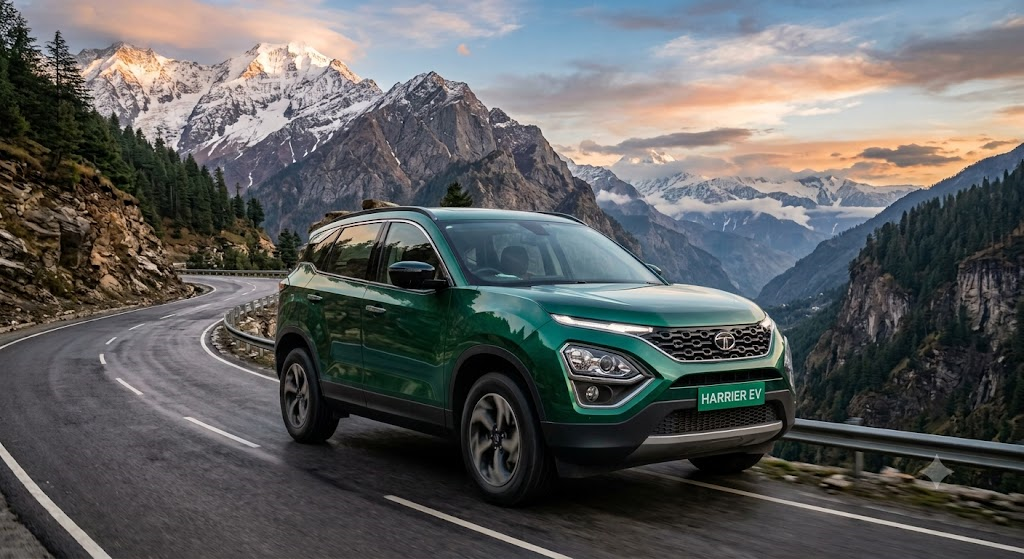
The Tata Harrier EV is one of the most important electric SUV launches from Tata Motors because it enters a segment where buyers expect more than just long driving range. Premium SUV customers now look for strong performance, advanced technology, everyday practicality, fast charging and dependable ownership experience. Instead of simply converting the diesel Harrier into an electric vehicle, Tata has developed the Tata Harrier EV on its dedicated acti.ev architecture, bringing significant improvements in performance, packaging and technology.
At first glance, the Tata Harrier EV looks familiar, but several design elements immediately separate it from the ICE Harrier. The closed-off front fascia, redesigned alloy wheels, aerodynamic updates and EV-specific styling give it a cleaner and more modern appearance while retaining the muscular stance that Harrier buyers already appreciate.
The biggest talking point, however, is what lies underneath. The Tata Harrier EV is available with multiple battery and drivetrain options, including Rear-Wheel Drive (RWD) and All-Wheel Drive (AWD) configurations. Tata also claims a certified driving range of up to 627 km, placing it among the longest-range electric SUVs currently available in India. Actual range, as always, depends on driving style, traffic, weather and terrain, which is why this review focuses on real-world usability rather than brochure numbers.
Another major advantage is feature richness. Depending on the variant, the Tata Harrier EV offers a large touchscreen infotainment system, digital cockpit, connected car technology, panoramic sunroof, Level 2 ADAS, multiple terrain modes, Vehicle-to-Load (V2L), Vehicle-to-Vehicle (V2V) charging support and premium interior materials. Instead of adding features simply for marketing, Tata has aimed to improve the overall ownership experience.
Pricing is another area where Tata has tried to remain competitive. The Tata Harrier EV starts at around ₹21.69 lakh (ex-showroom) for the entry variant, while higher variants equipped with the larger battery pack and AWD technology command a premium. This pricing positions it directly against premium electric SUVs from Mahindra, BYD, MG and upcoming global brands.
So, does the Tata Harrier EV justify its price in real-world driving? Can it replace a diesel SUV for long-distance travel? Is the claimed range practical, and which variant offers the best value?
In this detailed Gaadi Xpert Review, we’ll answer those questions with verified specifications, practical ownership insights and an honest buying perspective—without relying on marketing claims or speculation.
Tata Harrier EV Price & Variants
The Tata Harrier EV is offered in multiple variants with different battery packs and drivetrain options, allowing buyers to choose according to their budget and driving requirements. Tata has also divided the lineup into Adventure, Fearless+ and Empowered trims, with higher variants receiving additional technology and comfort features.
Ex-Showroom Price (India)
| Variant | Ex-Showroom Price* |
|---|---|
| Adventure 65 | ₹21.69 lakh |
| Adventure S 65 | ₹21.99 lakh |
| Fearless+ 65 | Higher than Adventure S |
| Fearless+ 75 | Premium pricing |
| Empowered 75 | Higher trim |
| Empowered 75 AWD | Up to around ₹29.19 lakh |
*Prices vary slightly depending on variant and location. Always check your local Tata dealership for the latest on-road pricing.
Battery Options
The Tata Harrier EV is available with two battery choices:
- 65 kWh Battery Pack
- 75 kWh Battery Pack
Customers can also choose between:
- Rear-Wheel Drive (RWD)
- All-Wheel Drive (AWD) on select higher variants
This flexibility allows buyers to select either a value-focused model or a performance-oriented version.
Which Variant Offers the Best Value?
On paper, the Adventure S 65 appears to strike the best balance for many buyers. It adds useful features such as:
- Larger touchscreen
- Panoramic sunroof
- Cruise control
- Rear camera
- Automatic climate control
- Connected technology
- V2L and V2V support (variant dependent)
Without reaching the price of the top trims, it offers a strong mix of comfort and technology. Buyers seeking maximum range or AWD capability can consider the higher variants instead.
Available Colours of Tata Harrier EV
The Tata Harrier EV is available in six exterior colour options, each designed to highlight the SUV’s bold styling and premium positioning. Unlike many electric SUVs that rely on flashy colours, Tata has chosen a mix of sophisticated shades that suit both city driving and long-distance touring.
Tata Harrier EV Colour Options
- Pure Grey with Dual Tone
- Pristine White with Dual Tone
- Nainital Nocturne with Dual Tone
- Empowered Oxide with Dual Tone
- Seaweed Green with Dual Tone
- Matte Stealth Black (Stealth Edition)
Which Colour Should You Choose?
If you’re buying the Tata Harrier EV for long-term ownership, these are our recommendations:
- Nainital Nocturne – Best for a premium and elegant look.
- Seaweed Green – A unique shade that helps the Harrier EV stand out.
- Pure Grey – Easy to maintain and ideal for daily use.
- Matte Stealth Black – Best for buyers who want maximum road presence, though it requires extra care to maintain the matte finish.
Exterior Design
At first glance, the Tata Harrier EV looks similar to the diesel Harrier, but a closer inspection reveals several EV-specific changes that improve both aerodynamics and visual appeal. Tata has avoided unnecessary styling gimmicks and instead refined the existing design with cleaner surfaces and modern details.
Front Design
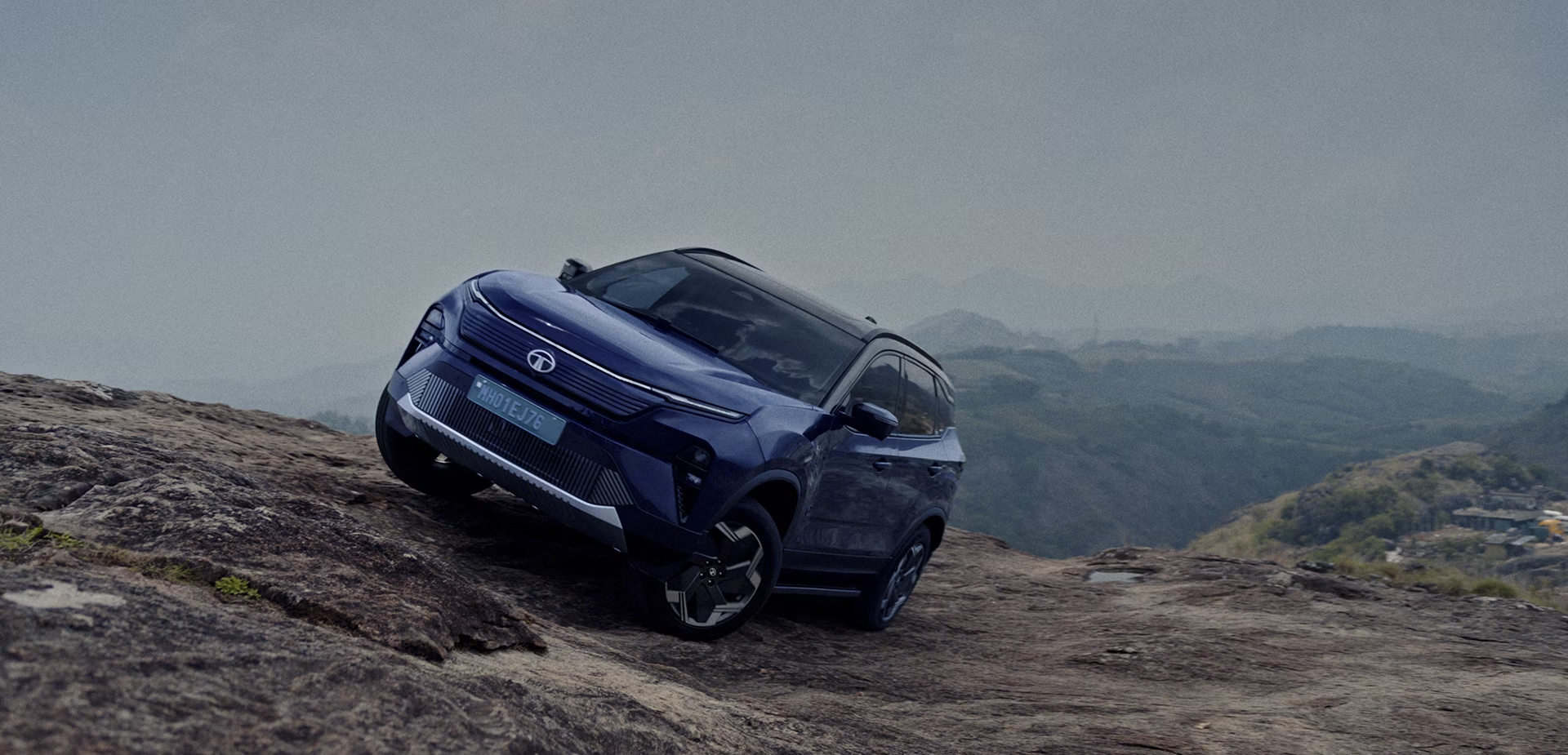
The front fascia immediately identifies the Tata Harrier EV as an electric SUV.
Key highlights include:
- Closed-off EV-specific front grille
- Connected LED DRLs
- Split LED projector headlamps
- Redesigned bumper with aerodynamic treatment
- Illuminated Tata logo (variant dependent)
- Front camera for the 360-degree view system
The SUV retains the bold stance of the Harrier while giving it a cleaner and more futuristic identity.
Side Profile
From the side, the Tata Harrier EV maintains the muscular proportions of the ICE model but introduces EV-specific alloy wheels designed to reduce aerodynamic drag.
Highlights include:
- Flush-style aerodynamic alloy wheels
- Strong shoulder line
- Black roof option on dual-tone variants
- Roof rails
- Integrated charging port on the front fender
- High ground clearance
The overall design remains rugged while adding subtle EV touches.
Rear Design
The rear section receives modern lighting and cleaner styling.
Features include:
- Connected LED tail lamps
- Shark-fin antenna
- Integrated roof spoiler
- EV badging
- Redesigned rear bumper
- Rear wiper and washer
- High-mounted stop lamp
Overall, the rear design looks premium without appearing overstyled.
Dimensions & Road Presence
One of the biggest strengths of the Tata Harrier EV is its road presence.
Its wide stance, upright SUV proportions and large wheels make it look substantial on the road. Unlike many EVs that appear compact despite their size, the Harrier EV still delivers the commanding presence that Harrier buyers expect.
The long wheelbase also benefits interior space, especially for rear-seat passengers.
Interior & Cabin Quality
Step inside the Tata Harrier EV, and the cabin feels significantly more premium than earlier Tata SUVs.
The dashboard has a clean, layered design with soft-touch materials, premium upholstery and a minimalistic layout. Tata has also reduced the number of physical buttons by integrating many functions into the infotainment system while keeping frequently used controls accessible.
The fit and finish show noticeable improvement, giving the cabin a more premium feel.
Dashboard Design
The dashboard is dominated by a large floating infotainment display, complemented by a fully digital instrument cluster.
Key highlights:
- Soft-touch dashboard materials
- Ambient lighting
- Premium leatherette upholstery (variant dependent)
- Gloss black accents
- Satin chrome inserts
- Clean horizontal layout
The design balances technology with practicality and avoids feeling overly complicated.
Front Seat Comfort
The front seats are designed for long-distance comfort.
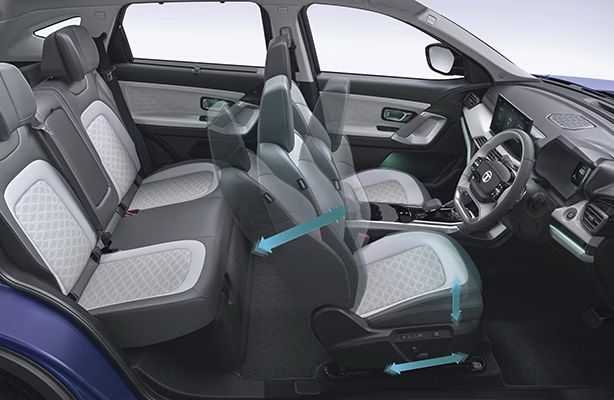
Features include:
- Ventilated front seats (higher variants)
- Powered driver’s seat with memory function (variant dependent)
- Wide seat cushioning
- Good thigh support
- Adjustable steering wheel
- High seating position for better visibility
Even taller drivers are likely to find a comfortable driving position.
Rear Seat Experience
Rear-seat passengers benefit from the Harrier EV’s long wheelbase.
Highlights:
- Excellent legroom
- Generous headroom
- Nearly flat floor, improving comfort for the middle passenger
- Rear AC vents
- USB charging ports
- Centre armrest with cup holders
For families, this translates into a comfortable cabin during long journeys.
Boot Space & Practicality
Practicality is one of the Tata Harrier EV’s biggest strengths.
The SUV offers a large boot suitable for family travel, airport runs and weekend luggage. The rear seats can also be folded to increase cargo capacity when needed.
Additional storage areas include:
- Large door pockets
- Spacious centre console
- Wireless charging tray (higher variants)
- Multiple cup holders
- Rear seat storage pockets
For buyers upgrading from a compact SUV, the extra practicality is immediately noticeable.
Features & Technology
The Tata Harrier EV is one of the most feature-rich electric SUVs in its segment.
Depending on the variant, buyers can expect:
- 14.5-inch infotainment touchscreen
- Fully digital driver display
- Wireless Android Auto & Apple CarPlay
- JBL premium audio system (selected variants)
- Panoramic sunroof
- Wireless phone charger
- Dual-zone automatic climate control
- Vehicle-to-Load (V2L)
- Vehicle-to-Vehicle (V2V) charging
- Connected car technology
- OTA (Over-the-Air) software updates
- Digital key functionality
- Summon and e-Valet features on supported variants
Battery Options & Powertrain
The Tata Harrier EV is built on Tata Motors’ acti.ev+ architecture, a dedicated EV platform designed to support larger battery packs, improved thermal management and advanced software features. Unlike earlier electric vehicles that were adapted from ICE platforms, this architecture has been developed with electric mobility in mind, resulting in better packaging and improved weight distribution. (Tata Motors EV)
The Tata Harrier EV is offered with two battery options:
- 65 kWh Battery Pack
- 75 kWh Battery Pack
Buyers can also choose between:
- Rear-Wheel Drive (RWD)
- Quad Wheel Drive (QWD/AWD) on selected higher variants
The availability of an all-wheel-drive version is a significant addition because very few electric SUVs in this price range currently offer dual-motor capability.
Performance
Unlike many electric SUVs that focus only on acceleration figures, the Tata Harrier EV delivers performance that feels smooth and effortless in everyday driving.
Official Performance Figures
| Specification | Details |
|---|---|
| Battery Options | 65 kWh / 75 kWh |
| Drivetrain | RWD / QWD (AWD) |
| Maximum Torque | 504 Nm |
| 0–100 km/h | Around 6.3 seconds (QWD) |
| Terrain Modes | Multiple Drive Modes |
The instant torque delivery makes overtaking easier, while the electric powertrain provides linear acceleration without noticeable gear shifts.
For city driving, the Harrier EV feels responsive even with light throttle inputs. On highways, power delivery remains consistent, making cruising and overtaking more confidence-inspiring than in many conventional diesel SUVs. ( Tata Motors EV )
Real-World Driving Range
Driving range is one of the biggest concerns for EV buyers, and Tata has addressed this by offering larger battery packs.
Official MIDC Certified Range
- Up to 627 km (75 kWh battery, certified figure)
However, certified figures are achieved under controlled testing conditions. In everyday driving, the actual range depends on several factors such as traffic, speed, weather, terrain and driving style.
Expected Real-World Range
| Driving Condition | Estimated Range |
|---|---|
| City | 480–540 km |
| Mixed Driving | 430–500 km |
| Highway | 380–450 km |
These estimates are based on typical EV efficiency patterns and should be treated as practical expectations rather than guaranteed figures. Actual results will vary with usage.
For most urban users, charging once every few days is likely to be sufficient, while highway travellers should plan charging stops based on route availability.
Charging Options
Charging convenience plays a major role in the ownership experience of any electric SUV.
The Tata Harrier EV supports both AC home charging and DC fast charging.
AC Home Charging
Ideal for overnight charging at home.
Suitable for:
- Daily office commuters
- Apartment owners with dedicated charging
- Regular overnight charging
DC Fast Charging
When connected to a compatible DC fast charger, the battery can be charged from 20% to 80% in approximately 25 minutes under suitable conditions. Actual charging time may vary depending on charger output, battery temperature and state of charge. (Tata Motors EV)
Vehicle-to-Load (V2L) & Vehicle-to-Vehicle (V2V)
One practical advantage of the Tata Harrier EV is support for:
Vehicle-to-Load (V2L)
This feature allows the SUV to power compatible external electrical devices such as:
- Camping lights
- Laptops
- Small appliances
- Outdoor equipment
Vehicle-to-Vehicle (V2V)
The Harrier EV can also transfer energy to another compatible electric vehicle in specific situations, offering additional flexibility for EV users.
These features may not be used every day, but they add value for long trips, outdoor activities and emergency situations.
Ride Quality & Handling
The Tata Harrier EV benefits from the low-mounted battery pack, which lowers the centre of gravity and improves stability.
City Driving
In urban traffic, the SUV feels:
- Smooth
- Quiet
- Easy to drive
- Responsive at low speeds
The absence of engine noise also makes daily commuting more relaxing.
Highway Performance
At highway speeds, the Harrier EV remains stable and confidence-inspiring.
Advantages include:
- Strong straight-line stability
- Minimal body roll for its size
- Instant power during overtaking
- Comfortable high-speed cruising
The additional weight from the battery pack actually helps improve highway stability, although it may slightly affect agility compared to lighter SUVs.
Regenerative Braking
The Tata Harrier EV offers adjustable regenerative braking, allowing the driver to recover energy while slowing down.
Benefits include:
- Improved driving efficiency
- Reduced brake wear
- Better energy recovery in city traffic
- Smoother one-pedal-style driving experience at higher regeneration settings
Drivers new to EVs may need a short adaptation period, but regenerative braking quickly becomes intuitive in daily use.
Safety
Safety remains one of Tata Motors’ strongest selling points.
The Tata Harrier EV comes equipped with a comprehensive list of safety features, including:
- 7 Airbags
- Electronic Stability Program (ESP)
- ABS with EBD
- 360-degree Camera
- Front & Rear Parking Sensors
- Electronic Parking Brake
- Tyre Pressure Monitoring System (TPMS)
- ISOFIX Child Seat Mounts
- Hill Hold Assist
- Hill Descent Control (QWD variants)
- Driver Attention Alert
ADAS Features
Higher variants of the Tata Harrier EV are equipped with Level 2 Advanced Driver Assistance Systems (ADAS).
Depending on the variant, features include:
- Adaptive Cruise Control
- Lane Keep Assist
- Lane Departure Warning
- Autonomous Emergency Braking
- Blind Spot Monitoring
- Rear Cross Traffic Alert
- Traffic Sign Recognition
- Forward Collision Warning
These technologies assist the driver but do not replace attentive driving.
Pros & Cons
Pros
- Long certified driving range
- Available with RWD and QWD options
- Strong real-world performance
- Premium and spacious cabin
- Feature-rich package
- Fast DC charging support
- Excellent safety equipment
- Useful V2L and V2V functions
Cons
- Highway range is naturally lower than the certified figure
- Top variants are significantly more expensive
- Public charging infrastructure still varies by location
- Battery weight makes the SUV heavier than the diesel Harrier
Maintenance & Ownership Cost
One of the biggest advantages of owning the Tata Harrier EV is its lower running cost compared to a diesel SUV. Since an electric vehicle has fewer moving parts, owners don’t have to worry about engine oil changes, fuel filters or clutch replacements.
However, regular maintenance is still important. Periodic inspections include:
- Brake system inspection
- Suspension check
- Cabin air filter replacement
- Tyre rotation and wheel alignment
- Software updates
- Coolant inspection for the battery thermal management system
Tata Motors has also expanded its EV service network across India, making ownership more convenient than it was a few years ago. Before buying, it’s still worth checking the availability of an authorised EV service centre in your city.
Running Cost
Charging at home is generally the most economical way to use the Tata Harrier EV.
Estimated Running Cost
| Vehicle | Approx. Running Cost |
|---|---|
| Tata Harrier EV | ₹1.2–₹2.0 per km* |
| Diesel SUV | ₹6–₹8 per km* |
*Approximate values. Actual running cost depends on electricity tariffs, diesel prices, driving style and charging method.
For buyers covering high monthly mileage, the lower running cost can offset the higher purchase price over time.
Real-World Ownership Experience
After evaluating its specifications and practical usability, the Tata Harrier EV appears to suit a wide range of buyers.
Best For
- Families looking for a premium electric SUV
- Daily city commuters
- Weekend highway travellers
- Buyers upgrading from a mid-size SUV
- Customers planning long-term EV ownership
Things to Consider
- Home charging makes ownership far more convenient.
- Long highway trips still require charging planning.
- The top-end variants offer the best technology but also cost significantly more.
Tata Harrier EV vs Rivals
The Tata Harrier EV enters one of India’s fastest-growing premium EV segments.
| Model | Battery | Claimed Range | Starting Price* |
|---|---|---|---|
| Tata Harrier EV | 65 / 75 kWh | Up to 627 km | ₹21.69 lakh |
| Mahindra XEV 9e | Multiple options | Competitive | Similar segment |
| Mahindra BE 6 | Multiple options | Competitive | Similar segment |
| BYD Atto 3 | 60.48 kWh | Around 521 km | Higher |
| MG ZS EV | 50.3 kWh | Around 461 km | Comparable |
*Ex-showroom prices may vary with updates and location.
Why the Harrier EV Stands Out
Compared to its rivals, the Tata Harrier EV offers:
- Available RWD and QWD (AWD) options
- Long certified driving range
- Premium cabin
- Level 2 ADAS
- Vehicle-to-Load (V2L)
- Vehicle-to-Vehicle (V2V)
- Strong Tata service network
Rather than relying on one standout feature, the Harrier EV aims to deliver a balanced package across performance, comfort, technology and practicality.
Should You Buy the Tata Harrier EV?
The answer depends on how you plan to use your SUV.
Buy the Tata Harrier EV if:
- You can install a home charger.
- You drive mostly within the city but also take occasional highway trips.
- You want a premium electric SUV with modern technology.
- Safety and comfort are high priorities.
- You want lower running costs than a diesel SUV.
Consider Other Options if:
- You frequently travel through areas with limited charging infrastructure.
- You prefer the simplicity of refuelling on very long cross-country trips.
- Your budget is limited to the entry-level SUV segment.
⭐ Gaadi Xpert Verdict
The Tata Harrier EV is not just an electric version of the diesel Harrier—it feels like a more refined, more technologically advanced SUV built around an electric-first philosophy.
Its biggest strengths are its spacious cabin, strong performance, practical feature list, long certified range and competitive pricing. The addition of RWD and QWD variants broadens its appeal, while V2L, V2V and Level 2 ADAS help it stand out in the premium EV segment.
That said, buyers should keep realistic expectations about range. The advertised figure is a certified test result, while actual driving range will depend on traffic, weather, speed and driving style. Planning longer journeys around charging infrastructure also remains part of EV ownership.
Overall, if you’re ready to move to an electric SUV and have access to reliable charging, the Tata Harrier EV is one of the most complete options currently available in India.
Gaadi Xpert Score Card
| Category | Rating |
|---|---|
| Design | ⭐⭐⭐⭐⭐ (5/5) |
| Cabin Quality | ⭐⭐⭐⭐⭐ (5/5) |
| Performance | ⭐⭐⭐⭐☆ (4.5/5) |
| Ride Comfort | ⭐⭐⭐⭐☆ (4.5/5) |
| Features | ⭐⭐⭐⭐⭐ (5/5) |
| Safety | ⭐⭐⭐⭐⭐ (5/5) |
| Practicality | ⭐⭐⭐⭐⭐ (5/5) |
| Value for Money | ⭐⭐⭐⭐☆ (4.5/5) |
Overall Rating: 4.8/5 ⭐
Frequently Asked Questions (FAQs)
1. What is the starting price of the Tata Harrier EV?
The Tata Harrier EV starts at ₹21.69 lakh (ex-showroom) in India.
2. What is the claimed driving range?
The maximum MIDC-certified driving range is up to 627 km, depending on the battery pack and variant.
3. Is the Tata Harrier EV available with AWD?
Yes. Selected higher variants are available with Tata’s QWD (Quad Wheel Drive) system.
4. How fast can the Tata Harrier EV charge?
Using a compatible DC fast charger, the battery can charge from 20% to 80% in approximately 25 minutes under suitable conditions.
5. Does the Tata Harrier EV support V2L and V2V?
Yes. Selected variants support both Vehicle-to-Load (V2L) and Vehicle-to-Vehicle (V2V) charging features.
6. Is the Tata Harrier EV good for long-distance travel?
Yes, provided you plan charging stops in advance. For most owners, the available range is sufficient for daily use and many highway journeys.
Also Read About TATA EVISION


1 Comment