India’s passenger vehicle market has reached a major turning point. In August 2026, CNG, hybrid and electric cars collectively overtook petrol cars in retail sales for the first time ever, according to data from the Federation of Automobile Dealers Associations (FADA).
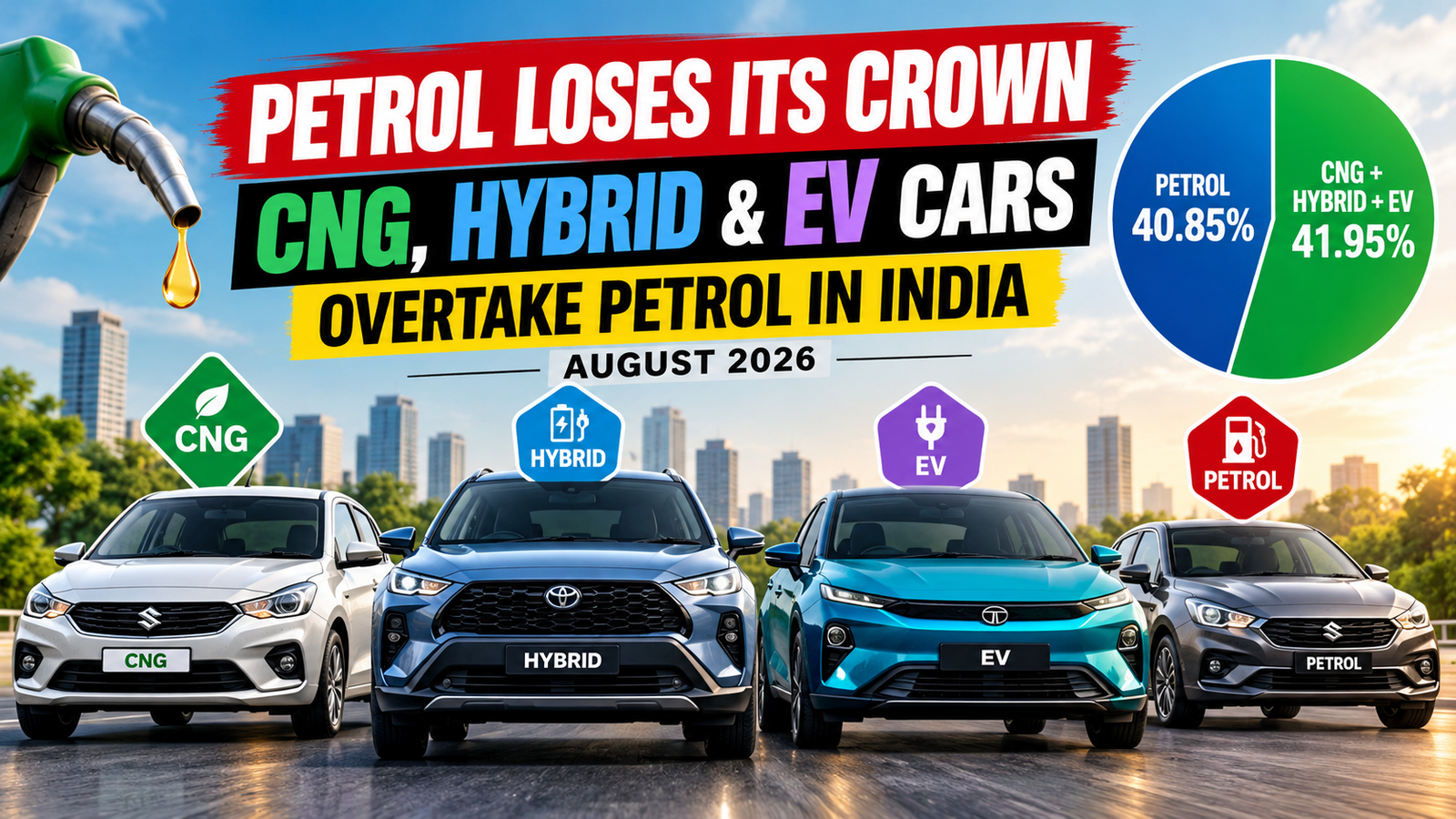
Alternative-fuel passenger vehicles accounted for 41.95% of total passenger vehicle retail sales, while petrol-powered cars held a 40.85% share. Although the difference was relatively small, the milestone is significant because petrol has traditionally dominated India’s car market.
The development shows that Indian buyers are increasingly looking beyond conventional petrol cars. At the same time, factors such as fuel costs, E20-related concerns, better hybrid technology, improving EV ranges and a wider choice of CNG models are changing buying decisions.
Alternative-Fuel Cars Reach 41.95% Share
According to FADA data, India retailed 4,02,398 passenger vehicles in August 2026. Of these, CNG, hybrid and electric vehicles together represented 41.95% of the market.
Petrol vehicles, meanwhile, accounted for 40.85%.
This marks the first time that the combined alternative-fuel category has moved ahead of petrol in India’s passenger vehicle retail market.
The milestone becomes even more important when viewed against the market’s previous trend. Petrol had maintained a sizeable lead over alternative fuels, but the gap has steadily narrowed as manufacturers expanded their CNG, hybrid and EV portfolios.
Why Are Indian Buyers Moving Away From Petrol?
Several factors are contributing to the change.
E20 Petrol Concerns
One of the biggest talking points in the Indian automotive market has been the transition toward E20 petrol, which contains 20% ethanol.
Some owners of older vehicles have raised concerns about fuel economy and compatibility. The government, however, has rejected what it called exaggerated claims surrounding E20 and has defended the ethanol-blending programme.
Nevertheless, uncertainty around fuel efficiency has become one factor influencing some consumers when they consider their next vehicle.
CNG Offers Lower Running Costs
CNG continues to be an important alternative for buyers who want an internal-combustion vehicle but are looking for lower running costs.
Unlike EVs, CNG cars do not require buyers to completely change their refuelling habits. They also provide a familiar driving experience while potentially reducing fuel expenses.
As a result, CNG has become an important bridge between traditional petrol vehicles and fully electric cars.
Hybrid Cars Are Becoming More Attractive
Hybrid vehicles are also playing an increasingly important role.
Modern hybrids can combine a petrol engine with electric assistance to improve efficiency without requiring owners to depend entirely on charging infrastructure.
For buyers who regularly drive long distances, hybrids can therefore offer a compromise between the convenience of petrol and the efficiency benefits of electrification.
EV Choices Are Expanding
Electric cars are another major part of the transition.
Indian consumers now have access to more EV models across different price segments than they did a few years ago. Manufacturers are also offering better driving ranges, while charging infrastructure continues to expand.
Recent registration data shows the momentum in the segment. Electric passenger vehicle registrations rose 50% year-on-year in August 2026 to 30,325 units, according to Vahan data compiled by Nuvama.
India’s Overall Auto Market Also Had a Strong August
The shift in fuel preference happened alongside a strong month for India’s wider automobile market.
FADA reported 24,23,201 total vehicle retail sales in August 2026, representing a 17.51% year-on-year increase and the highest-ever August retail figure.
However, August sales were lower than July on a month-on-month basis. FADA attributed this partly to the seasonal monsoon slowdown and a shift in the festive calendar, with some Ganesh Chaturthi and Onam-related buying activity moving into September.
The combination of strong overall demand and a changing fuel mix makes August particularly important for the Indian automobile industry.
Petrol’s Market Share Falls to a Record Low
The most striking part of the data is not simply that alternative fuels reached 42%.
It is also the decline in petrol’s market share.
Petrol accounted for 40.85% of passenger vehicle retail sales in August, its lowest recorded share according to the reported data.
This does not mean petrol cars are suddenly disappearing from the Indian market. Petrol remains one of the country’s most important automotive fuel types.
Instead, the data indicates that consumers now have more practical alternatives than ever before.
CNG, Hybrid and EVs Could Reshape Future Car Sales
The August milestone could have a major impact on how car manufacturers plan their future portfolios.
Automakers are likely to continue increasing investment in CNG models, strong-hybrid powertrains and EVs because consumer demand is moving in that direction.
For buyers, this means more choices.
A customer looking for low running costs can consider CNG. Someone wanting a conventional ownership experience with better efficiency can look at a hybrid. Buyers ready to move away from petrol completely can choose an EV.
This wider choice is gradually reducing petrol’s dominance.
Rising Oil Prices Could Accelerate the Shift
Fuel economics could become another important factor.
Reuters reported that higher oil prices linked to geopolitical tensions are also supporting interest in alternative-fuel vehicles. When conventional fuel becomes more expensive, buyers naturally pay more attention to vehicles that can reduce their running costs.
Therefore, if fuel prices remain elevated, the demand for CNG, hybrids and EVs could remain strong.
What This Means for India’s Auto Industry
The August 2026 numbers represent more than a single month’s sales trend.
They indicate a structural change in India’s passenger vehicle market.
For years, the typical Indian car-buying decision revolved around petrol and diesel. Today, consumers are increasingly comparing petrol vs CNG vs hybrid vs EV before making a purchase.
Manufacturers will need to respond accordingly.
Companies with strong alternative-fuel portfolios could benefit as this transition continues, while automakers relying heavily on conventional powertrains may face increasing pressure to diversify.
What Happens Next?
The next few months will be crucial.
India is entering the important festive buying season, which traditionally brings stronger demand for passenger vehicles. FADA has also highlighted the importance of monitoring inventory levels as the industry heads into this period.
If CNG, hybrid and EV vehicles continue to maintain a combined share above petrol, August 2026 could eventually be remembered as the month when India’s passenger vehicle market officially entered a new phase.
However, one month’s data should not be treated as proof that petrol has permanently lost its position. The gap between the two categories was only about 1.1 percentage points, so future monthly results will be important.
Gaadi Xpert Verdict
August 2026 is a major milestone for India’s automobile industry.
For the first time, the combined share of CNG + hybrid + EV passenger vehicles reached 41.95%, ahead of petrol at 40.85%.
The change is being supported by several factors, including growing CNG availability, improving hybrid technology, expanding EV choices, better charging infrastructure, fuel-cost concerns and the ongoing debate around E20 petrol.
Petrol cars are certainly not finished. However, their dominance is no longer unquestioned.
The Indian car buyer now has more alternatives—and August 2026 shows that those alternatives are becoming mainstream.