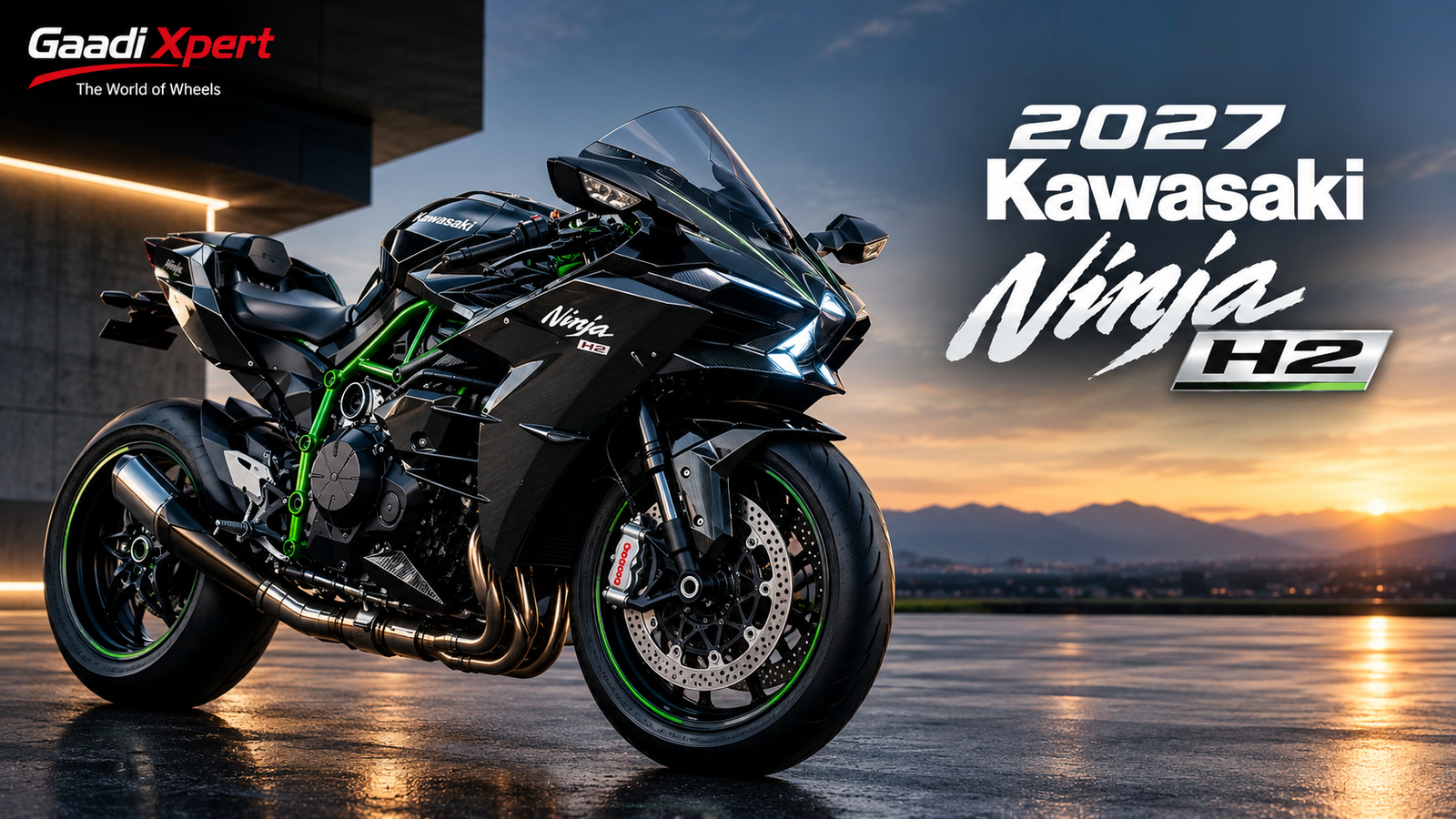
Kawasaki has officially brought back one of the most recognisable supercharged motorcycles in the world with the 2027 Kawasaki Ninja H2. Revealed on September 16, 2026, the new model continues the Ninja H2 name with a substantially revised supercharged engine, updated gearing, new braking hardware and refreshed rider electronics.
Rather than simply carrying over the previous motorcycle, Kawasaki says the 2027 Ninja H2 has received changes to several major engine components, including the intake system, supercharger impeller, pistons, cylinder head, crankshaft, camshafts, throttle bodies and exhaust system.
The result is a motorcycle designed to deliver stronger low- and mid-range torque while retaining the distinctive high-rpm acceleration that has defined the Ninja H2 since its introduction.
For 2027, the Ninja H2 uses a 998cc inline-four-cylinder supercharged engine producing 200 PS at 11,000 rpm and 135 Nm at 8,500 rpm. With Ram Air, Kawasaki lists maximum power at 209 PS.
Here is everything officially confirmed so far.
2027 Kawasaki Ninja H2: What’s New?
The biggest changes are underneath the familiar bodywork.
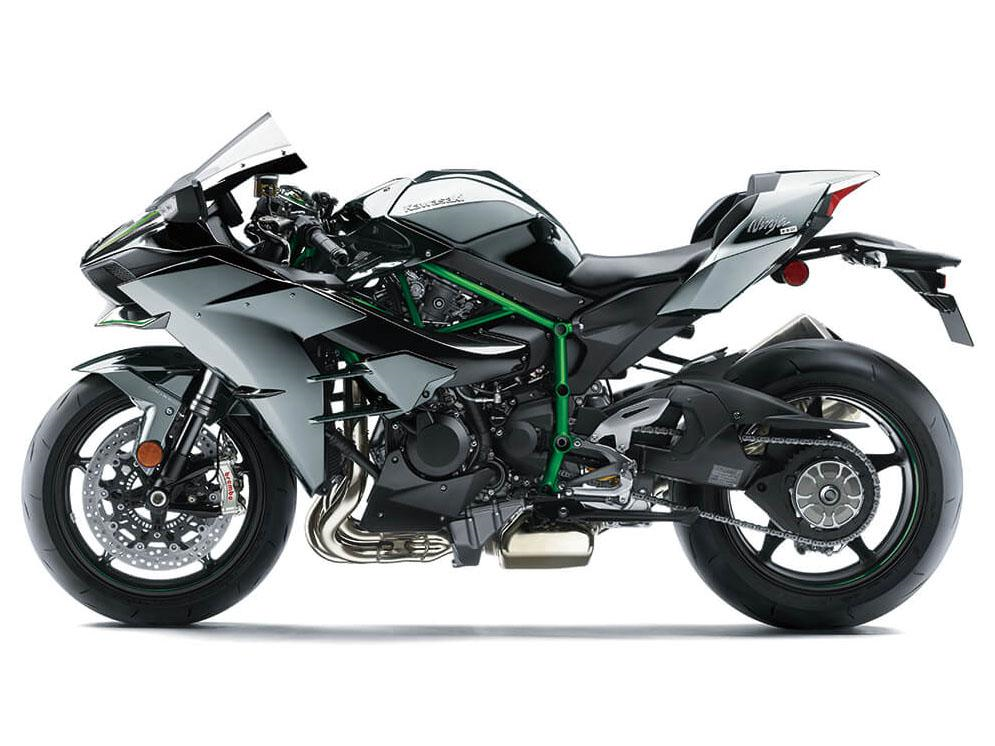
Kawasaki has redesigned the supercharger’s impeller and intake system, while the engine receives new pistons, cylinder head, cylinder, crankshaft and camshafts. The throttle bodies have also been redesigned.
The exhaust system has been revised as well. Kawasaki says the new system uses optimised pipe diameters, a redesigned pre-chamber layout and a compact silencer. Apart from contributing to the engine’s revised characteristics, the lighter exhaust system helps the motorcycle’s overall package.
The transmission gearing has also been revised specifically for the 2027 model.
According to Kawasaki, the changes are intended to improve acceleration in everyday riding while preserving the strong performance of the supercharged engine at higher rpm.
That means the new Ninja H2 is not simply about chasing the biggest peak-power number. Kawasaki’s stated focus is improved torque delivery through the lower and middle parts of the rev range.
2027 Kawasaki Ninja H2 Engine & Performance
At the centre of the motorcycle is Kawasaki’s 998cc liquid-cooled, four-cylinder engine with a supercharger.
The engine uses a DOHC, 16-valve layout with a 76.0 x 55.0 mm bore and stroke and an 11.2:1 compression ratio. Fuel delivery comes through dual-injection fuel injection with four 40mm throttle bodies.
Official performance figures
| Specification | 2027 Kawasaki Ninja H2 |
|---|---|
| Engine | 998cc inline-four supercharged |
| Maximum Power | 200 PS @ 11,000 rpm |
| Ram Air Power | 209 PS @ 11,000 rpm |
| Maximum Torque | 135 Nm @ 8,500 rpm |
| Transmission | 6-speed |
| Final Drive | Chain |
| Fuel Capacity | 17 litres |
| Kerb Mass | 238 kg |
| Seat Height | 825 mm |
These are Kawasaki’s published European specifications.
One interesting point is that the 2027 Ninja H2’s headline power figure is lower than the 240 hp figure listed for the 2026 US-spec Ninja H2. However, the specifications are not directly interchangeable because Kawasaki publishes different market-specific certification and measurement information. The 2027 European model is officially rated at 200 PS, or 209 PS with Ram Air.
So, comparing the numbers without considering market and specification differences can be misleading.
Supercharger Remains the Ninja H2’s Biggest Identity
The supercharger continues to separate the Ninja H2 from conventional litre-class superbikes.
Instead of increasing displacement to achieve its performance targets, Kawasaki uses forced induction to extract high output from a relatively compact 998cc engine.
Kawasaki says the Ninja H2’s supercharged engine was developed with technology and expertise from across the Kawasaki Heavy Industries Group, including aerospace and gas-turbine specialists. The motorcycle also carries Kawasaki’s distinctive River Mark, associated with selected models representing significant engineering heritage.
For the 2027 motorcycle, Kawasaki has focused this technology on stronger torque delivery rather than simply increasing peak output.
2027 Ninja H2 Design
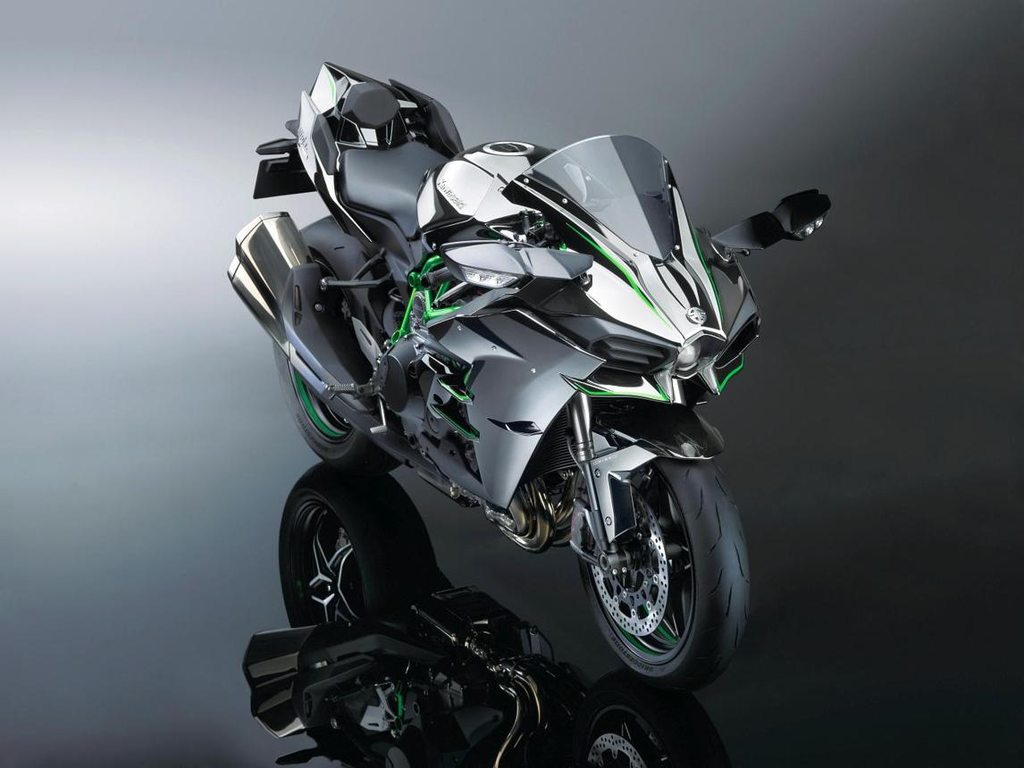
Visually, Kawasaki has retained the aggressive silhouette that makes the Ninja H2 immediately recognisable.
The motorcycle continues with a full-faired hypersport design and Kawasaki’s distinctive supercharged intake arrangement.
The official 2027 European specification lists Mirror Coated Spark Black as the colour for the standard Ninja H2.
The design remains relatively purposeful rather than receiving a completely new visual identity. Kawasaki has instead concentrated much of the development effort on the mechanical and electronic package.
Brembo Hypure Brakes Introduced
One of the most significant chassis updates is at the front.
The 2027 Kawasaki Ninja H2 becomes the first Kawasaki model to use Brembo Hypure front brake calipers, according to Kawasaki.
The new calipers are designed around a lightweight construction, high rigidity and linear braking response. They work with 330mm semi-floating front discs.
At the rear, braking is handled by a 250mm disc.
This is an important upgrade because the Ninja H2 is a heavy and extremely powerful motorcycle. Controlling its speed requires a braking system capable of delivering strong performance while maintaining predictable response.
Suspension & Chassis
The Ninja H2 continues to use Kawasaki’s high-tensile steel trellis frame.
The official specifications list:
- 43mm front fork
- KYB front suspension
- Öhlins TTX36 rear shock
- 120mm front wheel travel
- 135mm rear wheel travel
- 24.5-degree rake
- 103mm trail
- 1,455mm wheelbase
The motorcycle rides on a 120/70 ZR17 front tyre and a massive 200/55 ZR17 rear tyre.
Despite the updates, the official kerb mass remains 238kg.
That figure is important because the Ninja H2 combines a large amount of performance hardware with a substantial chassis and road equipment package.
Updated Electronics Package
The 2027 Ninja H2 also receives an updated electronic package.
Kawasaki lists technologies including:
- Kawasaki Cornering Management Function (KCMF)
- Kawasaki Traction Control (KTRC)
- Kawasaki Launch Control Mode (KLCM)
- Kawasaki Intelligent anti-lock Brake System (KIBS)
- Kawasaki Engine Brake Control (KEBC)
- Kawasaki Quick Shifter (KQS)
- IMU-enhanced chassis orientation awareness
- Öhlins electronic steering damper
- Electronic cruise control
These systems are designed to help manage the motorcycle’s performance across different riding conditions.
The updated instrumentation also gets more functionality.
Kawasaki says the new meter offers two selectable display types. One layout is inspired by the motorcycle’s air-duct silhouette, while the second focuses more strongly on boost information and aviation-inspired lean/attitude displays.
Kawasaki Ninja H2 Dimensions
Despite being built around extreme performance, the Ninja H2 remains a road-going motorcycle.
| Dimension | 2027 Ninja H2 |
|---|---|
| Length | 2,085 mm |
| Width | 770 mm |
| Height | 1,125 mm |
| Wheelbase | 1,455 mm |
| Ground Clearance | 130 mm |
| Seat Height | 825 mm |
| Fuel Tank | 17 litres |
| Kerb Mass | 238 kg |
All figures above are from Kawasaki’s published 2027 European specifications.
The 825mm seat height is relatively manageable on paper for a motorcycle of this size, although the 238kg kerb weight remains an important consideration for low-speed manoeuvring.
Kawasaki Ninja H2 Carbon Also Returns
Alongside the standard Ninja H2, Kawasaki is also bringing back the Ninja H2 Carbon.
The Carbon version uses a carbon-fibre-reinforced plastic upper cowl and is positioned as a more exclusive version of the supercharged flagship.
Kawasaki has confirmed that the Ninja H2 Carbon is part of the 2027 return of the H2 family.
What About the Ninja H2R?
The Ninja H2R continues separately as Kawasaki’s track-only supercharged flagship.
Unlike the road-going Ninja H2, the H2R is designed exclusively for closed-course use and therefore follows a different performance and regulatory approach.
Kawasaki continues to position the H2R above the road-going H2 in terms of outright performance.
The important distinction is simple:
Ninja H2 = road-legal supercharged hypersport
Ninja H2R = track-only extreme-performance machine
The two motorcycles share the H2 engineering philosophy but serve very different purposes.
2027 Kawasaki Ninja H2 Mileage
Mileage is not the main reason someone buys a Ninja H2, but Kawasaki has published an official fuel-consumption figure for the European model.
The 2027 Ninja H2 is listed at approximately 5.9 litres/100km, equivalent to roughly 16.9km/l under the applicable test cycle.
Real-world consumption will naturally depend on riding style, traffic, speed and how frequently the supercharger’s performance is used.
2027 Kawasaki Ninja H2 Price
At the time of Kawasaki’s September 16, 2026 announcement, India-specific pricing has not been officially announced.
Therefore, it would not be reliable to publish a fixed India price as confirmed information.
The same applies to an India launch date.
For now, the safest position is:
Global model: Officially confirmed
2027 model: Officially confirmed
India launch: Not officially confirmed
India price: Not officially announced
This distinction is important for an accurate automotive news report.
2027 Kawasaki Ninja H2 : What Makes It Different?
The biggest attraction of the 2027 Kawasaki Ninja H2 is not just its power figure.
It is the combination of:
998cc inline-four engine + supercharger + revised engine internals + revised gearing + 209 PS Ram Air output + premium suspension + Brembo Hypure brakes + advanced electronics.
Kawasaki has essentially retained the core H2 formula while updating the motorcycle around today’s requirements.
The manufacturer itself describes the new model as an evolution of its supercharged flagship rather than a completely new-generation motorcycle.
2027 Kawasaki Ninja H2 : Pros & Cons
Pros
- Unique supercharged 998cc inline-four engine
- 209 PS maximum power with Ram Air
- 135 Nm peak torque
- Strong low- and mid-range torque focus
- Brembo Hypure front calipers
- Öhlins rear suspension
- Advanced electronic rider aids
- Distinctive Ninja H2 design
- 17-litre fuel tank
- Carbon version also available
Cons
- 238kg kerb weight
- Extremely high-performance motorcycle
- High running and ownership costs can be expected
- India availability is not confirmed
- India pricing is not yet official
- Not designed as an everyday commuter motorcycle
2027 Kawasaki Ninja H2 : Gaadi Xpert Verdict
The 2027 Kawasaki Ninja H2 is not a completely new motorcycle, but Kawasaki has made enough mechanical and electronic changes to give the supercharged flagship a meaningful update.
The biggest story is actually the change in philosophy. Instead of chasing a larger peak-power figure, Kawasaki has concentrated on stronger mid-range torque, revised gearing and a more refined power delivery.
The 998cc supercharged inline-four now produces 200 PS, rising to 209 PS with Ram Air, while peak torque reaches 135 Nm at 8,500 rpm. Combined with Brembo Hypure brakes, KYB suspension, Öhlins hardware and a sophisticated electronics package, the 2027 Ninja H2 remains one of Kawasaki’s most technically distinctive road motorcycles.
For Indian buyers, however, the key question remains availability. Kawasaki has not officially announced an India launch date or India price for the 2027 Ninja H2 yet.
Until Kawasaki India makes that announcement, those details should be treated as unconfirmed rather than reported as official.
2027 Kawasaki Ninja H2 FAQs
Is the 2027 Kawasaki Ninja H2 officially launched?
Kawasaki officially announced the 2027 Ninja H2 on September 16, 2026, as part of the return of the supercharged H2 series.
What engine does the 2027 Ninja H2 use?
It uses a 998cc liquid-cooled inline-four-cylinder engine with a supercharger.
How much power does the 2027 Kawasaki Ninja H2 produce?
It produces 200 PS at 11,000 rpm, while Kawasaki lists 209 PS at 11,000 rpm with Ram Air.
What is the torque of the 2027 Ninja H2?
Maximum torque is 135 Nm at 8,500 rpm.
Does the 2027 Ninja H2 get new brakes?
Yes. It becomes the first Kawasaki model to use Brembo Hypure front brake calipers.
Is the 2027 Ninja H2 coming to India?
Kawasaki has not officially confirmed an India launch date or India-specific pricing at the time of writing.