Volkswagen Biggest Crisis : For decades, Volkswagen has been a symbol of German engineering, trusted by millions of drivers across the world. From the iconic Golf and Passat to modern SUVs and electric vehicles, the brand has built a reputation for quality, innovation, and reliability. As one of the world’s largest automobile manufacturers, Volkswagen has played a major role in shaping the global automotive industry.
But in 2026, the conversation has changed dramatically.
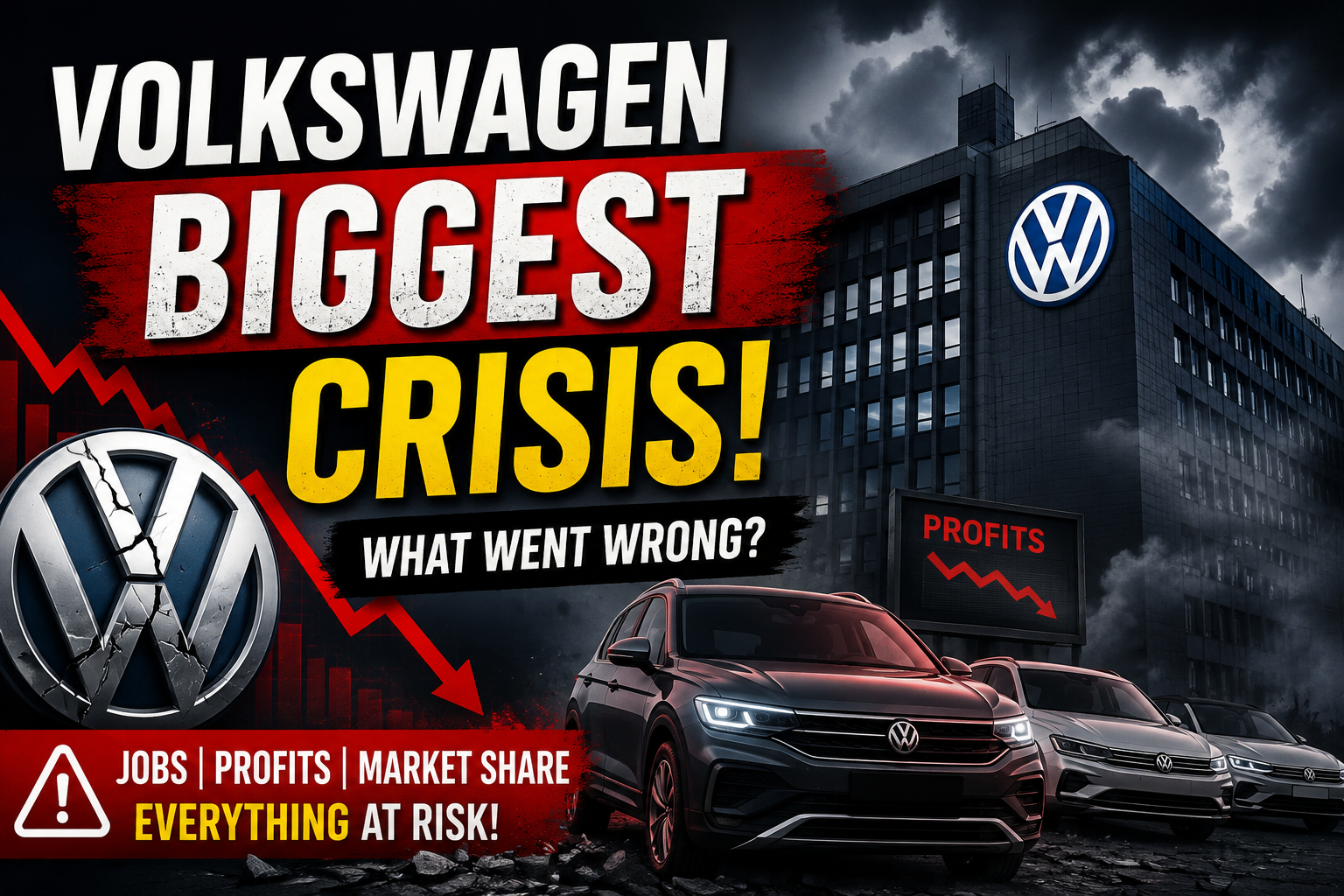
Instead of making headlines for a new car launch or breakthrough technology, Volkswagen is now facing one of the biggest crises in its history. The company has announced a major restructuring plan that includes reducing costs, simplifying its vehicle lineup, reviewing production capacity, and improving overall efficiency. These decisions come at a time when the global automotive market is changing faster than ever before.
So, what pushed one of the world’s biggest car manufacturers into this position?
The answer lies in a combination of challenges that have been building over the past few years. Rising competition from fast-growing Chinese automakers, massive investments in electric vehicles, increasing manufacturing costs in Europe, changing customer demand, and intense global market pressure have all affected Volkswagen’s business. Together, these factors have forced the company to rethink its long-term strategy.
Rather than treating these issues as short-term setbacks, Volkswagen has chosen to respond with a large-scale transformation aimed at making the company stronger and more competitive in the years ahead. According to the company’s recent announcements, the restructuring plan is designed to improve profitability, reduce unnecessary costs, and focus resources on future technologies and high-demand products.
The news has attracted attention far beyond Europe. Customers, investors, industry experts, and automobile enthusiasts around the world are closely watching Volkswagen’s next move. In India, many people are also asking whether these global developments could influence Volkswagen’s future product launches, investments, or long-term plans in the country.
The Volkswagen Biggest Crisis has become one of the most discussed stories in the global automotive industry. Experts believe the Volkswagen Biggest Crisis is the result of several long-term challenges rather than a single event.
Key Highlights
- Volkswagen has announced one of the biggest restructuring plans in its history.
- The company aims to reduce costs, streamline operations, and improve long-term profitability.
- Growing competition, especially in the electric vehicle market, has increased pressure on the German automaker.
- The restructuring is part of Volkswagen’s strategy to remain competitive in a rapidly evolving global automotive industry.
- There is currently no official indication that Volkswagen will exit the Indian market, but global changes could influence future product planning.
In this detailed Gaadi Xpert report, we’ll explain what is happening inside Volkswagen, the biggest reasons behind the company’s current challenges, what this means for the future of the brand, and whether Indian customers should be concerned. { volkswagen biggest crisis }
Why Is Volkswagen Facing Its Biggest Crisis in 2026?
Volkswagen’s current situation is not the result of a single mistake or one unsuccessful vehicle. Instead, it is the outcome of several global challenges that have developed over the past few years. From rising competition in China to increasing production costs in Europe, the company is now under pressure from multiple directions.
Here are the six biggest reasons behind Volkswagen’s restructuring plan. [ volkswagen biggest crisis ]
1. Chinese EV Brands Are Growing Faster Than Ever
For many years, China was Volkswagen’s most important market. The company enjoyed strong sales and built a loyal customer base across the country.
However, the market has changed rapidly. Domestic manufacturers such as BYD, Geely, XPeng, Li Auto, and Xiaomi have introduced new electric vehicles with advanced technology, competitive pricing, and faster product updates. As a result, many customers are choosing local brands over traditional global manufacturers.
This shift has reduced Volkswagen’s market share in China, making it harder for the company to maintain the growth it once enjoyed.
2. The Shift to Electric Vehicles Has Become More Expensive
Like many global automakers, Volkswagen has invested billions of euros to develop electric vehicles, battery technology, software platforms, and future mobility solutions.
While electric vehicles continue to grow worldwide, demand has been uneven across different regions. In some markets, customers are still choosing petrol, diesel, or hybrid vehicles due to concerns about charging infrastructure, affordability, and ownership costs.
This means Volkswagen must continue investing heavily in future technology while managing slower returns on those investments in certain markets.
3. Rising Manufacturing Costs in Europe
Building vehicles in Europe has become significantly more expensive over the last few years.
Higher labour costs, increased energy prices, stricter environmental regulations, and supply chain challenges have all pushed manufacturing expenses upward. These rising costs directly affect profitability, especially when competition is forcing automakers to keep vehicle prices competitive.
To improve efficiency, Volkswagen is reviewing its global production network and looking for ways to reduce unnecessary expenses.
The Volkswagen Biggest Crisis cannot be linked to one issue alone. Rising costs, intense competition, and changing customer preferences have all contributed to the Volkswagen Biggest Crisis in 2026.
4. Too Many Models, Higher Costs
Volkswagen offers a wide range of hatchbacks, sedans, SUVs, electric vehicles, and performance models across different international markets.
Although a broad portfolio gives customers more choice, it also increases development, manufacturing, marketing, and maintenance costs. Managing dozens of models requires significant investment every year.
The company now plans to simplify its lineup by focusing more on high-demand and profitable vehicles while reducing complexity across its global portfolio.
5. Global Competition Has Become Stronger
The automotive industry is becoming more competitive than ever before.
Traditional manufacturers are competing not only with each other but also with fast-growing electric vehicle startups and technology-focused companies. Brands from China are expanding into international markets with feature-rich vehicles offered at aggressive prices, creating additional pressure on established automakers like Volkswagen.
To remain competitive, Volkswagen must innovate faster while carefully controlling costs.
6. Profitability Has Become a Top Priority
Despite remaining one of the world’s largest automobile manufacturers, Volkswagen is now placing greater focus on improving profitability rather than simply increasing sales volume.
The company’s restructuring plan aims to reduce operating costs, improve efficiency, simplify business operations, and strengthen long-term financial performance. Instead of reacting only to today’s challenges, Volkswagen is preparing itself for an automotive industry that will increasingly depend on electrification, software, digital services, and intelligent manufacturing.
The Bigger Picture
Volkswagen’s biggest crisis in 2026 is not about the company disappearing from the automotive industry. Instead, it reflects how quickly the global car market is changing.
Manufacturers that were once market leaders are now being challenged by new technologies, changing customer expectations, and rapidly growing competitors. Volkswagen’s restructuring is an attempt to adapt to this new reality and secure its position for the future.
Although the Volkswagen Biggest Crisis is a global issue, Indian customers are naturally wondering whether it will affect Volkswagen India’s future plans.
What Does Volkswagen Biggest Crisis Mean for India?
After reports of Volkswagen’s global restructuring plan, many Indian car buyers have started asking the same question:
Will Volkswagen leave India?
Based on the information available so far, the answer is No.
At the time of writing, Volkswagen has not announced any plans to exit the Indian market. The company’s restructuring strategy is focused on improving its global business by reducing costs, increasing efficiency, and strengthening long-term profitability. There has been no official statement suggesting that Volkswagen India will shut down its operations or stop selling vehicles in the country.
Is Volkswagen India Safe?
Volkswagen continues to operate in India through its existing dealer network, service centres, and product portfolio. Models such as the Virtus, Taigun, and Tiguan remain an important part of the brand’s presence in the Indian market.
In recent years, Volkswagen has also invested in India under its India 2.0 strategy, developing products specifically for Indian customers and strengthening its local manufacturing operations. This shows that India remains an important market in Volkswagen’s long-term global plans.
While global restructuring may influence how future investments are prioritised, there is currently no official indication that customer support, after-sales service, or existing vehicle ownership in India will be affected.
Could Future Car Launches Change?
Large global restructuring programmes often lead companies to review their future product plans.
This does not necessarily mean that upcoming Volkswagen models will be cancelled in India. However, the company may become more selective about which global products are introduced into different markets. Future launches, production decisions, and investment priorities could evolve as Volkswagen focuses on improving efficiency worldwide.
Until the company makes official announcements, any specific claims about future Indian launches should be treated as speculation.
Should Existing Volkswagen Owners Be Worried?
For current Volkswagen owners, there is no immediate reason for concern.
Routine servicing, warranty support, spare parts availability, and dealership operations are expected to continue as normal unless Volkswagen announces otherwise. Existing customers should continue following official updates from Volkswagen India rather than relying on rumours circulating on social media.
What Should Buyers Planning to Purchase a Volkswagen Do?
If you are considering buying a Volkswagen vehicle, the company’s global restructuring should not automatically discourage your decision.
Instead, buyers should evaluate the same factors they normally would:
- Vehicle safety ratings
- Features and technology
- Engine performance
- After-sales service in their city
- Maintenance costs
- Overall value for money
Volkswagen continues to manufacture well-engineered vehicles, and its current restructuring is aimed at making the company more competitive over the long term rather than reducing product quality.
Gaadi Xpert Analysis
Volkswagen’s biggest challenge today is not India’s market—it is the rapidly changing global automotive industry.
For Indian customers, the situation should be viewed as a business transformation rather than a warning sign. Unless Volkswagen officially announces changes to its India strategy, buyers and existing owners have no reason to assume that the brand is leaving the country or discontinuing support.
As always, the best approach is to rely on official company announcements instead of online rumours. We’ll continue to monitor Volkswagen’s global developments and provide verified updates as new information becomes available.
Can Volkswagen Recover from Its Biggest Crisis?
The answer is yes—but it won’t be easy.
Volkswagen remains one of the world’s largest automobile manufacturers with a strong global presence, decades of engineering expertise, and a diverse portfolio of passenger cars, luxury vehicles, and commercial vehicles. These strengths give the company a solid foundation to adapt to changing market conditions.
However, the road ahead will require difficult decisions.
The company must successfully balance several priorities at the same time. It needs to strengthen its position in the electric vehicle market, improve software development, reduce production costs, simplify its product lineup, and compete with fast-growing Chinese manufacturers that are introducing new models at a rapid pace.
If Volkswagen executes its restructuring strategy effectively, the company could emerge stronger, more efficient, and better prepared for the next generation of mobility. If not, competition in the global automotive industry is likely to become even more intense.
One thing is clear—2026 could become a defining year in Volkswagen’s long history.
Gaadi Xpert Verdict
Volkswagen biggest crisis is not the end of the company. Instead, it marks the beginning of a major transformation.
The global automotive industry is changing rapidly. Electrification, software-defined vehicles, artificial intelligence, connected technology, and increasing competition are reshaping how manufacturers build and sell cars. Even established brands must adapt to remain competitive.
Volkswagen’s restructuring plan reflects this changing reality. While reducing costs and reviewing operations may sound concerning, these steps are part of a broader effort to secure the company’s future rather than simply respond to short-term challenges.
For Indian customers, there is currently no official reason to panic. Volkswagen India continues to operate normally, and there has been no announcement suggesting an exit from the market. Buyers should continue to evaluate Volkswagen vehicles based on their safety, quality, features, ownership experience, and official updates—not on speculation.
At Gaadi Xpert, we believe Volkswagen still has the resources, technology, and brand value to recover. The company’s success, however, will depend on how quickly it adapts to a rapidly evolving global automotive landscape.
Our analysis shows that the Volkswagen Biggest Crisis should be viewed as a major business transformation instead of the downfall of the company. How Volkswagen responds to the Volkswagen Biggest Crisis will shape its future over the next decade.
Also Read About New Launch VOLKSWAGEN TAYRON
Frequently Asked Questions (FAQs)
Why is Volkswagen facing a crisis in 2026?
Volkswagen is facing major challenges due to rising competition in China, high manufacturing costs, heavy investment in electric vehicles, changing customer demand, and the need to improve long-term profitability. These factors have led the company to announce a large-scale restructuring plan.
Is Volkswagen leaving India?
No. At the time of writing, Volkswagen has not announced any plans to exit the Indian market. Its dealerships, service network, and current vehicle lineup continue to operate as usual.
Will Volkswagen stop making cars?
No. Volkswagen continues to manufacture and sell vehicles across multiple global markets. The restructuring focuses on improving efficiency and reducing costs, not ending vehicle production.
Will Volkswagen biggest crisis affect existing owners?
There is currently no official indication that existing Volkswagen owners in India will be affected. Warranty coverage, servicing, and spare parts support continue through the company’s authorised dealer network.
Can Volkswagen recover from this situation?
Yes. Volkswagen has significant financial resources, global manufacturing capabilities, and strong engineering expertise. If the company successfully implements its restructuring strategy and adapts to changing market trends, it has the potential to strengthen its position over the coming years.
Final Thoughts
The Volkswagen Biggest Crisis is more than just a business headline—it reflects how quickly the global automotive industry is evolving. Companies that once dominated the market are now being challenged by new technologies, changing consumer expectations, and aggressive competition from emerging automakers.
Volkswagen’s response over the next few years will be closely watched by customers, investors, and the entire automotive industry. Whether the company turns this challenge into a success story will depend on the decisions it makes today.
For the latest automotive news, launch updates, expert analysis, and unbiased reviews, stay connected with Gaadi Xpert.
The Volkswagen Biggest Crisis marks one of the most important moments in the company’s history. Whether the Volkswagen Biggest Crisis becomes a success story or a long-term challenge will depend on how effectively the company executes its restructuring strategy.
Also Read VOLKSWAGEN Newsroom for volkswagen biggest crisis.