Self-Driving Mahindra Thar : A modified Mahindra Thar has attracted attention for its ability to navigate challenging roads without a human driver controlling the vehicle in the conventional way. The latest demonstration highlights a particularly interesting situation: what happens when an autonomous vehicle encounters oncoming traffic on a narrow road with limited space to move forward?
The demonstration involves Swaayatt Robots, an Indian autonomous-driving technology company based in Bhopal. Its experiments use a modified Mahindra Thar to showcase the capabilities of its self-driving system in demanding road conditions.
The development highlights India’s growing interest in autonomous mobility. However, the demonstration does not mean that Mahindra has launched a self-driving Thar for customers.
Self-Driving Mahindra Thar Demonstration: What Happened?
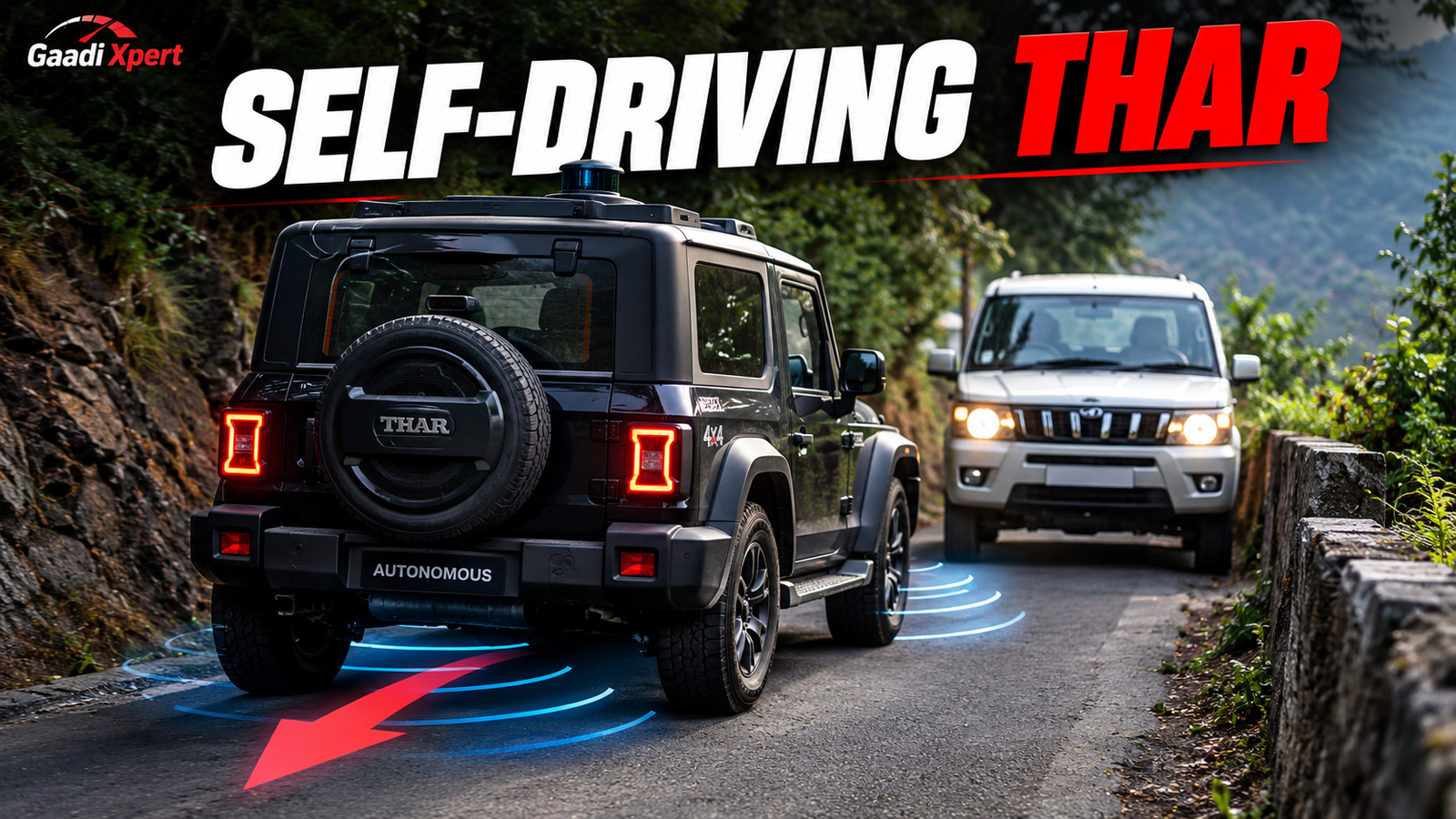
A video shared on October 17, 2026, reportedly shows an autonomous Mahindra Thar reversing on a narrow, single-lane road after encountering a blockage caused by oncoming traffic.
Instead of simply continuing forward, the vehicle demonstrates the ability to respond to the situation and move backwards to manage the obstruction. This type of manoeuvre matters because narrow Indian roads often leave drivers with limited room when vehicles approach from opposite directions.
The demonstration focuses on the decision-making involved in autonomous driving. A vehicle must recognise its surroundings, understand the available space and determine an appropriate movement rather than follow a fixed route blindly.
According to the report, the video was shared by Sanjeev Sharma on X. Swaayatt Robots has also published demonstrations of its autonomous-driving technology on its official website.
These videos offer a glimpse into the company’s research, although they do not independently establish that the system can handle every road condition safely.
Who Developed the Self-Driving Technology?
Swaayatt Robots is an Indian technology company working on autonomous driving. Based in Bhopal, Madhya Pradesh, the company develops systems designed to help vehicles navigate complex and unpredictable environments.
Its work focuses on autonomous navigation, obstacle avoidance and decision-making in situations where vehicles must respond to changing surroundings.
The company has showcased autonomous driving in different environments, including off-road conditions and traffic scenarios involving other vehicles.
Using a Mahindra Thar as a demonstration vehicle gives the company a platform for testing its technology on roads and terrain that can present difficult navigation challenges.
It is important to distinguish the technology developer from the vehicle manufacturer. Mahindra provides the Thar platform, while the reported autonomous-driving experiments involve Swaayatt Robots’ technology.
How Does an Autonomous Mahindra Thar Work?
An autonomous vehicle must perform several tasks simultaneously. It needs to understand its surroundings, estimate the position of nearby objects and select movements that allow it to navigate safely.
The modified Thar shown in autonomous-driving demonstrations uses specialised hardware and software rather than relying only on the SUV’s standard driving systems.
1. Environmental perception
Autonomous vehicles use sensors and onboard computing systems to collect information about their surroundings. Depending on the vehicle and its configuration, these systems can include cameras, radar, lidar or other sensing technologies.
They help the vehicle identify road boundaries, obstacles and nearby traffic.
2. Path planning
Once the system understands its surroundings, it must decide where the vehicle can travel.
On a narrow road, this becomes particularly important because the vehicle may not have enough space to pass another vehicle safely.
3. Decision-making
The system must evaluate possible actions, such as stopping, moving forward or reversing.
The latest reported Thar demonstration is particularly interesting because reversing in response to a road blockage requires the vehicle to react to a changing situation instead of simply following a predetermined path.
4. Vehicle control
After selecting an action, the system must translate its decision into vehicle movements.
Steering, acceleration and braking must work together to execute the manoeuvre. The vehicle also needs to account for surrounding obstacles and the space available for movement.
The exact hardware configuration and technical specifications of the demonstrated Thar have not been fully established by the available reporting.
Why Is This Demonstration Important for Indian Roads?
Indian roads present a different set of challenges from carefully mapped highways or controlled testing environments.
Narrow streets, inconsistent lane markings, parked vehicles, pedestrians, two-wheelers and unexpected obstacles can make autonomous navigation difficult.
A vehicle that can recognise a blockage and reverse appropriately could demonstrate progress towards handling some of these situations.
However, a single demonstration cannot establish how reliably the system would perform across different locations, weather conditions, traffic densities and road surfaces.
Autonomous-driving technology must undergo extensive testing before developers can establish its reliability in everyday use.
Does This Mean the Mahindra Thar Is Fully Self-Driving?
No. The demonstration should not be confused with a production-ready, fully autonomous SUV available for purchase.
Swaayatt Robots has showcased technology it describes in terms of advanced autonomous-driving capabilities, including Level 5 demonstrations. However, a company’s description of its technology and the performance of a particular test vehicle do not, by themselves, establish that the vehicle meets every requirement for unrestricted Level 5 operation.
Under the SAE driving automation framework, Level 5 represents full driving automation within the framework’s intended scope. It differs significantly from driver-assistance systems that require a human to supervise driving.
The reported demonstration also does not confirm that Mahindra plans to offer the same technology in its showroom models.
For now, the development is best understood as a demonstration of autonomous-driving research using a modified Thar.
Will a Self-Driving Mahindra Thar Launch in India?
There is no confirmed customer launch date or production plan for a factory-fitted self-driving Mahindra Thar established by the reports discussed here.
The demonstration does not provide confirmed information about pricing, commercial availability, a production version or a timeline for public-road deployment.
Bringing autonomous-driving technology to customers would require further development, validation, safety testing and compliance with applicable regulations.
Manufacturers and technology developers must also address difficult questions about responsibility, system reliability and how a vehicle should respond when it encounters situations its software cannot confidently handle.
Therefore, buyers should not interpret the demonstration as confirmation that a self-driving Thar will arrive in showrooms soon.
What Does This Mean for India’s Automotive Industry?
The demonstration highlights the work Indian technology companies are undertaking in an increasingly important area of automotive development.
Autonomous driving requires expertise in software, sensors, computing, robotics and vehicle engineering. Progress in these fields could create opportunities for domestic research and technology development.
It could also support future applications in logistics, controlled industrial environments, specialised mobility and other settings where automated vehicle movement may offer practical benefits.
Nevertheless, moving from a successful demonstration to a commercially deployable system remains a substantial challenge.
Developers must show that their technology can handle unpredictable situations consistently, not just perform selected manoeuvres during testing.
Final Verdict
The self-driving Mahindra Thar demonstration is an interesting development in India’s autonomous-driving research. Its reported ability to reverse when a narrow road becomes blocked highlights the importance of real-time decision-making in complex driving environments.
Swaayatt Robots is the technology developer associated with these demonstrations, while the Thar serves as the test vehicle.
The next major milestone will be demonstrating consistent performance across a wider range of road conditions, followed by the safety validation and regulatory work needed for real-world deployment.
For now, this is a promising technology demonstration—not a confirmed launch of a fully self-driving Mahindra SUV.