

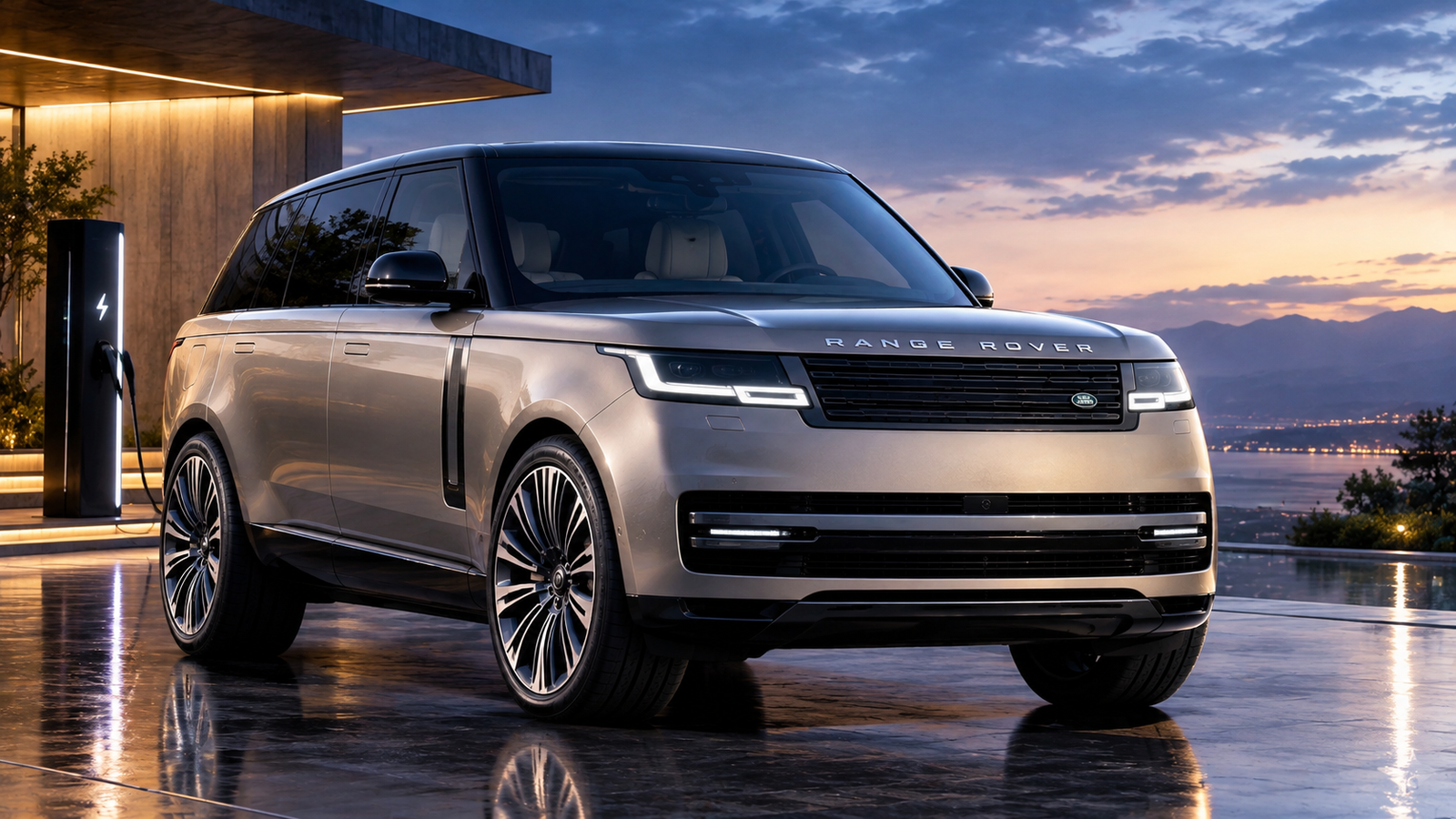
The Range Rover Electric 2026 has officially arrived as the first fully electric version of the iconic Range Rover SUV. Revealed globally on September 2, 2026, the new luxury electric SUV combines the familiar Range Rover design with a completely electric powertrain, advanced 800V charging technology and serious off-road capability.
Unlike many new electric SUVs that adopt a completely different design language, the Range Rover Electric stays close to the traditional Range Rover formula. It focuses on luxury, comfort, refinement and all-terrain capability while replacing the conventional petrol and diesel powertrains with electric motors.
The new model offers a claimed WLTP range of up to 600 km, an estimated real-world range of up to 535 km, and fast charging from 10 to 80 percent in around 22 minutes when connected to a suitable 350kW DC charger.
Interestingly, the Range Rover Electric has also opened bookings in India. However, its final Indian price has not yet been announced. The SUV will be imported into India, making it a highly exclusive electric luxury SUV for the Indian market.
Range Rover Electric 2026 Launch and Price
The Range Rover Electric was officially revealed on September 2, 2026, marking an important milestone for Jaguar Land Rover’s electrification strategy.
In the UK, the new electric Range Rover starts at £154,070. Higher specifications and personalization options can push the price substantially higher.
For India, JLR has opened bookings, but the company has not yet announced the final ex-showroom price. Therefore, any unofficial estimate should not be treated as the confirmed Range Rover Electric price in India.
Range Rover Electric Price Overview
| Market | Price/Status |
|---|---|
| UK | From £154,070 |
| India | Bookings open; price not officially announced |
| Production | Solihull, UK |
| Powertrain | Fully electric |
| Battery | 118.5 kWh |
| Range | Up to 600 km WLTP |
The UK starting price makes the Range Rover Electric significantly more expensive than mainstream premium EVs. However, the SUV is positioned in a completely different luxury segment.
Range Rover Electric Battery and Powertrain
At the heart of the new Range Rover Electric is a 118.5 kWh lithium-ion battery pack. The battery uses a double-stack configuration with 344 Nickel Manganese Cobalt cells.
Power comes from twin 260 kW permanent-magnet electric motors, giving the SUV all-wheel drive and a combined output of around 550 PS and 850 Nm.
The enormous torque figure is particularly important for an SUV designed to maintain Range Rover’s off-road character.
The electric motors can deliver torque extremely quickly, while Range Rover’s Intelligent Torque Management system continuously adjusts torque delivery according to the driving surface. The system can respond within milliseconds, helping improve traction on difficult terrain.
Range Rover Electric Performance
The Range Rover Electric can accelerate from 0-60 mph in 4.3 seconds, while the 0-100 km/h figure is around 4.5 seconds.
That is impressive considering the SUV’s size and luxury-focused character.
| Performance | Range Rover Electric |
|---|---|
| Power | Up to 550 PS |
| Torque | 850 Nm |
| Drive | AWD |
| 0-60 mph | 4.3 seconds |
| 0-100 km/h | Around 4.5 seconds |
| Battery | 118.5 kWh |
| Range | Up to 600 km WLTP |
Range Rover Electric Range
Range is one of the biggest talking points of the new electric Range Rover.
According to Range Rover’s official figures, the SUV can travel up to 600 km on a single charge under the WLTP cycle. However, the company’s website also lists an estimated real-world range of up to 535 km.
This difference is important because real-world EV range can change depending on driving speed, temperature, road conditions, terrain, passenger load and use of the climate-control system.
For long-distance driving, the 535 km estimated real-world figure is more useful as a practical reference than simply looking at the maximum WLTP number.
Range Rover Electric Charging Time
The Range Rover Electric uses an advanced 800V electrical architecture.
With a compatible 350 kW DC fast charger, the SUV can charge from 10 to 80 percent in approximately 22 minutes. Range Rover also claims that up to 220 km of WLTP range can be added in around 10 minutes under suitable charging conditions.
For home charging, the SUV supports 22 kW AC charging. A 0-100 percent charge can take less than seven hours with a 22 kW charger, while a 7 kW charger can take around 19 hours.
Range Rover Electric Charging Summary
- Battery: 118.5 kWh
- Architecture: 800V
- Maximum DC charging: 350 kW
- 10-80% DC charging: Around 22 minutes
- 10-minute fast charge: Up to 220 km WLTP range
- 22 kW AC charging: Less than 7 hours
- 7 kW AC charging: Around 19 hours
Therefore, the Range Rover Electric is not only about having a large battery. Its high-voltage architecture also allows considerably faster charging when the right charging infrastructure is available.
Range Rover Electric Exterior Design
One of the most interesting aspects of the new Range Rover Electric is that it does not look dramatically different from the conventional Range Rover.
The overall silhouette remains instantly recognisable. The SUV retains the upright stance, long bonnet, clean body surfaces and premium proportions that have become synonymous with the Range Rover name.
At the front, the electric SUV receives a cleaner design treatment because it does not need a conventional combustion-engine grille. The overall styling remains minimalist rather than aggressively futuristic.
The side profile continues to emphasise the large luxury-SUV proportions.
At the rear, the design remains clean and understated. The electric version is therefore more of an evolution of the existing Range Rover design than a radical styling experiment.
Range Rover Electric Colours
Range Rover offers extensive personalisation options across its luxury SUV range, including metallic, premium metallic and SV Ultra metallic finishes. The company also provides a wide selection of exterior colours and bespoke options depending on specification and market.
Exact colour availability can vary according to market, trim and model year.
Range Rover Electric Interior and Cabin
The interior is where the Range Rover Electric focuses heavily on luxury and refinement.
Because electric motors are much quieter than conventional combustion engines, Range Rover has used the silent nature of electric propulsion to create an even quieter cabin.
The company describes it as the quietest Range Rover yet.
Advanced acoustic insulation, laminated glass and active noise-cancellation technology are used to reduce unwanted noise inside the cabin.
The cabin also uses premium materials and wellness-focused technologies.
Depending on specification, features include:
- Premium luxury seating
- Acoustic laminated glass
- Active Noise Cancellation
- Cabin Air Purification Pro
- PM2.5 filtration
- Nanoe X technology
- CO₂ monitoring
- Ambient fragrance technology
- Configurable cabin lighting
- Premium audio and entertainment systems
- Advanced infotainment technology
The overall approach is clear: the Range Rover Electric is designed to feel like a luxury lounge rather than simply an electric SUV.
Range Rover Electric Technology and Features
The new electric Range Rover introduces several technologies specifically developed around its electric architecture.
One of the important systems is ThermAssist, which is designed to reduce heating energy consumption by around 40 percent and help maintain efficiency in changing weather conditions.
The SUV also uses a sophisticated battery cooling system and smart battery management technology.
Range Rover says its battery is protected by a re-engineered flat underbody, which is important because the vehicle is expected to handle difficult terrain.
Another interesting feature is the ability to use single-pedal driving with Terrain Response. This allows the driver to control acceleration and deceleration more naturally while travelling on challenging surfaces.
Range Rover Electric Off-Road Capability
This is arguably the most important part of the Range Rover Electric story.
JLR did not simply convert a luxury SUV into an EV. The company wanted the electric model to maintain the all-terrain capability associated with the Range Rover brand.
The new SUV can wade through water up to 900 mm deep. It also offers up to 2,500 kg of towing capacity.
Electric motors also provide instant torque, which can be useful while climbing steep surfaces or dealing with low-traction conditions.
The Intelligent Torque Management system can adjust torque delivery extremely quickly, helping the vehicle maintain traction across different surfaces.
Why 900 mm Wading Depth Matters
A 900 mm wading capability is unusual for an electric luxury SUV.
Water crossings can be challenging for conventional EVs because batteries and electrical systems need strong protection. Range Rover has therefore engineered the underbody and battery protection system specifically to maintain the vehicle’s off-road capability.
However, owners should still follow the manufacturer’s instructions before attempting water crossings.
Range Rover Electric Safety
Range Rover has equipped the electric SUV with a wide range of modern driver-assistance and safety technologies.
Depending on specification and market, the vehicle can offer advanced systems designed to assist with:
- Emergency braking
- Lane assistance
- Adaptive cruise control
- Blind-spot monitoring
- Parking assistance
- Surround-view cameras
- Driver monitoring
- Traffic-sign recognition
- Collision warning
Exact equipment can vary between specifications and markets, so buyers should check the final local specification before making a purchase.
Range Rover Electric Battery Warranty
Battery durability is an important consideration for a large luxury EV.
Range Rover states that the traction battery is covered for eight years or 160,000 km, whichever comes first, subject to the applicable terms and conditions.
The company also uses digital battery-health monitoring technology to help track battery condition over the vehicle’s ownership period.
Range Rover Electric Production
The Range Rover Electric is being produced at JLR’s Solihull plant in the United Kingdom, the historic home of Range Rover production.
The launch is particularly important for Jaguar Land Rover because it represents the first fully electric Range Rover production model.
According to reports, the development programme involved extensive testing across different environments and conditions before the SUV reached production.
Range Rover Electric India Launch and Bookings
For Indian buyers, there is already an important update.
JLR has opened Range Rover Electric bookings in India from September 2, 2026. The vehicle is expected to arrive as a fully imported model.
However, the official Indian price has not been announced yet. Therefore, an exact ex-showroom figure should not be published as confirmed until JLR announces it.
The Indian market is particularly interesting because the Range Rover brand already has a strong presence among luxury SUV buyers.
The electric version could therefore attract customers looking for a zero-tailpipe-emission alternative without moving away from the traditional Range Rover experience.
Range Rover Electric Rivals
The Range Rover Electric enters a premium electric SUV segment that includes several high-performance and luxury models.
Its potential rivals include:
Porsche Cayenne Electric
The Porsche Cayenne Electric focuses strongly on performance, technology and driving dynamics.
Lotus Eletre
The Lotus Eletre combines high-performance electric power with a sporty luxury-SUV design.
Mercedes-Benz G-Class Electric
The electric G-Class is another luxury off-road-focused EV and is perhaps one of the closest alternatives in terms of brand image and all-terrain positioning.
BMW iX
The BMW iX offers luxury, long-distance comfort and advanced electric technology, although its positioning is different from the Range Rover.
The Range Rover Electric’s biggest advantage is that it combines luxury, traditional Range Rover design and genuine off-road capability in one package.
Range Rover Electric Pros and Cons
Pros
- Iconic Range Rover design
- Fully electric powertrain
- Up to 600 km WLTP range
- Estimated real-world range of up to 535 km
- 550 PS and 850 Nm
- 800V charging architecture
- 10-80% charging in around 22 minutes
- 900 mm water-wading capability
- Premium and quiet cabin
- Strong off-road capability
- 2,500 kg towing capacity
Cons
- Extremely expensive
- Large battery means a heavy vehicle
- 350 kW charging infrastructure is not widely available everywhere
- Real-world range will vary significantly depending on conditions
- Final Indian price is still pending
- Luxury EV ownership and maintenance can remain expensive
Range Rover Electric: Should You Buy It?
The Range Rover Electric is not aimed at buyers searching for the most affordable electric SUV.
Instead, it is designed for customers who want a premium luxury SUV that can deliver silent electric performance without sacrificing the traditional Range Rover experience.
If your priorities are luxury, comfort, performance, technology and off-road capability, the Range Rover Electric makes a strong case.
On the other hand, buyers looking purely for maximum range or the lowest EV running cost can find more affordable alternatives.
For Indian customers, the biggest question will be the final price and local specifications.
⭐ Gaadi Xpert Verdict
The Range Rover Electric 2026 is an important launch because it brings one of the world’s most recognisable luxury SUVs into the fully electric era.
Rather than creating a futuristic-looking EV that abandons its heritage, Range Rover has taken a different approach. The company has retained the familiar luxury-SUV identity and added a powerful electric drivetrain underneath.
The combination of 550 PS, 850 Nm, a 118.5 kWh battery, up to 600 km WLTP range, 22-minute fast charging and 900 mm wading capability makes it one of the most interesting luxury electric SUVs of 2026.
Gaadi Xpert Score Card
| Category | Score |
|---|---|
| Exterior Design | ⭐⭐⭐⭐⭐ |
| Interior & Luxury | ⭐⭐⭐⭐⭐ |
| Performance | ⭐⭐⭐⭐⭐ |
| Electric Range | ⭐⭐⭐⭐½ |
| Technology | ⭐⭐⭐⭐⭐ |
| Off-Road Capability | ⭐⭐⭐⭐⭐ |
| Charging | ⭐⭐⭐⭐½ |
| Value for Money | ⭐⭐⭐ |
| Overall | 4.7/5 |
Gaadi Xpert Verdict:
The Range Rover Electric is best described as a traditional luxury Range Rover transformed for the electric era. Its biggest strength is that electrification has not come at the cost of the SUV’s luxury or off-road identity.
Frequently Asked Questions
Is Range Rover Electric fully electric?
Yes. The Range Rover Electric is a battery-electric vehicle with no petrol or diesel engine.
What is the Range Rover Electric range?
The official WLTP range is up to 600 km, while Range Rover lists an estimated real-world range of up to 535 km.
What is the Range Rover Electric battery capacity?
It uses a 118.5 kWh lithium-ion battery pack.
How much power does the Range Rover Electric produce?
The twin electric motors deliver up to approximately 550 PS and 850 Nm of torque.
How fast can the Range Rover Electric charge?
Using a suitable 350 kW DC charger, the battery can charge from 10 to 80 percent in around 22 minutes.
What is the Range Rover Electric’s water-wading depth?
The SUV can wade through up to 900 mm of water under the manufacturer’s specified conditions.
Is Range Rover Electric coming to India?
Yes. JLR has opened bookings for the Range Rover Electric in India. The final Indian price has not yet been announced.
What is the UK price of the Range Rover Electric?
The UK starting price is £154,070.
Where is Range Rover Electric manufactured?
The Range Rover Electric is manufactured at JLR’s Solihull plant in the UK.
Final Take
The Range Rover Electric marks a major change for one of the world’s best-known luxury SUV names.
With its familiar design, ultra-quiet cabin, 118.5 kWh battery, 550 PS electric powertrain, 600 km claimed range and serious off-road hardware, it attempts to prove that going electric does not mean giving up the character that made the Range Rover famous.
For Indian buyers, the next major update will be the official India price and final specifications. Until then, the Range Rover Electric remains one of the most significant global luxury EV launches of September 2026.

1 Comment