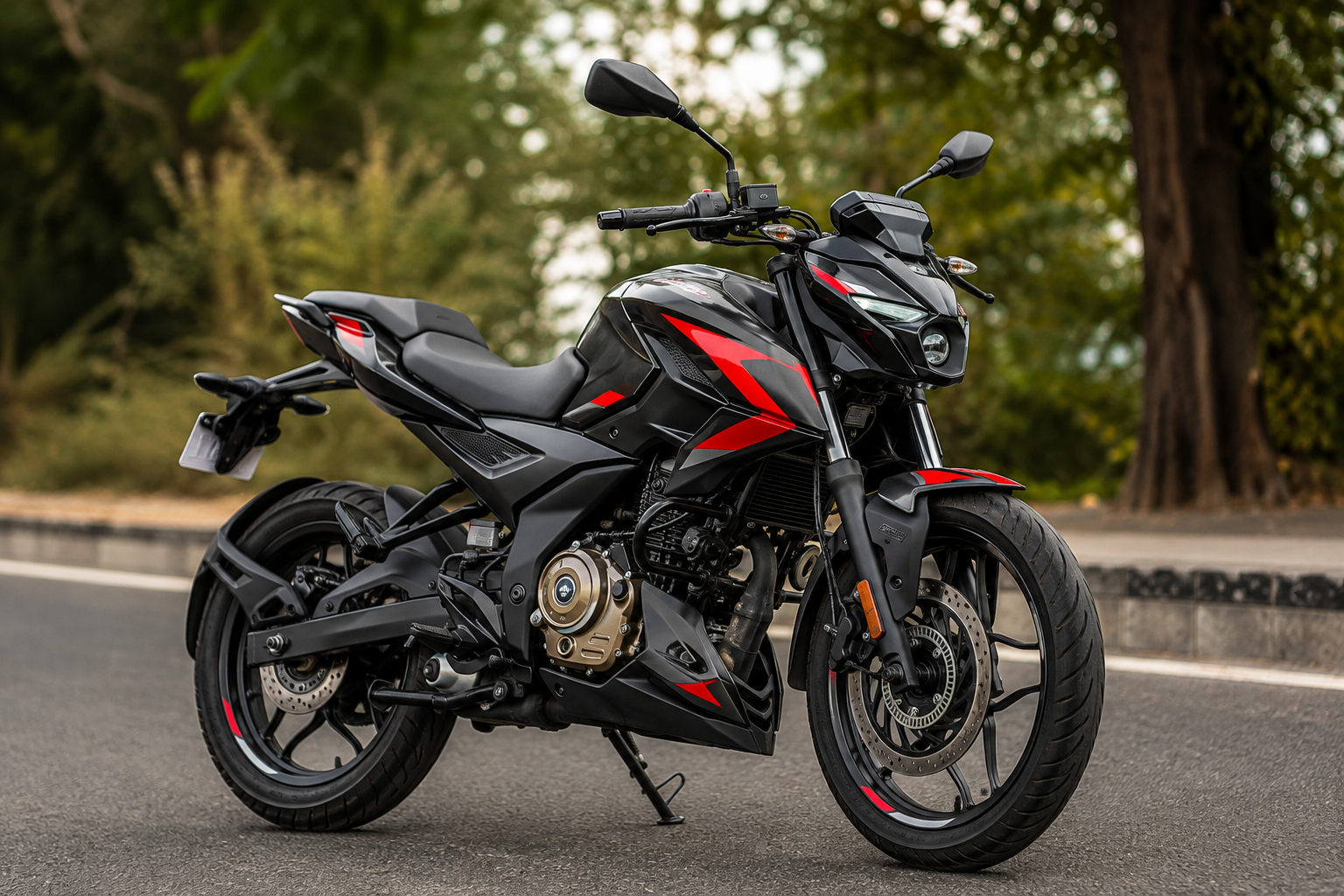
Bajaj Pulsar N160 S and N160 SS : Bajaj Auto has expanded its popular Pulsar N160 lineup with two new variants, the Bajaj Pulsar N160 S and Bajaj Pulsar N160 SS. Launched in India on 7 August 2026, these new variants bring a major mechanical and technology upgrade to the N160 family.
The biggest change is under the fuel tank. Both motorcycles get a new 164.5cc, single-cylinder, oil-cooled, 4-valve engine that produces 18.5 PS at 9,500 rpm and 14.4 Nm at 8,000 rpm. The engine is paired with a 5-speed gearbox. Compared with the earlier 2-valve N160 engine, the new setup focuses more strongly on performance while adding modern electronic controls.
Bajaj has also introduced an electronic throttle body on these new variants. This allows the motorcycle to offer multiple riding modes, including Road, Rain, Sport and Off-Road modes. The bikes also feature Bajaj’s Crawl Technology, designed to make very low-speed riding easier with reduced clutch intervention.
The two motorcycles are positioned differently within the range. The N160 S works as the more accessible version, while the N160 SS sits at the top and adds more advanced technology, including a 5-inch TFT display, Google Maps integration and traction control.
Bajaj Pulsar N160 S & N160 SS Price
Bajaj has priced the new motorcycles as follows:
| Model | Ex-Showroom Delhi Price |
|---|---|
| Pulsar N160 S | ₹1,33,511 |
| Pulsar N160 SS | ₹1,42,585 |
The prices are ex-showroom Delhi and the two new variants will be sold alongside the existing Pulsar N160 range.
The ₹9,074 price gap between the N160 S and N160 SS is important because the higher variant brings considerably more technology. The SS gets the larger TFT display, Google Maps integration and traction control, while the S uses an LCD-based setup with Bluetooth connectivity and turn-by-turn navigation.
What Makes the NewBajaj Pulsar N160 S and N160 SS Different ?
The biggest difference is not simply styling. Bajaj has used the two variants to create different equipment levels within the N160 family.
Pulsar N160 S focuses on the combination of the new 4-valve engine, riding modes and useful connectivity features without going all the way to the premium TFT setup.
Pulsar N160 SS, on the other hand, is the technology-focused flagship. Its 5-inch TFT instrument cluster, Google Maps integration and traction control make it the more feature-rich option.
This means buyers now have a choice between a relatively simpler performance-oriented N160 and a more technology-loaded version without moving into a larger engine category.
New 4-Valve Engine: The Biggest Mechanical Upgrade
The new 164.5cc oil-cooled 4-valve engine is arguably the most important upgrade for the new bajaj pulsar N160 S and N160 SS.
It develops:
- Displacement: 164.5cc
- Engine type: Single-cylinder, 4-valve
- Cooling: Oil-cooled
- Maximum power: 18.5 PS @ 9,500 rpm
- Maximum torque: 14.4 Nm @ 8,000 rpm
- Transmission: 5-speed manual
The new engine produces around 2.5 PS more power than the outgoing 16 PS N160, although peak torque is marginally lower. The engine’s higher power output gives the new N160 variants a stronger performance focus on paper.
Bajaj has also claimed a 0–60 km/h acceleration time of 4.5 seconds, according to launch coverage.
That makes the new bajaj pulsar N160 S and N160 SS much more interesting in the highly competitive 160cc motorcycle segment.
Design & Styling
The new Bajaj Pulsar N160 S and N160 SS continue with the familiar N160 streetfighter identity, but the updated motorcycles receive a sharper and more premium visual treatment. Bajaj has kept the overall muscular stance of the N160 while using the new variants to give the motorcycle a stronger technology-focused character.
At the front, the signature Pulsar-style LED lighting remains an important part of the design. The compact headlamp and muscular tank area give the motorcycle a sporty street-bike appearance without making it look unnecessarily aggressive.
The fuel-tank section remains one of the strongest visual elements. Sharp tank extensions flow towards the side panels, creating a wider and more planted appearance. The exposed mechanical elements underneath also help retain the streetfighter character that has become associated with the N-series Pulsars.
The overall design is therefore more of an evolution rather than a completely new-generation styling change. This is a sensible approach because the N160 already has a distinctive road presence.
Bajaj Pulsar N160 S and N160 SS : Visual Difference
The major difference between the two motorcycles is not their basic body design. Instead, Bajaj has focused heavily on the equipment and technology levels.
The N160 S gets an LCD instrument console with Bluetooth connectivity and turn-by-turn navigation.
The N160 SS takes things a step further with a 5-inch TFT display and Google Maps integration, making it the more premium-looking and technology-loaded version.
This distinction is important because buyers looking for a relatively straightforward performance motorcycle can choose the S, while technology-focused buyers have the SS.
Colours
Bajaj offers the new Bajaj Pulsar N160 S and N160 SS in three colour options:
- Atlantic Blue
- Pearl Metallic White
- Brooklyn Black
These colours give the motorcycle a mixture of sporty and premium appeal. Among them, Brooklyn Black is likely to appeal to buyers who prefer a more understated streetfighter look, while Atlantic Blue gives the motorcycle a more distinctive road presence.
Dimensions & Weight
The new N160 S is reported with a 795 mm seat height and approximately 151 kg kerb weight. These numbers keep the motorcycle within a fairly manageable range for a 160cc street motorcycle.
| Specification | Pulsar N160 S |
|---|---|
| Engine | 164.5cc-class |
| Seat Height | 795 mm |
| Kerb Weight | 151 kg |
| Gearbox | 5-speed |
| Fuel Tank | 14 litres |
| Front Tyre | 100/80-17 |
| Rear Tyre | 130/70-17 |
The 14-litre fuel tank is particularly useful for riders who use their motorcycle for daily commuting as well as occasional highway riding.
The 795 mm seat height also keeps the motorcycle accessible to a broad range of riders, while the 17-inch wheel setup is designed around the usual street-bike balance between stability and manoeuvrability.
Bajaj Pulsar N160 S and N160 SS Instrument Console & Connectivity
This is where the difference between the N160 S and N160 SS becomes much more noticeable.
Pulsar N160 S
The N160 S gets an LCD instrument console with:
- Bluetooth connectivity
- Turn-by-turn navigation
- Connected-bike functions
- Essential riding information
This gives the S variant a modern feature set without adding the more expensive TFT hardware.
Pulsar N160 SS
The N160 SS gets a more premium 5-inch TFT instrument cluster.
Its biggest advantage is Google Maps integration, which brings proper map-based navigation to the motorcycle’s display. This is a significant upgrade over basic turn-by-turn navigation because riders can access a more familiar mapping interface directly through the motorcycle’s connected system.
Bajaj Pulsar N160 S and N160 SS Riding Modes
Another major upgrade for the new N160 family is the introduction of four riding modes:
- Road
- Rain
- Sport
- Off-Road
The addition of multiple riding modes is unusual in this price and engine category and gives the new N160 variants a more sophisticated electronic package.
The modes are enabled by the motorcycle’s electronic throttle system, allowing the engine response and electronic intervention to be adapted for different riding conditions.
Bajaj Pulsar N160 S and N160 SS Electronic Throttle & Crawl Technology
The N160 SS gets an electronic throttle system, which is one of the headline technological upgrades of the new motorcycle.
Bajaj has also introduced Crawl Technology, designed to make very low-speed movement easier. The feature is particularly relevant in slow-moving traffic and tight manoeuvring situations, where riders normally need to work continuously with the clutch and throttle.
This combination of electronic throttle control and riding modes gives the new Pulsar N160 SS a significantly more advanced electronic package than the earlier N160.
Technology Package: Bajaj Pulsar N160 S and N160 SS
| Feature | N160 S | N160 SS |
|---|---|---|
| 4-Valve Engine | ✅ | ✅ |
| 5-Speed Gearbox | ✅ | ✅ |
| Riding Modes | ✅ | ✅ |
| Crawl Technology | ✅ | ✅ |
| Bluetooth | ✅ | ✅ |
| Turn-by-Turn Navigation | ✅ | — |
| 5-inch TFT | — | ✅ |
| Google Maps | — | ✅ |
| Electronic Throttle | Advanced electronic package | ✅ |
| Traction Control | — | ✅ |
The N160 SS clearly has the more comprehensive technology package, while the N160 S concentrates on delivering the important mechanical upgrades at a lower entry price.
4-Valve Engine & Performance
The biggest mechanical update on the new Bajaj Pulsar N160 S and N160 SS is the introduction of a new 164.5cc, single-cylinder, oil-cooled, 4-valve engine.
This engine produces a claimed 18.5 PS at 9,500 rpm and 14.4 Nm at 8,000 rpm, with power sent to the rear wheel through a 5-speed gearbox.
| Engine Specification | N160 S & N160 SS |
|---|---|
| Engine Type | Single-cylinder, 4-valve |
| Displacement | 164.5cc |
| Cooling | Oil-cooled |
| Maximum Power | 18.5 PS @ 9,500 rpm |
| Maximum Torque | 14.4 Nm @ 8,000 rpm |
| Gearbox | 5-speed |
| Throttle | Electronic |
The move from a 2-valve to a 4-valve configuration is an important change. A 4-valve cylinder head allows the engine to breathe more efficiently, which helps Bajaj extract higher performance from the same basic engine category.
Compared with the previous N160’s 16 PS output, the new engine delivers a significant increase in peak power. Bajaj claims a 0–60 km/h time of 4.5 seconds, giving the new motorcycle a stronger performance focus.
However, the new engine is not designed purely for outright acceleration. Its higher-revving character and electronic throttle also allow Bajaj to introduce different riding modes.
5-Speed Gearbox
The engine continues to use a 5-speed manual transmission.
A 5-speed gearbox is still a sensible setup for a 160cc motorcycle because it provides enough flexibility for city riding while keeping the mechanical package relatively simple.
For everyday commuting, the lower gears should provide the response required for traffic conditions, while the upper gears can be used when the road opens up.
The combination of the 164.5cc engine and 5-speed gearbox should make the bajaj pulsar N160 S and N160 SS capable of handling both urban commuting and occasional highway use.
Electronic Throttle & Riding Modes
One of the most interesting upgrades is the addition of an electronic throttle system.
Unlike a conventional cable-operated throttle, an electronic throttle allows the motorcycle’s electronics to control throttle response more precisely. This technology becomes particularly useful when multiple riding modes are offered.
The new N160 gets four riding modes:
- Road
- Rain
- Sport
- Off-Road
Road Mode
Road mode is expected to be the everyday setting. It is designed around normal road conditions and should provide a balanced combination of throttle response and electronic intervention.
For most daily riding, this is likely to be the mode that owners use most frequently.
Rain Mode
Rain mode is intended for slippery or wet conditions.
The objective here is smoother throttle response and greater electronic assistance so that power delivery is easier to manage when available grip is reduced.
Sport Mode
Sport mode is where the new 4-valve engine should feel most performance-oriented.
It is designed to offer a sharper throttle response and allow riders to make better use of the engine’s performance.
For enthusiasts, this will probably be the most interesting mode on the motorcycle.
Off-Road Mode
The inclusion of an Off-Road mode is particularly unusual for a street-focused 160cc motorcycle.
It indicates that Bajaj has designed the electronics with different riding environments in mind rather than limiting the system to conventional Road and Rain settings.
However, this does not turn the N160 into a dedicated adventure motorcycle. The Off-Road mode should be viewed as an electronic riding setting rather than evidence of serious off-road capability.
Crawl Technology
Bajaj has also introduced Crawl Technology on the new N160 variants.
This system is designed for extremely low-speed riding, where maintaining a smooth balance between clutch and throttle can be difficult.
It can be particularly useful in:
- Heavy traffic
- Slow-moving queues
- Tight U-turns
- Parking areas
- Low-speed manoeuvring
For Indian urban conditions, this is actually a useful feature rather than just a technology headline.
The system should make the motorcycle easier to control when riders are moving at very low speeds.
Bajaj Pulsar N160 S and N160 SS Suspension Setup
The new N160 retains the familiar street-bike suspension philosophy.
At the front, the motorcycle uses telescopic suspension, while the rear gets a monoshock setup.
This combination is widely used in the 160cc segment because it provides a good balance between everyday comfort, cornering stability and packaging.
For Indian roads, suspension tuning is especially important because motorcycles regularly encounter potholes, speed breakers and broken surfaces.
The N160’s relatively compact dimensions and street-focused setup should help it remain manageable in crowded urban conditions.
Bajaj Pulsar N160 S and N160 SS Braking System
Braking hardware remains an important part of the N160 package.
The motorcycle gets a front disc brake and rear disc brake, supported by an anti-lock braking system.
The ABS system is particularly important because the motorcycle’s increased power output means riders can reach higher speeds more quickly.
The combination of disc brakes and ABS should provide better braking control during emergency stops, especially when road conditions are less than perfect.
Traction Control on N160 SS
The N160 SS gets another major electronic upgrade: traction control.
Traction control monitors wheel behaviour and can intervene when it detects excessive rear-wheel slip.
This is useful in situations such as:
- Wet roads
- Loose surfaces
- Hard acceleration
- Reduced-grip corners
Its presence on a 160cc motorcycle at this price point makes the N160 SS particularly interesting.
The N160 S does not get the same level of electronic assistance, which is one of the reasons the SS sits higher in the lineup.
Ride & Handling
The Pulsar N160 has traditionally been positioned as a sporty street motorcycle rather than a dedicated track machine.
The new variants continue that philosophy.
The 795 mm seat height should make the motorcycle reasonably accessible for everyday riders, while the approximately 151 kg kerb weight keeps it within a manageable range for the segment.
The 17-inch wheels also contribute to predictable road manners.
In city traffic, the motorcycle’s dimensions should make filtering through traffic relatively easy. On open roads, the chassis and wider rear tyre should provide a more planted feel.
The new electronic throttle could also make the motorcycle’s behaviour more predictable across different riding modes.
City Riding
This is where the N160 S is likely to make the most sense for many buyers.
The 164.5cc engine provides considerably more power than the previous 16 PS setup, while Crawl Technology is designed specifically to reduce the effort involved in low-speed riding.
The Road mode should be suitable for normal commuting, while Rain mode could prove useful during India’s monsoon conditions.
The combination of manageable weight, 795 mm seat height and compact street-bike dimensions makes the N160 practical for daily use.
Highway Performance
With 18.5 PS, the new N160 has enough output to make occasional highway riding considerably more comfortable than what you would expect from a basic commuter motorcycle.
The engine’s peak power arrives at 9,500 rpm, so the motorcycle is clearly designed to deliver stronger performance higher in the rev range.
However, riders should remember that this remains a 164.5cc motorcycle. It is best suited to normal highway cruising rather than sustained high-speed touring.
For weekend rides and intercity travel, however, the performance package looks considerably more capable than before.
Bajaj Pulsar N160 S and N160 SS: Performance Difference
Interestingly, both variants share the same basic 164.5cc 4-valve engine, so the headline engine output is not the main reason to choose the SS.
The difference comes primarily from electronics.
| Area | N160 S | N160 SS |
|---|---|---|
| Engine | 164.5cc 4-valve | 164.5cc 4-valve |
| Power | 18.5 PS | 18.5 PS |
| Torque | 14.4 Nm | 14.4 Nm |
| Gearbox | 5-speed | 5-speed |
| Riding Modes | Yes | Yes |
| Crawl Technology | Yes | Yes |
| Traction Control | No | Yes |
| TFT Display | No | Yes |
Therefore, the N160 S is the performance-value option, while the N160 SS is the technology-focused option.
Bajaj Pulsar N160 S and N160 SS Mileage & Everyday Practicality
The new Bajaj Pulsar N160 S and N160 SS are primarily performance-oriented 160cc motorcycles, but everyday usability remains an important part of their appeal.
The new 164.5cc 4-valve engine produces 18.5 PS, so buyers should not look at the motorcycle purely as a mileage-focused commuter. Bajaj has prioritised stronger performance and more advanced electronics with these new variants.
However, the engine capacity remains relatively small, and the motorcycle uses a 14-litre fuel tank. This gives the N160 a useful balance between performance and practicality.
Actual mileage will depend heavily on riding style, traffic, riding mode, road conditions and maintenance. Therefore, a fixed real-world mileage figure should not be treated as guaranteed.
For buyers upgrading from a 100cc or 125cc commuter, the N160 is better understood as a sporty daily motorcycle that can also deliver reasonable fuel economy, rather than a pure mileage machine.
Bajaj Pulsar N160 S and N160 SS Safety Features
Safety is another area where the new N160 variants receive meaningful equipment.
The motorcycle gets disc brakes and ABS, providing better braking control compared with a basic commuter motorcycle.
The N160 SS goes further by adding traction control.
Key Safety & Control Features
- ABS
- Front and rear disc brakes
- Traction control on N160 SS
- Rain riding mode
- Electronic throttle
- LED lighting
- Multiple riding modes
- 17-inch wheels
The combination of Rain mode and traction control is particularly useful for Indian riding conditions, where wet roads can significantly reduce available grip.
It is important to note that electronic assistance does not replace responsible riding. Tyre condition, braking technique and road conditions remain equally important.
Bajaj Pulsar N160 S and N160 SS Maintenance & Ownership
The N160 S and N160 SS use a relatively compact single-cylinder engine, which should help keep routine mechanical maintenance manageable compared with larger-capacity motorcycles.
However, the N160 SS has a more sophisticated electronics package, including its TFT display, connectivity features, electronic throttle and traction control.
That means long-term ownership involves more electronic components than a simpler motorcycle.
Potential owners should therefore pay attention to:
- Regular engine servicing
- Engine oil replacement
- Brake-pad condition
- Chain cleaning and lubrication
- Tyre pressure
- Battery health
- Software/electronic-system updates where applicable
- Periodic inspection of electrical components
Because the motorcycles are newly launched, it is too early to give a reliable long-term maintenance-cost figure based on actual owner data.
Bajaj Pulsar N160 S and N160 SS: Which One Makes More Sense?
The difference between these two motorcycles is mainly about equipment rather than engine performance.
Choose the Pulsar N160 S if:
- You want the new 4-valve engine.
- You want strong performance without paying for every premium feature.
- You prefer an LCD console.
- You want connected features and navigation.
- You want a lower purchase price.
Choose the Pulsar N160 SS if:
- You want the most feature-loaded N160.
- A 5-inch TFT display matters to you.
- You want Google Maps integration.
- You want traction control.
- You are comfortable paying extra for electronics and technology.
The important point is that both motorcycles use the same basic engine output, so choosing the SS does not mean getting a more powerful engine.
You are mainly paying for the additional technology.
Main Competitors
The new Bajaj Pulsar N160 S and N160 SS enter one of India’s most competitive motorcycle segments.
Their competition includes motorcycles such as:
- TVS Apache RTR 160 4V
- Hero Xtreme 160R
- Yamaha FZ-S FI
- Suzuki Gixxer
- Honda SP160
Among these, the TVS Apache RTR 160 4V remains one of the strongest performance-oriented rivals because of its sporty character and established position in the 160cc segment.
The new Pulsar N160 SS, however, tries to create a different selling point by bringing a substantial electronics package into the segment.
Bajaj Pulsar N160 S And N160 SS: Pros & Cons
Pros
- New 164.5cc 4-valve engine
- Strong 18.5 PS power output
- Four riding modes
- Electronic throttle
- Crawl Technology
- 5-speed gearbox
- 795 mm seat height
- 14-litre fuel tank
- N160 SS gets traction control
- N160 SS gets 5-inch TFT
- Google Maps integration on N160 SS
- Sporty streetfighter design
Cons
- Styling changes are relatively limited
- N160 SS costs noticeably more than the S
- Higher electronics content could increase long-term complexity
- Real-world mileage is yet to be established for the new engine
- Off-Road mode does not make it a dedicated off-road motorcycle
Should You Buy the Bajaj Pulsar N160 S?
The Pulsar N160 S looks like the more sensible choice for riders who want the new-generation mechanical package without spending extra on the top-spec electronics.
At ₹1,33,511 ex-showroom Delhi, it offers the new 18.5 PS 4-valve engine, multiple riding modes and connected features at a relatively competitive entry price.
If your priority is performance + daily practicality + value, the S is arguably the more balanced version.
Should You Buy the Bajaj Pulsar N160 SS?
The Pulsar N160 SS is aimed at a different type of buyer.
At ₹1,42,585 ex-showroom Delhi, it costs more than the N160 S, but adds features such as the 5-inch TFT, Google Maps integration and traction control.
If you enjoy technology and want your motorcycle to offer a more premium electronic experience, the SS makes more sense.
However, if you are not particularly interested in TFT displays, advanced connectivity or traction control, the additional money may not deliver enough practical benefit for your riding needs.
⭐ Gaadi Xpert Verdict
The Bajaj Pulsar N160 S and N160 SS are much more than simple cosmetic updates.
Bajaj has significantly upgraded the N160’s mechanical package with a 164.5cc 4-valve engine producing 18.5 PS and 14.4 Nm. The addition of electronic throttle control, four riding modes and Crawl Technology gives the motorcycle a much more sophisticated character.
The N160 S is the value-oriented choice. It delivers the core mechanical upgrades without going too far into premium electronics.
The N160 SS, meanwhile, is the technology flagship. Its TFT display, Google Maps integration and traction control make it one of the most feature-rich motorcycles in this engine category.
For us, the N160 S is the better value-for-money pick, while the N160 SS is the better choice for technology-focused riders.
Gaadi Xpert Scorecard
| Category | Score |
|---|---|
| Design | 8/10 |
| Engine & Performance | 9/10 |
| Features | 9/10 |
| Technology | 9/10 |
| Safety | 9/10 |
| Ride & Handling | 8.5/10 |
| Practicality | 8.5/10 |
| Value for Money | 8.5/10 |
| Overall | 8.7/10 |
Final Verdict
The new Bajaj Pulsar N160 S and N160 SS push the N160 much further into the premium 160cc motorcycle space.
With the new 4-valve engine, 18.5 PS, riding modes, electronic throttle and modern connectivity, the motorcycle now offers considerably more technology than the earlier N160.
The choice between the two is straightforward: buy the N160 S for maximum value, or choose the N160 SS if you want the full technology package.
For most buyers, we would pick the N160 S because it captures the most important upgrades while keeping the price lower.
FAQs
What is the price of the Bajaj Pulsar N160 S?
The Bajaj Pulsar N160 S is priced at ₹1,33,511 ex-showroom Delhi.
What is the price of the Bajaj Pulsar N160 SS?
The Bajaj Pulsar N160 SS is priced at ₹1,42,585 ex-showroom Delhi.
What engine does the new N160 use?
Both motorcycles use a 164.5cc single-cylinder, oil-cooled 4-valve engine.
How much power does the new Pulsar N160 produce?
The new engine produces 18.5 PS at 9,500 rpm.
How much torque does the N160 produce?
The engine produces 14.4 Nm at 8,000 rpm.
Does the N160 SS get traction control?
Yes. Traction control is available on the N160 SS.
Does the N160 SS get a TFT display?
Yes. The N160 SS gets a 5-inch TFT instrument display.
Does the N160 S get navigation?
Yes. The N160 S gets connected features with turn-by-turn navigation, while the SS adds Google Maps integration through its TFT system.
How many riding modes does the new N160 have?
The new N160 gets four riding modes: Road, Rain, Sport and Off-Road.
Which N160 should you buy?
For most buyers, the N160 S is the better value option. The N160 SS is worth considering if you specifically want the TFT display, Google Maps integration and traction control.
Official Prices of Bajaj Pulsar N160 S and N160 SS
Also Read The Genuine Comparison Between TATA PUNCH & HYUNDAI EXTER