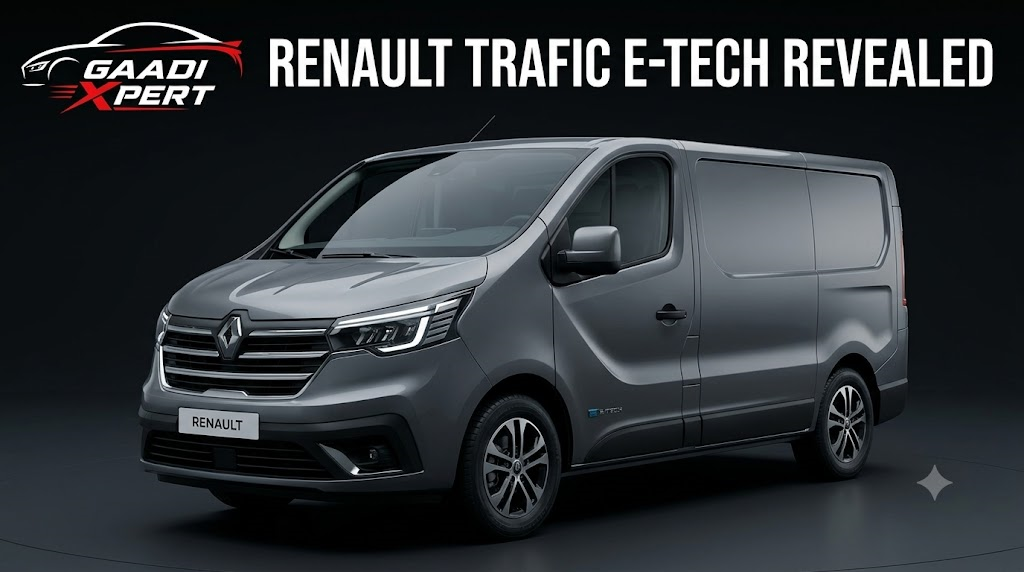
Renault has officially unveiled the New Trafic Van E-Tech electric at the IAA Transportation 2026 in Hannover, Germany. The new electric commercial van marks an important step in Renault’s next-generation light commercial vehicle strategy and is the first of five new LCVs the company plans to introduce between now and 2028.
The new Renault Trafic Van E-Tech electric combines an 81 kWh battery, 800V electrical architecture, fast charging capability and software-defined vehicle technology. Renault says the electric van can deliver more than 470 km of range, although its final WLTP homologation is still pending. In urban use, Renault claims the range can reach nearly 690 km under its stated conditions.
Along with its electric powertrain, Renault has also focused on the practical requirements of commercial customers. The new Trafic offers up to 5.8 cubic metres of load volume, a payload of up to 1.3 tonnes and towing capacity of up to 2 tonnes.
So, this is not simply an electric version of an existing van. Renault is using the new Trafic Van E-Tech electric to introduce a new technology and business strategy for its future LCV range.
Renault Trafic Van E-Tech Electric: What Has Been Revealed?
The new Renault Trafic Van E-Tech electric made its appearance at the 2026 IAA Transportation show in Hannover.
Renault says the model is part of its futuREady plan, under which the company intends to launch five new light commercial vehicles between now and 2028. The Trafic Van E-Tech electric is the first model in this new generation.
The Trafic name itself has a long history. Renault introduced the Trafic in 1980, and the company says more than 2.8 million units have been sold since then.
For the latest generation, however, Renault is moving the Trafic into a much more technology-focused electric era.
The van is designed and built in Europe at Renault’s Sandouville plant in France.
Renault Trafic Van E-Tech Electric Design
The new electric Trafic follows Renault’s latest commercial-vehicle design philosophy.
Its body has been designed around the requirements of professional users while keeping the vehicle relatively compact for urban environments. Renault says the van is only 1.89 metres tall, which allows it to access standard underground car parks.
That is particularly useful for urban delivery businesses where vehicle height can become a practical limitation.
The wheels are positioned toward the corners of the vehicle, helping Renault create more usable interior space while maintaining manoeuvrability.
The design also incorporates a short front overhang and an extended wheelbase. Renault had previously explained that the Trafic E-Tech electric architecture was designed to combine cargo practicality with passenger-car-like driving characteristics.
Dimensions and Practicality
For a commercial vehicle, design is not only about appearance. Cargo capacity and ease of loading are much more important.
The new Renault Trafic Van E-Tech electric offers:
- Load volume: up to 5.8 m³
- Payload: up to 1.3 tonnes
- Towing capacity: up to 2 tonnes
- Euro pallets: up to three
- Load height: 53 cm
- Turning circle: 10.3 metres
These figures show that Renault has tried to preserve the core functionality expected from a medium-sized commercial van despite the move to electric power.
The 10.3-metre turning circle is another important feature for city-based operators. Renault says the handling agility is comparable to the Renault Clio.
That could make the electric Trafic easier to operate in narrow streets, delivery zones and crowded urban areas.
Renault Trafic Van E-Tech Electric Battery and Range
The new Renault Trafic Van E-Tech electric uses an 81 kWh battery.
Renault currently states a range of more than 470 km, but there is an important qualification here: the final WLTP homologation is still pending. Therefore, 470+ km should currently be treated as Renault’s stated target/claim rather than a final certified WLTP number.
Renault also says that in urban driving, the vehicle can achieve nearly 690 km of range under its stated conditions.
The company says this could allow the vehicle to operate for up to five working days without charging, depending on the type of work and usage pattern.
For commercial customers, that could be more important than a headline range figure alone.
A delivery van that can complete several days of work without frequent charging can potentially reduce downtime and simplify fleet planning.
800V Fast Charging Technology
One of the biggest technology highlights of the new Trafic Van E-Tech electric is its 800V electrical architecture.
Renault says that with suitable charging infrastructure, the vehicle can recover up to 280 km of range in 20 minutes.
In urban use, the company says the same 20-minute charging period can add up to 380 km of range under its stated conditions.
This is particularly relevant for commercial operators.
For a private EV owner, charging can often be planned around overnight parking. However, commercial vans may spend most of the day on the road. Therefore, fast charging during a driver break or loading period can have a direct effect on productivity.
Renault has therefore placed charging speed alongside range as one of the key selling points of the new electric Trafic.
Software-Defined Vehicle Technology
Another major change is the introduction of Software-Defined Vehicle (SDV) architecture.
Renault describes the new Trafic Van E-Tech electric as its first vehicle using this approach in the LCV range.
Instead of treating software as something that remains mostly fixed after production, the SDV approach allows Renault to continuously update and improve various vehicle functions.
The company says this architecture can support:
- Regular vehicle updates
- More personalised driving experiences
- Predictive maintenance
- Additional features over the vehicle’s lifetime
- Potentially improved residual value through continued updates
In simple terms, Renault wants the van to behave more like a connected digital product that can receive improvements during its operating life.
For fleet operators, this could become increasingly important because vehicle software can influence maintenance, efficiency, safety and fleet management.
Two Supercomputers Instead of a Traditional Electronic Architecture
The new Trafic Van E-Tech electric also introduces a significantly different electronic architecture.
Renault’s SDV strategy centralises vehicle functions rather than relying on a large number of separate electronic control units.
This allows software updates and vehicle functions to be managed more centrally.
The approach is intended to make future upgrades easier and give Renault more flexibility to add functions during the vehicle’s lifetime.
For professional users, the biggest benefit may not be the technology itself but the possibility of reducing downtime and improving maintenance through predictive systems.
Renault Trafic Van E-Tech Electric Interior and Driver Comfort
Renault has also focused on the driver’s working environment.
Commercial van drivers can spend several hours behind the wheel every day, so seat position, visibility, manoeuvrability and cabin comfort become important factors.
The new Trafic has been designed to provide a more passenger-car-like driving experience.
Renault highlights its ergonomic driving position, improved visibility and quiet operation.
The low height of 1.89 metres also helps make the van practical in urban environments.
Furthermore, the 10.3-metre turning circle is intended to make manoeuvring easier in tight spaces.
This combination of electric power, low noise and passenger-car-inspired driving characteristics could make the new Trafic noticeably different from conventional diesel commercial vans.
Cargo Space and Commercial Capability
Although the new Trafic is heavily focused on electrification and technology, Renault has not ignored its traditional commercial-vehicle requirements.
The van provides up to 5.8 m³ of cargo capacity.
It can carry up to 1.3 tonnes of payload and tow up to 2 tonnes.
There is also space for three Euro pallets.
The loading height is listed at 53 cm, which can make frequent loading and unloading easier for professional users.
This is important because an electric commercial vehicle cannot succeed simply by offering a large battery. It also needs to perform the basic job expected from a van.
Renault’s approach with the Trafic is therefore to combine electric efficiency with conventional LCV practicality.
Vehicle-to-Load Function
The new Renault Trafic Van E-Tech electric will also support Vehicle-to-Load (V2L) functionality.
This allows the vehicle’s battery to supply electricity to external equipment.
For example, a professional working at a construction site could potentially use the van as a source of electricity for compatible equipment.
This can be useful when grid power is unavailable or when carrying a separate portable power source would be inconvenient.
Renault is also preparing an electric power take-off (ePTO) solution for future applications. The company says this could support heavier conversions such as refrigeration units and ambulance equipment.
Conversion Options
Commercial vehicles are rarely used in only one configuration.
Different businesses require different bodies and equipment. Renault has therefore developed the new Trafic around a conversion-friendly strategy.
The initial range will include a panel van, with availability planned by the end of 2026.
Renault also plans to add chassis-cab and crew-cab versions in 2027.
This approach could allow the electric Trafic to serve a wider range of applications rather than being limited to standard delivery work.
Lower Running Costs
Running costs are one of the biggest reasons businesses consider electric commercial vehicles.
Renault says the new Trafic Van E-Tech electric can offer a total cost of ownership up to 10% lower than an equivalent internal-combustion version.
However, actual savings will depend on factors such as electricity prices, charging infrastructure, annual mileage, maintenance costs and operating conditions.
Therefore, Renault’s 10% figure should be considered a manufacturer claim rather than a universal saving applicable to every fleet.
Still, for high-mileage commercial operators, the combination of electric power, reduced routine maintenance requirements and fast charging could make the operating-cost equation increasingly relevant.
Production in France
The new Trafic Van E-Tech electric is designed and produced in Europe.
Renault is manufacturing the vehicle at its Sandouville plant in France.
This is part of Renault’s broader strategy of developing and producing its next-generation electric LCVs in Europe.
The company says the new model demonstrates its commitment to developing technologically advanced commercial vehicles within Europe.
Renault’s Five-New-LCV Strategy
The new Trafic is not an isolated product.
Renault has announced plans to introduce five new LCVs between now and 2028 as part of its futuREady strategy.
The Trafic Van E-Tech electric is the first model in this new generation.
Renault is therefore using the 2026 IAA Transportation show not just to showcase a new electric van, but also to communicate its wider commercial-vehicle strategy.
The company already has the Kangoo, Trafic and Master families in its LCV portfolio. The next stage is expected to bring more electrification, software technology and specialised commercial solutions.
Renault Trafic Van E-Tech Electric Safety and Technology
Renault has not positioned the new Trafic as just a battery-powered transport vehicle.
Its SDV architecture is also intended to support advanced safety and maintenance functions.
Renault says the software-defined architecture can enable predictive maintenance and continuous updates.
Predictive maintenance could potentially help fleet operators identify issues earlier and reduce unexpected downtime.
For businesses, this is an important area because an unavailable commercial vehicle can directly affect deliveries and daily operations.
The exact safety-equipment specification can vary by market and configuration, so final market-specific equipment should be confirmed when Renault announces individual versions.
Is the Renault Trafic Van E-Tech Electric Coming to India?
At the time of its IAA Transportation 2026 unveiling, Renault’s official announcement focuses on the European market and European LCV strategy.
Renault has not announced an India launch date or India-specific price for the new Trafic Van E-Tech electric in the information currently released.
Therefore, it would be incorrect to publish an Indian launch date or expected price as confirmed information.
If Renault later confirms an India programme, those details can be added separately.
Renault Trafic Van E-Tech Electric Price
Renault has not announced an official price for the new Trafic Van E-Tech electric in the current IAA Transportation 2026 announcement.
The final price will likely depend on battery configuration, body style, equipment and market.
For now, any online figure presented as the confirmed European or Indian price should be treated cautiously unless Renault officially confirms it.
Renault Trafic Van E-Tech Electric: Key Specifications
| Specification | Renault Trafic Van E-Tech Electric |
|---|---|
| Vehicle type | Electric medium-size van |
| Debut | IAA Transportation 2026, Hannover |
| Battery | 81 kWh |
| Claimed range | Over 470 km |
| WLTP status | Homologation pending |
| Urban range claim | Nearly 690 km |
| Electrical architecture | 800V |
| 20-minute charging | Up to 280 km range |
| Urban 20-minute charging claim | Up to 380 km |
| Load volume | Up to 5.8 m³ |
| Payload | Up to 1.3 tonnes |
| Towing capacity | Up to 2 tonnes |
| Euro pallets | Up to 3 |
| Turning circle | 10.3 metres |
| Height | 1.89 metres |
| V2L | Yes |
| Panel van | Planned by end of 2026 |
| Chassis-cab / crew cab | Planned for 2027 |
| Production | Sandouville, France |
Specifications are based on Renault’s current official information. Final homologated figures and market-specific specifications may differ.
Renault Trafic Van E-Tech Electric vs Traditional Diesel Vans
The biggest difference is obviously the powertrain.
A conventional diesel van can be refuelled within minutes almost anywhere. The electric Trafic, meanwhile, depends on charging infrastructure. However, Renault’s 800V system is designed to reduce charging downtime significantly.
The electric model also brings the potential benefits of quieter operation and lower energy and maintenance costs.
On the other hand, actual suitability will depend on the operator’s daily route.
A fleet running predictable urban routes with access to high-power charging may benefit significantly from the electric powertrain. A long-distance operator without reliable charging infrastructure may have different requirements.
That is why the new Trafic should be viewed as a commercial tool rather than simply an electric alternative to a diesel van.
Gaadi Xpert Analysis
The Renault Trafic Van E-Tech electric is significant because Renault has combined three major trends in one commercial vehicle: electrification, fast charging and software-defined architecture.
The 81 kWh battery and 470+ km claimed range address the range concern, while 800V charging targets the downtime problem.
At the same time, Renault has retained the fundamentals of a commercial van, including up to 5.8 m³ of cargo capacity, 1.3-tonne payload and 2-tonne towing capacity.
However, the most interesting part may actually be the SDV architecture.
Commercial vehicles typically remain in service for many years. If software updates can continue adding functions and improving maintenance during that period, the ownership experience could change significantly.
There is still one important caveat: the 470+ km figure is not yet a final WLTP-certified number. Therefore, real-world range and final efficiency will need to be assessed once homologation and independent testing are available.
Should You Wait for the Renault Trafic Van E-Tech Electric?
For European businesses looking at an electric medium-size van, the new Trafic brings a combination of long claimed range, rapid charging and strong cargo capability.
However, the right choice will depend heavily on the individual fleet’s operating pattern.
Businesses should consider:
- Daily driving distance
- Availability of high-power charging
- Payload requirements
- Towing requirements
- Electricity costs
- Annual mileage
- Fleet downtime
- Conversion requirements
- Local incentives and regulations
The vehicle’s final homologated range and market-specific pricing will also be important before making a purchase decision.
Final Verdict
The Renault Trafic Van E-Tech electric represents a new direction for Renault’s commercial-vehicle business.
Its biggest highlights are the 81 kWh battery, more than 470 km claimed range, 800V architecture, 280 km of claimed range recovery in 20 minutes, up to 5.8 m³ cargo capacity and 1.3-tonne payload.
More importantly, Renault has combined these features with a software-defined architecture designed to support continuous updates and predictive maintenance.
The new electric Trafic is therefore not simply about replacing a diesel engine with an electric motor. Renault is attempting to build a more connected, updateable and fleet-focused commercial vehicle.
The final picture will become clearer once WLTP homologation, pricing and market-specific specifications are officially confirmed.
For now, the Renault Trafic Van E-Tech electric stands as one of the key electric commercial-vehicle reveals of IAA Transportation 2026.
Frequently Asked Questions
1. What is the Renault Trafic Van E-Tech electric?
It is Renault’s new-generation electric medium-sized commercial van, unveiled at IAA Transportation 2026 in Hannover.
2. What is the Renault Trafic Van E-Tech electric range?
Renault currently claims more than 470 km of range, while final WLTP homologation is still pending. The company also claims nearly 690 km in urban use under its stated conditions.
3. What battery does the new Trafic electric use?
The new model uses an 81 kWh battery.
4. How fast can the Renault Trafic Van E-Tech charge?
Renault says the 800V system can recover up to 280 km of range in 20 minutes, or up to 380 km in urban use under its stated conditions.
5. What is the cargo capacity?
The new electric Trafic offers up to 5.8 m³ of load volume.
6. What is its payload?
The maximum payload is up to 1.3 tonnes.
7. Does it support towing?
Yes. Renault quotes a maximum towing capacity of up to 2 tonnes.
8. Is the Renault Trafic Van E-Tech coming to India?
Renault has not announced an India launch date or India-specific pricing in the current IAA Transportation 2026 information.
9. What is SDV technology in the new Trafic?
SDV stands for Software-Defined Vehicle. It allows vehicle functions to be managed through a more centralised software architecture and supports future updates, personalised functions and predictive maintenance.
10. When will the Renault Trafic Van E-Tech panel van be available?
Renault says the panel-van version is planned for the end of 2026, while chassis-cab and crew-cab versions are planned for 2027.