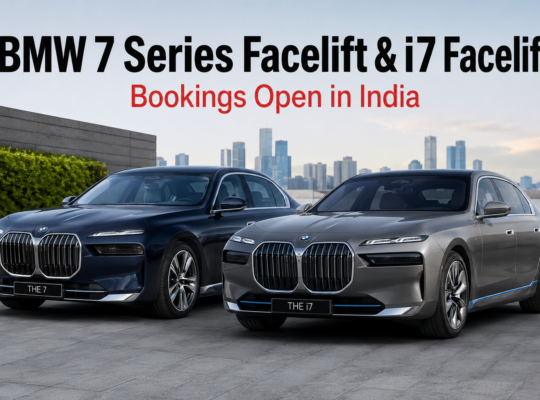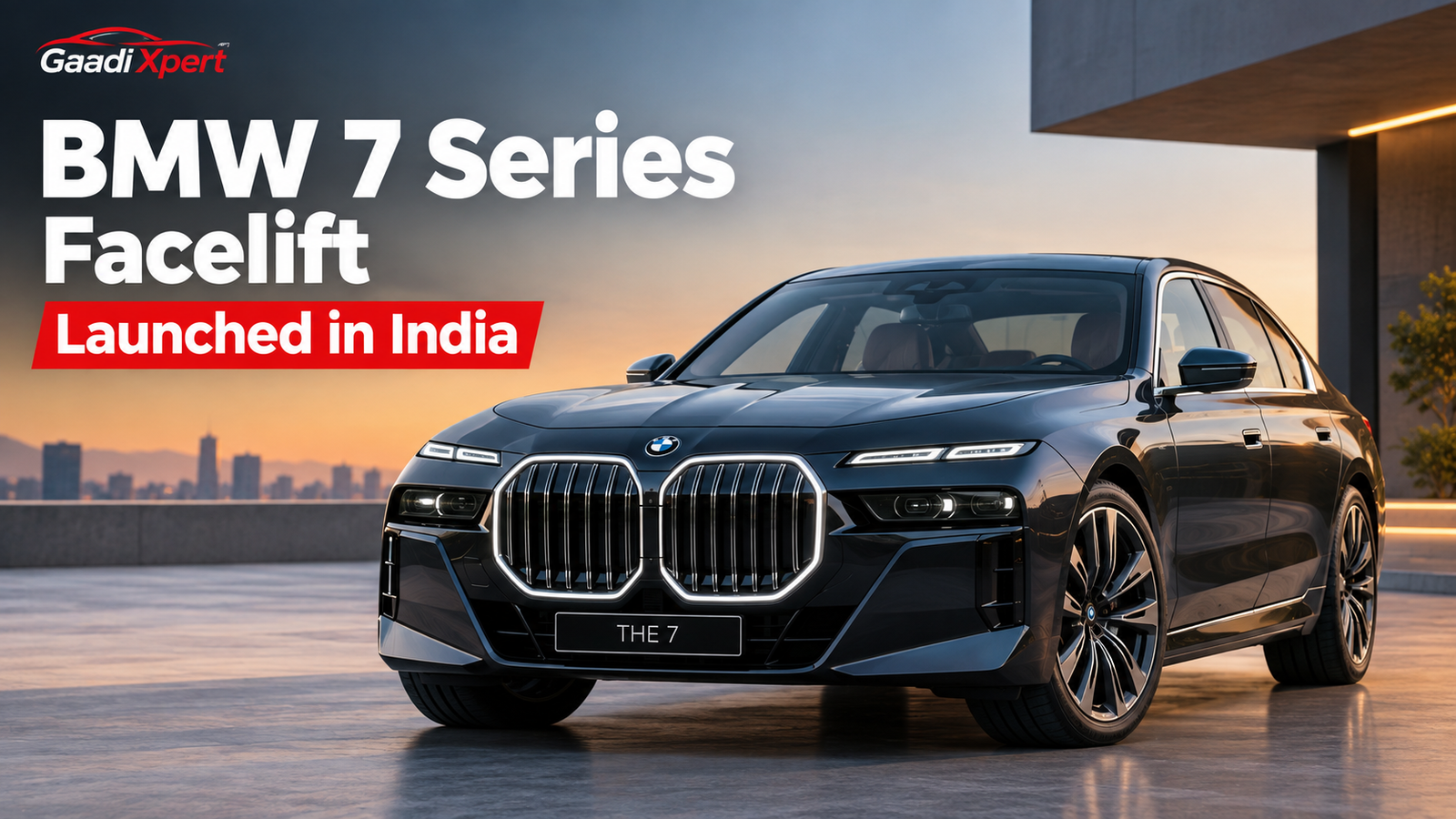
BMW has officially launched the new BMW 7 Series range in India, bringing a major technology and design update to its flagship luxury sedan. The new BMW 7 Series combines a petrol-powered luxury limousine with fully electric i7 variants, giving buyers the choice between traditional combustion performance and electric mobility.
The India range includes the BMW 740 M Sport, BMW i7 eDrive50 xDrive M Sport and the range-topping BMW i7 M70 xDrive. Prices start at ₹1.95 crore ex-showroom, while the most powerful i7 M70 is priced at ₹2.65 crore ex-showroom.
The latest 7 Series is not simply a cosmetic facelift. BMW describes this update as its most extensive 7 Series model update so far, with Neue Klasse technologies making their way into the luxury sedan for the first time. These include the new BMW Panoramic iDrive, BMW Operating System X, a new passenger screen and expanded digital and driver-assistance technologies.
The new BMW 7 Series also continues BMW’s “Power of Choice” approach. Customers can choose between a six-cylinder petrol powertrain and fully electric i7 models.
BMW 7 Series Facelift India Price
The new BMW 7 Series range has been launched in India at the following ex-showroom prices:
| Variant | Powertrain | India Price |
|---|---|---|
| BMW 740 M Sport | Petrol | ₹1.95 crore |
| BMW i7 eDrive50 xDrive M Sport | Electric | ₹1.95 crore |
| BMW i7 M70 xDrive | Electric | ₹2.65 crore |
The interesting part is that the petrol-powered BMW 740 M Sport and the electric BMW i7 eDrive50 xDrive M Sport carry the same starting price of ₹1.95 crore.
BMW India has opened bookings for the new 7 Series range, while deliveries are scheduled to begin from October 2026.
The BMW i7 eDrive50 will be locally produced in India, while the high-performance BMW i7 M70 xDrive is offered as a completely built-up unit.
BMW 7 Series Facelift: What Has Changed?
The latest BMW 7 Series is based on the seventh-generation model but receives a substantial update.
BMW says the new model is the first luxury sedan in its segment to bring technologies developed for the Neue Klasse into an existing model line. This makes the 7 Series an important technology carrier for BMW’s future products.
The changes cover almost every important area of the car.
The exterior gets a new luxury design language, the cabin receives a major digital upgrade, the electric i7 gets improved battery technology and range, while the driver-assistance package also becomes more advanced.
For buyers, this means the new BMW 7 Series is positioned as both a luxury chauffeur-driven sedan and a technology showcase for BMW.
New BMW 7 Series Exterior Design
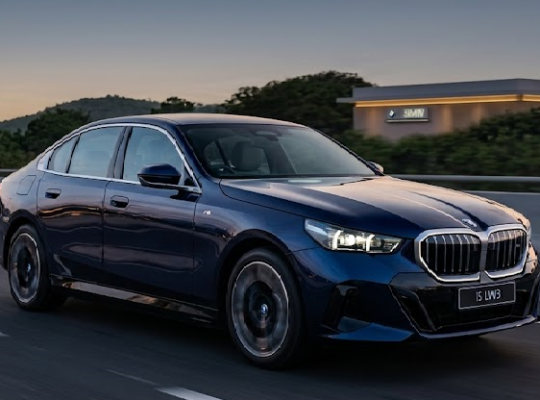
The new BMW 7 Series gets a more modern and cleaner exterior design.
At the front, the biggest visual highlight is the redesigned BMW kidney grille with BMW Iconic Glow. The illuminated grille gives the flagship sedan a distinctive appearance, particularly at night.
The car also gets new crystal headlights that form an important part of BMW’s latest luxury-class design language.
BMW describes the overall exterior as more monolithic, with cleaner surfaces and a stronger visual presence. The side profile uses reduced surfacing and a defined character line, while the rear receives newly designed lights and cleaner forms.
The new design is not intended to make the 7 Series look radically different. Instead, BMW has focused on making the flagship sedan look more sophisticated and technically advanced.
BMW 7 Series M Sport Design
The M Sport variants add a sportier character to the luxury sedan.
The M Sport package brings additional aerodynamic elements and distinctive M-specific styling details. Larger air intakes, M-specific exterior elements, sportier bumpers and larger wheels help separate the M Sport versions from the standard luxury-focused appearance.
BMW also offers M Sport Package Pro for customers looking for a more aggressive appearance.
The new 7 Series can be equipped with wheels ranging from 20-inch designs to new 22-inch wheels available from the factory.
BMW 7 Series Interior: A Completely New Digital Experience
The cabin is where the new BMW 7 Series makes one of its biggest jumps.
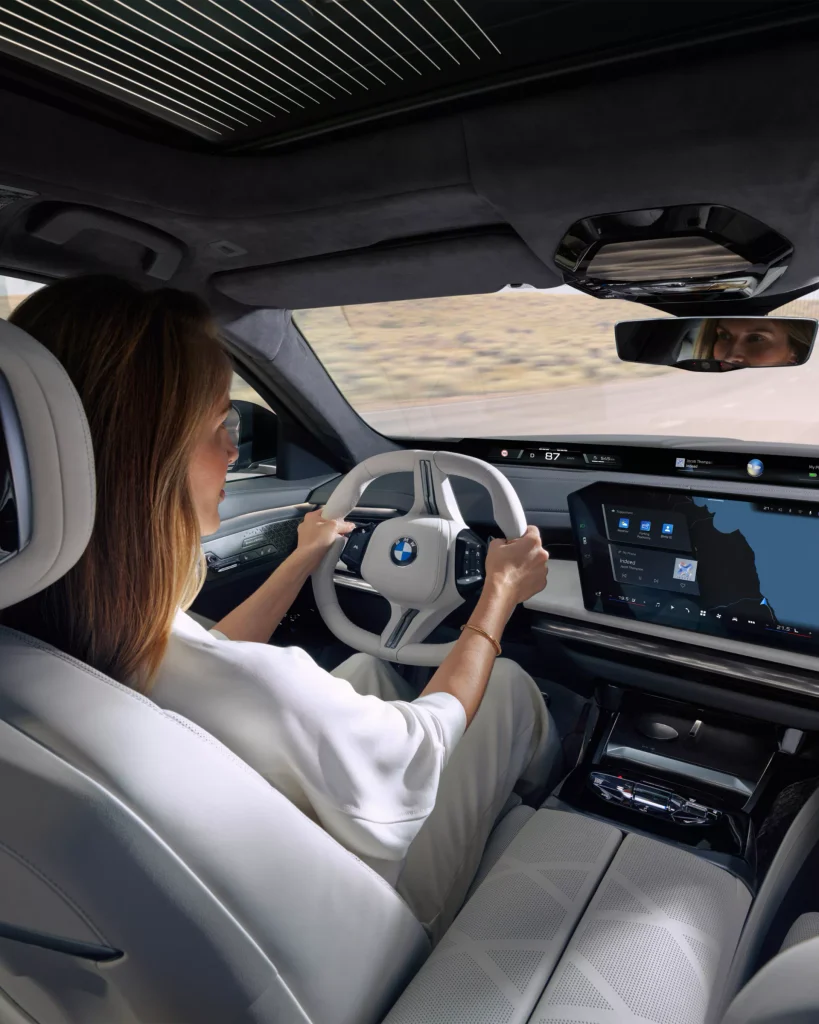
BMW has redesigned the digital experience around the new BMW Panoramic iDrive system.
The system combines a driver-focused display concept with a large central screen and a new passenger display.
The new BMW Panoramic iDrive works with BMW Operating System X, giving the cabin a more connected and software-focused experience.
BMW says the system has been designed around the driver while also giving passengers more entertainment and information options.
BMW Passenger Screen
One of the major additions is the BMW Passenger Screen, which makes its debut in the new 7 Series.
The passenger can use the dedicated display for entertainment and other digital functions without taking control of the driver’s main interface.
This is especially important in a car like the 7 Series because rear-seat and passenger comfort are as important as driving technology.
BMW Theatre Screen
The rear passengers continue to get one of the most impressive entertainment features available in the BMW 7 Series.
The optional BMW Theatre Screen measures 31.3 inches and offers an 8K display.
BMW says the system can be used for streaming, gaming and video calls.
The large screen is combined with a premium audio system to create a more cinema-like experience for rear passengers.
For a chauffeur-driven luxury sedan, this is one of the features that separates the 7 Series from an ordinary premium executive car.
Luxury Features Inside the New BMW 7 Series
BMW has continued to focus heavily on materials and passenger comfort.
The cabin uses a combination of premium materials including leather, fabric, wood, crystal glass and metal, depending on specification.
The new 7 Series also offers:
- Comfort seats
- Optional Executive Lounge seating
- Panoramic glass sunroof
- Four-zone automatic climate control
- Travel & Comfort System
- Automatic doors
- Digital interior mirror
- Ambient lighting
- Bowers & Wilkins sound system
- Dolby Atmos support
The Executive Lounge setup is particularly important for buyers who intend to use the 7 Series primarily from the rear seat.
BMW’s approach is clear: the new 7 Series is designed to work equally well as a driver’s car and as a chauffeur-driven luxury sedan.
BMW 740 M Sport Engine and Performance
The petrol-powered BMW 740 M Sport continues to use a six-cylinder petrol engine with 48V mild-hybrid technology.
The engine produces 400 hp.
BMW’s official global information confirms that the new 740 xDrive is part of the updated 7 Series powertrain portfolio, alongside electric and plug-in hybrid versions in global markets.
For India, the 740 M Sport is positioned as the petrol alternative to the electric i7 eDrive50.
The appeal here is straightforward. Buyers who still prefer the sound, response and refuelling convenience of a petrol engine can continue with the traditional 7 Series experience while getting the latest cabin and technology upgrades.
The petrol model also benefits from BMW’s advanced chassis technology, including adaptive two-axle air suspension.
BMW i7 eDrive50 xDrive: The Electric 7 Series
The BMW i7 eDrive50 xDrive is one of the most important variants in the new range.
BMW has upgraded the electric technology of the i7, with the latest generation of BMW eDrive technology and new cylindrical battery cells.
The updated electric 7 Series can now deliver an electric range of more than 720 km under WLTP, depending on the specific variant and configuration. BMW’s official global technical information quotes the i7 eDrive50 with a maximum range of around 728 km WLTP for the relevant specification.
This is a major improvement for a large luxury electric sedan.
For Indian customers, however, the WLTP figure should not be treated as a guaranteed real-world driving range. Actual range can vary depending on temperature, driving style, traffic, wheel and tyre specification, air-conditioning usage and road conditions.
That distinction is important when discussing luxury EVs because laboratory test figures and everyday driving results are not always identical.
BMW i7 Battery and Charging Technology
BMW has upgraded the electric architecture of the i7 as part of the latest update.
The new electric models use BMW’s sixth-generation eDrive technology and cylindrical battery cells.
BMW has also worked on improving charging convenience through intelligent charging functions, route planning optimised around charging stops and adaptive recuperation.
The system can use route information to help manage energy consumption during longer journeys.
This is particularly useful for a luxury EV such as the i7 because long-distance usability is just as important as outright performance.
BMW i7 M70 xDrive: The Most Powerful 7 Series
At the top of the range sits the BMW i7 M70 xDrive.
BMW positions the i7 M70 as the most powerful 7 Series ever produced.
It combines BMW’s luxury limousine experience with M performance technology and an all-electric powertrain.
The M70 receives specific M design elements and performance-focused chassis tuning.
BMW’s global 7 Series information identifies the M Performance models as an important part of the new range, with three M Performance derivatives available globally.
The i7 M70 is aimed at buyers who want the comfort of a flagship luxury sedan but do not want to compromise on acceleration and performance.
Unlike the locally produced i7, the M70 is brought into India as a completely built-up unit.
Its India price is ₹2.65 crore ex-showroom.
BMW 7 Series Facelift: Panoramic iDrive
The biggest technology story in the new BMW 7 Series is arguably the BMW Panoramic iDrive.
The system is part of BMW’s broader Neue Klasse technology strategy.
It works together with:
- BMW Operating System X
- BMW Panoramic Vision
- BMW Passenger Screen
- BMW Intelligent Personal Assistant
- BMW Maps
- Smartphone integration
- BMW Digital Key Plus
- BMW Digital Premium
- ConnectedDrive upgrades
- Over-the-air software updates
The idea is to make the car more software-defined while keeping the controls intuitive.
BMW is also introducing enhanced voice functionality through its Intelligent Personal Assistant, including Amazon Alexa+ AI technology in markets where the feature is available.
BMW Panoramic Vision
The new BMW Panoramic Vision technology is another major addition.
Instead of relying only on a traditional driver display, BMW uses a wider projection area across the lower portion of the windscreen to present important information.
This technology comes from the Neue Klasse family and is now being introduced into the flagship 7 Series.
The goal is to keep important information within the driver’s natural field of view while reducing the need to look away from the road.
BMW 7 Series Safety and Driver Assistance
The new BMW 7 Series also gets major improvements in driver assistance.
BMW says the updated sedan uses advanced SAE Level 2 driver-assistance technologies and increased use of artificial intelligence for comfort, safety and partially automated driving.
The system package includes BMW Symbiotic Drive, which is designed to improve the interaction between driver and vehicle.
In supported European markets, BMW’s Motorway Assistant enables hands-off driving at speeds of up to 130 km/h.
The City Assistant can also support navigation-guided Address-to-Address journeys in urban environments.
However, these capabilities are market-dependent.
Therefore, Indian buyers should not assume that every automated-driving function available internationally will operate in exactly the same way in India.
This is an important reliability point when discussing BMW’s global technology because local regulations, road conditions and feature availability can vary.
Park Assist and AI-Based Parking
The new 7 Series also receives enhanced parking assistance.
BMW says Park Assist is fitted as standard, while AI-supported parking-space detection and manoeuvre planning are designed to make parking easier.
The car can analyse available parking spaces and assist with the required manoeuvres.
For a large sedan like the BMW 7 Series, this technology is particularly useful in tight urban environments.
BMW has also integrated technologies such as digital tyre-condition monitoring with AI, an integrated braking system and wheel-slip limitation technology.
BMW 7 Series Ride and Handling
Despite its size, the BMW 7 Series continues to focus on driving dynamics.
The new model comes with adaptive two-axle air suspension and electronically controlled dampers.
This allows BMW to balance two very different requirements.
The first is the smooth ride expected from a flagship luxury sedan.
The second is the sharper response expected from a BMW.
BMW also offers optional chassis systems with Integral Active Steering and roll stabilisation.
These technologies are designed to improve agility without sacrificing long-distance comfort.
The M Sport package further changes the chassis character towards a more dynamic driving experience.
BMW 7 Series Suspension and Comfort
The adaptive air suspension is one of the most important technologies in the new 7 Series.
A luxury sedan of this size needs to isolate passengers from poor road surfaces while remaining stable at higher speeds.
BMW uses electronically controlled dampers and two-axle air suspension to achieve that balance.
For rear-seat passengers, this technology is particularly important because the 7 Series is not only designed to be driven fast; it is also designed to be experienced from the back seat.
BMW 7 Series Production
The new BMW 7 Series is produced at BMW Group Plant Dingolfing in Germany for global markets.
BMW says all drive-system variants of the new 7 Series Sedan are built on a single production line at the Dingolfing plant.
For India, the local production story becomes particularly important with the i7.
BMW is expanding local production of the electric i7 at its Chennai facility, making the electric flagship more accessible in the Indian market.
The performance-focused i7 M70 xDrive continues as a completely built-up import.
BMW 7 Series: Petrol vs Electric
One of the biggest changes in BMW’s strategy is that buyers can now choose between petrol and electric powertrains at the same entry price.
BMW 740 M Sport
The 740 M Sport is better suited to buyers who:
- Prefer a petrol engine
- Frequently travel long distances
- Want quick refuelling
- Do not want to plan journeys around charging
- Prefer the traditional BMW driving experience
BMW i7 eDrive50 xDrive M Sport
The i7 eDrive50 makes more sense for buyers who:
- Have convenient access to charging
- Want a quieter luxury experience
- Prefer electric performance
- Want a long claimed WLTP range
- Are comfortable moving to an EV
BMW i7 M70 xDrive
The i7 M70 is for buyers who want:
- Maximum electric performance
- M Performance character
- Flagship luxury
- A high-performance chauffeur-driven EV
- The most powerful 7 Series experience
This three-way choice makes the new 7 Series range considerably more interesting than a conventional facelift.
BMW 7 Series vs Mercedes-Benz S-Class
The BMW 7 Series operates in one of the most competitive luxury-car segments in India.
Its biggest traditional rival is the Mercedes-Benz S-Class.
The Mercedes focuses strongly on comfort, rear-seat luxury and traditional luxury-car appeal.
BMW takes a slightly different route.
The new 7 Series puts much more emphasis on technology, digitalisation, driving dynamics and powertrain choice.
With the new Panoramic iDrive and i7 electric range, BMW is clearly trying to position the 7 Series as a technology-led alternative in the flagship luxury segment.
The i7 also gives BMW a major advantage for buyers who want an electric luxury limousine without moving to a separate SUV body style.
BMW 7 Series: Should You Buy It?
The answer depends heavily on what you expect from a flagship luxury car.
If you still want a powerful petrol luxury sedan and do a lot of long-distance travel, the BMW 740 M Sport remains the straightforward choice.
If you are ready to switch to electric mobility and have reliable charging access, the BMW i7 eDrive50 xDrive M Sport becomes a very interesting proposition.
The fact that both start at ₹1.95 crore makes the decision more about powertrain preference than simply price.
Then there is the i7 M70.
At ₹2.65 crore, it sits in a different category within the range. It is aimed at buyers who want the most performance BMW can offer from the 7 Series family.
BMW 7 Series Facelift: Pros and Cons
Pros
- Premium flagship design
- New BMW Panoramic iDrive
- BMW Passenger Screen
- 31.3-inch 8K Theatre Screen
- Advanced rear-seat comfort
- Petrol and electric powertrain choices
- Up to around 728 km WLTP range for the relevant i7 specification
- Advanced driver-assistance technologies
- Adaptive two-axle air suspension
- Locally produced i7 in India
- Powerful i7 M70 performance variant
Cons
- Extremely high purchase price
- Large dimensions can make city driving difficult
- Real-world EV range will vary from claimed WLTP figures
- Some advanced driver-assistance features are market dependent
- i7 M70 remains a completely built-up import
Gaadi Xpert Verdict
The new BMW 7 Series facelift is much more than a routine design update.
BMW has used its flagship sedan to introduce important Neue Klasse technologies, especially the new Panoramic iDrive and expanded digital ecosystem.
At the same time, BMW has not abandoned conventional powertrains. The 740 M Sport continues to offer a petrol-powered luxury experience, while the i7 range gives customers a fully electric alternative.
The biggest surprise for the Indian market is the pricing strategy.
The BMW 740 M Sport and BMW i7 eDrive50 xDrive M Sport both start at ₹1.95 crore, giving buyers a genuine choice between petrol and electric power without a higher entry price for the i7.
Then there is the i7 M70 xDrive at ₹2.65 crore, which takes the same luxury formula into high-performance EV territory.
For us, the most significant version is the BMW i7 eDrive50 xDrive M Sport. Its combination of flagship comfort, electric performance, long claimed WLTP range, local production and the latest BMW digital technology makes it the most future-focused version in the range.
However, the BMW 740 M Sport remains the safer choice for buyers who regularly cover long distances and want the convenience of a petrol powertrain.
Overall, the new BMW 7 Series shows where BMW sees the future of luxury cars heading: more technology, more personalisation, more electrification and more choice.
And that is exactly what makes this facelift important.
BMW 7 Series Facelift FAQs
What is the price of the new BMW 7 Series in India?
The new BMW 740 M Sport starts at ₹1.95 crore ex-showroom. The BMW i7 eDrive50 xDrive M Sport is also priced at ₹1.95 crore, while the i7 M70 xDrive costs ₹2.65 crore ex-showroom.
Which BMW 7 Series variants are available in India?
The India range includes the BMW 740 M Sport, BMW i7 eDrive50 xDrive M Sport and BMW i7 M70 xDrive.
Is the BMW i7 locally produced in India?
Yes. BMW is producing the i7 locally at its Chennai facility for the Indian market.
What is the range of the BMW i7?
BMW’s global specifications indicate that the latest electric 7 Series can offer more than 720 km of WLTP range, with the relevant i7 eDrive50 specification reaching around 728 km.
What is the BMW 7 Series Theatre Screen?
The BMW Theatre Screen is a large 31.3-inch 8K display designed primarily for rear-seat passengers.
Does the new BMW 7 Series get BMW Panoramic iDrive?
Yes. The new 7 Series introduces BMW Panoramic iDrive along with BMW Operating System X and a new BMW Passenger Screen.
When will BMW 7 Series deliveries begin in India?
BMW India has scheduled customer deliveries to begin from October 2026.
Which is better: BMW 740 M Sport or BMW i7 eDrive50?
The 740 M Sport is better suited to buyers who prefer petrol power and easy long-distance refuelling. The i7 eDrive50 is better suited to buyers with convenient charging access who want a quieter and more future-focused electric luxury sedan.
Final Word
The new BMW 7 Series is one of the most technology-heavy updates BMW has introduced to its flagship luxury sedan.
With the combination of petrol and electric powertrains, advanced suspension technology, a dramatically upgraded digital cabin and Neue Klasse-inspired technology, BMW has given the 7 Series a clear role as a bridge between today’s luxury cars and the company’s next generation.
For Indian buyers, the choice is now simple: petrol performance with the 740 M Sport, balanced electric luxury with the i7 eDrive50, or maximum electric performance with the i7 M70 xDrive.
The new BMW 7 Series is not trying to replace the traditional luxury sedan. Instead, it is trying to redefine what a modern luxury sedan can be.