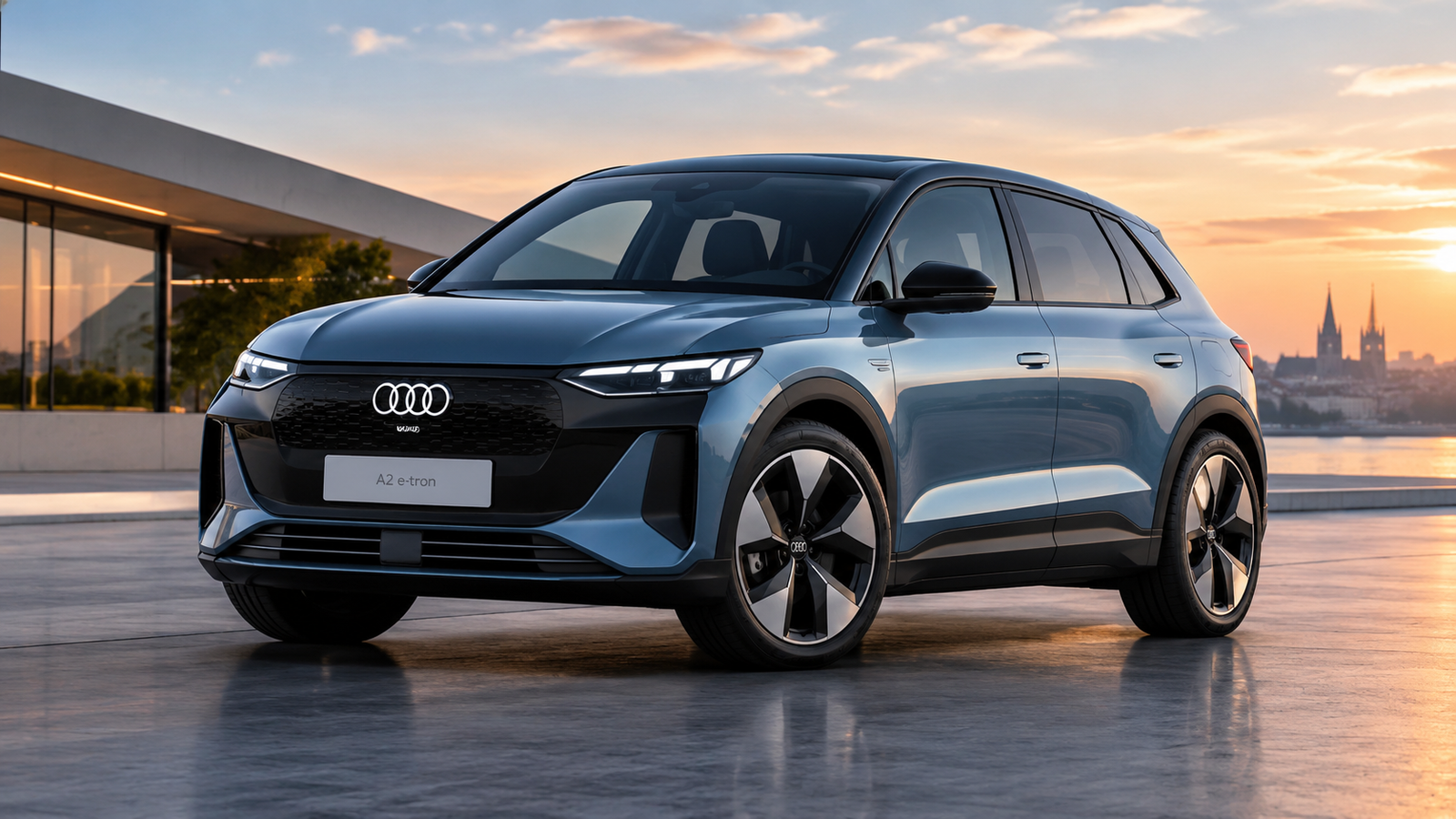
Audi has officially unveiled its new Audi A2 e-tron in Paris, bringing the iconic A2 name back in an all-electric format. However, this is not simply a revival of an old nameplate. The new A2 e-tron has been developed as Audi’s new entry-level electric model for the European market, with a strong focus on efficiency, practicality, technology and everyday usability.
The new electric compact model was unveiled by Audi CEO Gernot Döllner in Paris on September 7, 2026. Audi says the A2 e-tron has been specifically designed around the needs of European customers and will be produced at the company’s home plant in Ingolstadt, Germany.
One of the biggest highlights is its maximum WLTP range of up to 646 km. Interestingly, Audi has achieved this range without simply putting an enormous battery into a compact car. Instead, the company has focused heavily on aerodynamics, drivetrain efficiency, low-energy consumption and intelligent battery technology.
The A2 e-tron can be equipped with three different battery capacities and four power outputs. Depending on the variant, power ranges from 125 kW to 240 kW, while battery capacities range from 52 kWh to 84 kWh.
The German market will get the A2 e-tron first. Audi has announced a starting price of €38,200 in Germany, while orders open on September 10, 2026. The first deliveries are scheduled to begin in December 2026.
So, what exactly does the new Audi A2 e-tron offer, and why is Audi putting so much emphasis on efficiency rather than simply chasing bigger batteries and more power? Let’s take a detailed look.
Audi A2 e-tron Price in Germany
The Audi A2 e-tron has been positioned as an entry-level electric model for the European market. In Germany, the range starts at €38,200 for the 125 kW version with a 52 kWh battery.
Audi has announced four power levels and three battery capacities. Therefore, the price changes significantly depending on the chosen configuration.
Here is the officially announced German pricing structure:
| Audi A2 e-tron Variant | Battery | Power | Germany Price |
|---|---|---|---|
| A2 e-tron 125 kW | 52 kWh | 125 kW | €38,200 |
| A2 e-tron 140 kW | 61 kWh | 140 kW | Not separately stated in official release |
| A2 e-tron 170 kW | 84 kWh | 170 kW | €48,900 |
| A2 e-tron 240 kW | 84 kWh | 240 kW | €51,200 |
The 61 kWh version is listed from €41,900, while the 170 kW model with the 84 kWh battery costs €48,900. At the top of the range, the 240 kW A2 e-tron is priced at €51,200 in Germany.
These are German market prices, not Indian prices.
Audi has not announced an India launch or India-specific pricing in the official information currently available. Therefore, it would be incorrect to present the German price as an Indian launch price.
Audi A2 e-tron Launch Date and Availability
The Audi A2 e-tron has already been unveiled in Paris, France, as part of Audi’s European product strategy.
The vehicle is developed in Germany and will be produced at Audi’s Ingolstadt plant. Audi says the model is specifically tailored to European customer requirements.
Orders in Germany open on September 10, 2026.
The first customer deliveries are scheduled to start in December 2026.
This makes Europe the key market for the new A2 e-tron at launch.
Audi has not confirmed an India launch date. Therefore, Indian buyers should not consider the A2 e-tron an India-launched model at this stage.
Audi A2 e-tron Range: Up to 646 km
Range is easily the most talked-about aspect of the new Audi A2 e-tron.
The maximum claimed range is up to 646 km according to the WLTP testing cycle. However, this figure applies specifically to the 170 kW version with the 84 kWh battery.
That distinction is important because the entire A2 e-tron range does not offer 646 km.
The officially announced figures are:
| Variant | Battery | WLTP Range |
|---|---|---|
| 125 kW | 52 kWh | Up to 423 km |
| 140 kW | 61 kWh | Up to 515 km |
| 170 kW | 84 kWh | Up to 646 km |
| 240 kW | 84 kWh | Up to 630 km |
The 170 kW model therefore delivers the highest claimed range.
The more powerful 240 kW version sacrifices some range because of its performance-focused setup. It can still travel up to 630 km on the WLTP cycle, which remains impressive for a compact premium EV.
Real-world range will naturally depend on factors such as speed, weather, temperature, traffic, driving style, tyre selection and use of climate control.
Therefore, the 646 km figure should be viewed as a WLTP-certified maximum, rather than a guarantee of 646 km in every driving condition.
Audi A2 e-tron Battery Options
Audi offers three battery capacities for the new A2 e-tron:
- 52 kWh
- 61 kWh
- 84 kWh
This approach allows customers to choose a version based on their driving requirements rather than forcing every buyer into the largest battery.
The smaller 52 kWh and 61 kWh batteries use lithium iron phosphate (LFP) cells. Audi uses a cell-to-pack configuration for these batteries, helping to improve packaging efficiency.
The larger 84 kWh battery uses nickel manganese cobalt (NMC) chemistry.
The 84 kWh battery is available with the 170 kW and 240 kW powertrains.
This means buyers who prioritise maximum range can choose the 170 kW/84 kWh combination, while customers looking for stronger performance can step up to the 240 kW model.
Audi A2 e-tron Performance
Despite its efficiency-focused positioning, the A2 e-tron is not a slow electric car.
Audi offers four power outputs:
- 125 kW
- 140 kW
- 170 kW
- 240 kW
The entry-level 125 kW version produces 350 Nm of torque and accelerates from 0 to 100 km/h in 8.8 seconds.
The 140 kW model also produces 350 Nm and completes the 0–100 km/h sprint in 7.9 seconds.
The 170 kW version brings the time down to 7.0 seconds.
At the top of the range, the 240 kW model produces 545 Nm and can accelerate from 0 to 100 km/h in just 5.7 seconds.
Top speed also varies by version.
The 125 kW, 140 kW and 170 kW models are limited to 160 km/h, while the 240 kW model can reach 200 km/h.
This gives the A2 e-tron a broad character range. The entry model is focused on efficient everyday driving, while the 240 kW version provides considerably stronger performance.
Rear-Wheel-Drive Electric Powertrain
The Audi A2 e-tron uses a rear-wheel-drive architecture.
Audi says the vehicle uses the latest generation of permanent-magnet synchronous motors, with APP350 or APP550 electric motors depending on the power level. Silicon-carbide semiconductors are also used in the power electronics to reduce conversion losses.
Rear-wheel drive also has some dynamic advantages.
During acceleration, weight transfer can improve traction at the rear axle. At the same time, keeping the front wheels dedicated to steering allows Audi to maintain a clean steering response.
Audi has also introduced four recuperation levels.
The strongest setting can provide a one-pedal driving experience through the selector’s B mode.
This allows the driver to adjust how aggressively the car recovers energy during deceleration.
Audi A2 e-tron Efficiency
Perhaps the most interesting part of the A2 e-tron story is its energy consumption.
Audi claims that the 140 kW version with the optional efficiency package can achieve 12.8 kWh/100 km according to WLTP.
Audi describes the A2 e-tron as the most efficient series-production Audi in the company’s history.
That figure is important because it demonstrates Audi’s strategy with this model.
Instead of relying only on a larger battery, Audi has attempted to reduce the amount of energy required to move the car.
That can have several advantages.
Lower consumption means more range from the same battery size. It can also reduce the amount of energy required during charging. For owners who drive long distances regularly, better efficiency can also mean fewer charging stops.
Aerodynamics: One of the A2 e-tron’s Biggest Strengths
Aerodynamics plays a major role in the A2 e-tron’s efficiency.
Audi has achieved a drag coefficient of 0.24, which the company says is the best figure in its compact segment.
The exterior design is therefore not just about styling.
The body has been shaped to reduce air resistance, while features such as an adjustable cooling-air intake, a largely enclosed underbody and aerodynamic wheels help manage airflow.
Audi has also developed special gap reducers around the wheel arches.
These reduce the space between the wheel and wheel housing, helping to control airflow around the wheels.
The door handles are also designed with aerodynamics in mind. Audi uses wing-shaped electric door handles with haptic sensors that sit neatly within the side profile.
All these small improvements work together.
Exterior Design
The new Audi A2 e-tron has a compact footprint, but Audi has attempted to give it a strong premium identity.
The short overhangs and long wheelbase help create a more spacious cabin without making the vehicle unnecessarily large.
The wheelbase measures 2.77 metres.
At the front, the sensors and headlights are integrated into a black-panel-style area.
This creates a cleaner appearance while also allowing Audi to integrate driver-assistance hardware into the design.
Rather than adding aggressive styling elements simply for visual impact, Audi has incorporated functional aerodynamic details throughout the vehicle.
This approach also reflects the company’s broader strategy for its new-generation EV models.
Interior and Cabin
Despite being positioned in the compact segment, the Audi A2 e-tron is designed to provide a relatively spacious interior.
Audi says the long wheelbase and efficient packaging create a generous cabin on a compact footprint.
The vehicle also gets a 1.6-square-metre panoramic glass roof.
That should help make the cabin feel more open and airy.
The high-voltage battery is packaged in a way that avoids unnecessarily compromising interior space. Audi says the higher energy density of the battery cells also helps improve seating position and legroom.
The A2 e-tron therefore attempts to balance three things:
- Compact exterior dimensions
- Large usable interior
- Efficient battery packaging
That combination could be particularly relevant in European cities where compact dimensions are valuable.
Audi A2 e-tron Technology
Technology is another major part of the A2 e-tron’s appeal.
The standard equipment includes Audi’s digital interface with:
- 11.9-inch Audi virtual cockpit plus
- 12.8-inch MMI touch display
- Audi assistant with AI integration
- e-tron route planner
- Digital services
The curved display arrangement gives the dashboard a modern appearance while keeping key vehicle information directly in front of the driver.
Audi has also integrated AI into its assistant.
The system can understand natural-language requests and provide information related to the vehicle, navigation and other functions.
AI-Powered Audi Assistant
The Audi assistant is more than a conventional voice-control system.
Audi says cloud-based AI models improve natural-language interaction, speech recognition and search results for navigation and music.
The assistant can also answer questions about the vehicle using information from the owner’s manual.
That means drivers can potentially ask questions in a more natural way instead of searching through menus.
As AI becomes increasingly common in modern vehicles, Audi is clearly positioning the A2 e-tron as a technology-focused compact EV.
e-tron Route Planner
Long-distance EV driving can be stressful if charging stops are not properly planned.
Audi attempts to solve this with its e-tron route planner.
The system can calculate charging stops based on factors such as traffic, route topography and charging-station availability.
It can also prepare the battery for charging so that the vehicle can achieve its charging potential when it reaches the station.
The system can even recommend an alternative route if it determines that a different driving speed could reduce charging stops.
This is particularly useful for long European road trips.
Audi A2 e-tron Charging
Charging performance varies depending on the battery.
The 52 kWh version supports DC charging at up to 100 kW.
The 61 kWh battery supports up to 105 kW.
The larger 84 kWh battery supports DC charging at up to 183 kW.
The 84 kWh version can charge from 10% to 80% in around 29 minutes.
The 52 kWh version requires around 24 minutes for the same 10–80% charging window, while the 61 kWh battery takes around 26 minutes according to Audi’s official technical information.
For long-distance users, the 183 kW charging capability of the larger battery should make highway charging considerably more practical.
Bidirectional Charging
One of the more interesting features of the A2 e-tron is its ability to work as a two-way energy system.
Audi offers Vehicle-to-Load (V2L) capability, allowing the battery to supply power to external equipment.
For example, the vehicle can power an e-bike, tools, camping equipment or other electrical devices.
The A2 e-tron can also support Vehicle-to-Home (V2H) under specific conditions.
In Germany, Austria and Switzerland, compatible home systems can use the car’s battery as an energy-storage unit.
For households with solar panels, this could become especially useful.
During the day, excess solar energy could be stored in the vehicle, while the stored energy could potentially be used by the home later.
However, V2H availability depends on compatible charging hardware and market-specific requirements.
Safety Features
Audi has equipped the A2 e-tron with a strong standard safety package.
The standard equipment includes:
- Emergency brake assist
- Evasive assist
- Attention assist
- Adaptive Cruise Control
- Parking System Plus
- Rearview camera
These features bring several advanced driver-assistance functions into Audi’s compact electric segment.
Depending on the market and configuration, additional technology may also be available.
The overall approach is clear: Audi wants the A2 e-tron to feel like a premium car despite its positioning as an entry-level electric model.
Audio and Premium Cabin Experience
Audi has also paid attention to the entertainment system.
An optional Audi sound system with eight speakers and a subwoofer delivers 220 watts.
For buyers wanting a more premium experience, the optional Sonos system comes with:
- 14 speakers
- Subwoofer
- 15 amplifier channels
- Up to 660 watts of amplifier power
The Sonos system also uses speakers positioned near the C-pillars to create a surround-sound effect.
Sustainability and Recycled Materials
Audi is also using the A2 e-tron to introduce a more resource-conscious approach to vehicle production.
Depending on configuration, more than 300 components use recycled materials, including recycled steel, aluminium and plastics.
Audi says more than 100 components use post-consumer recycled materials.
The company is also designing certain components with easier recycling and reuse in mind.
Material sourcing, manufacturing, battery production and end-of-life recycling all play a role in the overall sustainability equation.
Audi A2 e-tron Production in Germany
The A2 e-tron is being produced at Audi’s Ingolstadt plant in Germany.
Interestingly, Audi is using existing manufacturing infrastructure rather than building an entirely new production system.
Company says the A2 e-tron uses more than 1,200 existing production components and around 250 robots that were already being used for other models.
Audi says this approach reduces investment requirements and saves resources.
The company has also introduced a production-control approach called the “pearl chain” principle at Ingolstadt.
The system uses a fixed sequence of customer orders to simplify manufacturing and reduce complexity.
Why the Audi A2 Name Matters
Its compact dimensions, lightweight construction and focus on efficiency made it unusual when it arrived around the turn of the century.
The new A2 e-tron carries some of that philosophy into the electric era.
Instead of focusing primarily on lightweight construction, the new model combines:
- Aerodynamic efficiency
- Electric powertrain technology
- Digital services
- Battery flexibility
- Recycled materials
- Intelligent charging
- Compact packaging
That makes the A2 e-tron more than just another electric hatchback.
Audi A2 e-tron: Key Specifications
| Specification | Audi A2 e-tron |
|---|---|
| Vehicle type | Premium compact electric car |
| Market focus | Europe |
| World unveiling | Paris |
| Production | Ingolstadt, Germany |
| Drive | Rear-wheel drive |
| Battery options | 52 / 61 / 84 kWh |
| Power options | 125 / 140 / 170 / 240 kW |
| Maximum torque | 545 Nm |
| Maximum range | 646 km WLTP |
| Maximum DC charging | 183 kW |
| 10–80% charging | Around 24–29 minutes |
| Best efficiency | 12.8 kWh/100 km |
| Drag coefficient | 0.24 |
| 0–100 km/h | 5.7–8.8 seconds |
| Top speed | Up to 200 km/h |
| German starting price | €38,200 |
| Orders open | September 10, 2026 |
| First deliveries | December 2026 |
All figures above are based on Audi’s officially published information.
Audi A2 e-tron vs Other Premium EVs
The A2 e-tron enters a highly competitive European EV market.
However, its positioning is slightly different from large premium electric SUVs and performance EVs.
Audi is not primarily selling the A2 e-tron on huge power figures.
Instead, the car’s strongest selling points are:
Efficiency: 12.8 kWh/100 km in its most efficient configuration.
Range: Up to 646 km WLTP.
Compact dimensions: Designed for European urban and everyday use.
Premium technology: AI assistant, advanced route planning and digital displays.
Charging: Up to 183 kW DC charging.
Practicality: Spacious cabin and large panoramic roof.
This makes the A2 e-tron particularly interesting for buyers who want a premium EV that does not feel unnecessarily large.
Is the 646 km Range the Biggest Advantage?
Yes, but there is a bigger story behind it.
The most interesting aspect is not simply that Audi has achieved 646 km.
It is how the company achieved it.
The A2 e-tron combines an efficient motor, aerodynamic body, low rolling and mechanical losses, intelligent battery management and efficient power electronics.
Audi’s 12.8 kWh/100 km figure demonstrates that improving efficiency can sometimes be more valuable than simply installing a larger battery.
A lighter energy requirement also means that the same amount of stored energy can take the car further.
That philosophy could become increasingly important as EV manufacturers try to improve affordability and reduce battery-material requirements.
What Makes the A2 e-tron Different?
The A2 e-tron has several features that separate it from many conventional compact EVs.
First, it is an Audi designed specifically around European requirements.
Second, Audi has made efficiency a central part of the vehicle rather than treating it as a secondary benefit.
Third, the vehicle offers a wide range of power and battery configurations.
Finally, its bidirectional charging capabilities add another layer of functionality.
The vehicle can therefore serve as more than transportation.
With V2L, it can act as a portable power source. With V2H in supported markets, it can also contribute to home energy management.
Should You Buy the Audi A2 e-tron?
For European buyers considering a premium compact EV, the A2 e-tron looks like a very interesting proposition.
The starting price of €38,200 places it below many larger premium EVs, while the maximum 646 km WLTP range gives it strong long-distance credentials.
The 140 kW version is particularly interesting from an efficiency perspective because it can achieve Audi’s lowest published consumption figure.
Meanwhile, the 170 kW version provides the highest range.
For performance-focused customers, the 240 kW model offers 5.7-second 0–100 km/h acceleration and a 200 km/h top speed.
Therefore, buyers can choose the car according to their priorities rather than compromising on a single configuration.
However, customers should remember that WLTP figures do not represent guaranteed real-world range.
Similarly, charging times depend on battery temperature, charger output and other conditions.
Audi A2 e-tron Pros and Cons
Pros
- Up to 646 km WLTP range
- Very low claimed energy consumption
- 0.24 drag coefficient
- Three battery options
- Four power outputs
- Up to 183 kW DC charging
- Rear-wheel drive
- Advanced digital technology
- AI-powered Audi assistant
- Bidirectional charging capability
- Spacious interior for its compact footprint
- Strong standard safety equipment
- German production
Cons
- 646 km range is limited to a specific 170 kW/84 kWh configuration
- Top-performance version has slightly lower range
- India launch has not been confirmed
- Premium variants become significantly more expensive
- Real-world range will be lower than the WLTP maximum in many conditions
⭐ Gaadi Xpert Verdict
The Audi A2 e-tron could become one of Audi’s most important compact electric cars in Europe.
Rather than trying to win the EV race purely through horsepower or battery size, Audi has taken a different approach. The company has focused on efficiency, aerodynamics, intelligent energy management and everyday usability.
The headline figure of 646 km WLTP range is certainly impressive, but the 12.8 kWh/100 km efficiency figure may actually be the more important achievement.
At the same time, the car doesn’t feel like an economy-focused EV. The cabin gets Audi’s latest digital interface, AI-assisted voice technology, advanced route planning, premium audio options and a long list of driver-assistance features.
The availability of 52 kWh, 61 kWh and 84 kWh batteries also gives European customers more flexibility.
For someone who primarily drives in cities, the smaller battery could make sense. For long-distance users, the 84 kWh version offers much greater range. Meanwhile, the 240 kW model caters to buyers who want stronger performance.
With German pricing starting at €38,200, orders opening on September 10, 2026, and deliveries beginning in December 2026, the A2 e-tron is now moving from concept and announcement into the production-car stage.
For now, however, there is no official India launch confirmation, so Indian buyers will have to wait for Audi to announce whether this compact premium EV will eventually enter the Indian market.
Overall, the Audi A2 e-tron looks like a strong example of where premium EVs could be heading next: not necessarily bigger, faster and heavier, but smarter, more efficient and better suited to everyday driving.
Gaadi Xpert Rating: 4.5/5
| Category | Score |
|---|---|
| Design | 4.5/5 |
| Range | 4.8/5 |
| Efficiency | 5/5 |
| Performance | 4.5/5 |
| Technology | 4.7/5 |
| Practicality | 4.5/5 |
| Charging | 4.5/5 |
| Overall | 4.5/5 |
Audi A2 e-tron FAQs
What is the range of the Audi A2 e-tron?
The Audi A2 e-tron offers a maximum WLTP range of up to 646 km. This figure applies to the 170 kW version with the 84 kWh battery.
What is the price of the Audi A2 e-tron?
The Audi A2 e-tron starts at €38,200 in Germany for the 125 kW version with the 52 kWh battery.
When will Audi A2 e-tron deliveries start?
Audi says the first deliveries will begin in December 2026.
When can customers order the Audi A2 e-tron?
Orders in Germany open on September 10, 2026.
Where is the Audi A2 e-tron made?
The Audi A2 e-tron is produced at Audi’s Ingolstadt plant in Germany.
What battery options are available?
Audi offers 52 kWh, 61 kWh and 84 kWh battery options.
What is the most powerful Audi A2 e-tron?
The top version produces 240 kW and 545 Nm of torque.
How fast can the Audi A2 e-tron accelerate?
The 240 kW version can accelerate from 0 to 100 km/h in 5.7 seconds.
How fast can the Audi A2 e-tron charge?
The 84 kWh battery supports DC charging at up to 183 kW and takes around 29 minutes to charge from 10% to 80% under Audi’s stated conditions.
Is the Audi A2 e-tron coming to India?
Audi has not officially confirmed an India launch in the information currently released for the A2 e-tron. Therefore, an India launch date or India price should not be assumed.
Is 646 km the real-world range?
No. The 646 km figure is a WLTP-certified maximum range. Actual range can vary depending on speed, weather, traffic, temperature, driving style and other conditions.
What is the efficiency of the Audi A2 e-tron?
Audi claims consumption as low as 12.8 kWh/100 km for the 140 kW version with the optional efficiency package. Audi describes this as its most efficient series-production model to date.