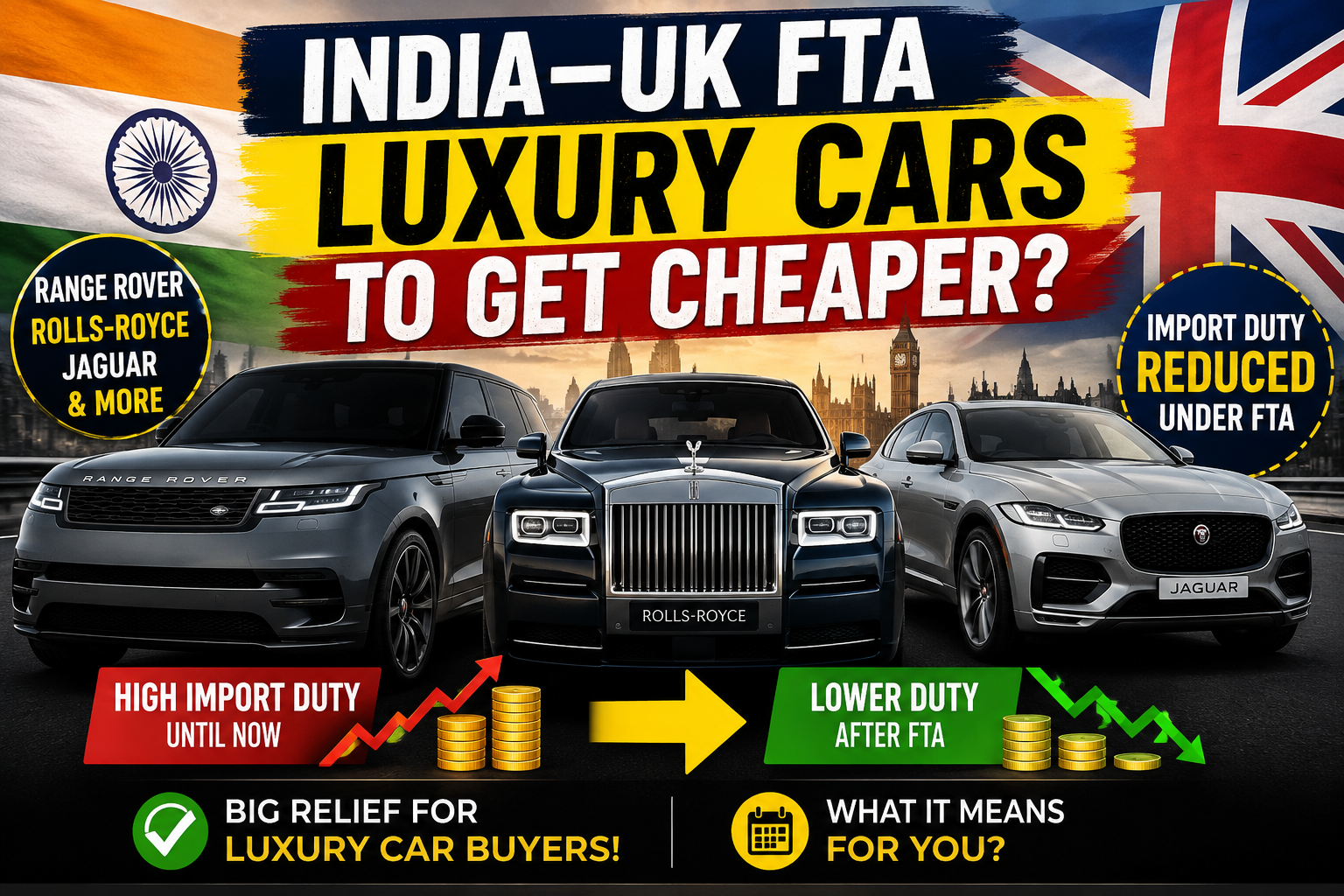
India UK FTA : The India–UK Comprehensive Economic and Trade Agreement (CETA) has officially come into effect from 15 July 2026, and it is already making headlines across the automotive industry. One of the biggest talking points is the reduction in import duties on eligible UK-built vehicles, which could significantly reduce the prices of some of Britain’s most iconic luxury cars in India.
For years, premium British brands such as Range Rover, Rolls-Royce, Jaguar, Aston Martin, Bentley, and McLaren have remained out of reach for most buyers because of India’s high import taxes. Depending on the model, imported Completely Built Unit (CBU) vehicles attracted customs duties of up to 110%, making these luxury cars among the most expensive in the world.
However, the new trade agreement changes the equation.
Under the India UK FTA, import duties on eligible UK-manufactured passenger vehicles will be reduced through a quota-based system. Instead of an immediate across-the-board duty cut, the agreement introduces a phased reduction, allowing a fixed number of qualifying vehicles to enter India at significantly lower customs duties every year.
This announcement has naturally sparked one big question among luxury car enthusiasts:
- Will the Range Rover become cheaper?
- Can buyers expect a price cut on Rolls-Royce Phantom and Cullinan?
- Will Jaguar models see lower prices?
- Is this the beginning of a more competitive luxury car market in India?
The short answer is yes—but not for every model, and not in every situation.
The impact depends on several factors, including where the vehicle is manufactured, whether it qualifies under the FTA quota, and how automakers decide to pass on the duty savings to customers. This means some models could witness noticeable price reductions, while others may see only a limited benefit.
In this article, we’ll explain exactly how the India UK FTA works, which luxury cars are expected to become more affordable, and what this means for Indian buyers looking to own a British luxury vehicle.
| Key Point | Details |
|---|---|
| Agreement Effective From | 15 July 2026 |
| Sector Impacted | Premium UK-built passenger vehicles |
| Duty Benefit | Reduced import duty on eligible vehicles under a tariff quota |
| Biggest Beneficiaries | Land Rover, Rolls-Royce, Jaguar, Bentley, Aston Martin, McLaren |
| Immediate Price Drop? | Not guaranteed |
| Long-Term Impact | More competitive luxury car market in India |
How the India UK FTA Works : Understanding the New Import Duty Rules
To understand whether luxury cars will actually become cheaper, it’s important to know how the India UK [ FTA ] Free Trade Agreement works. While many headlines suggest that import duties have been slashed, the reality is a bit more nuanced.
While the India UK FTA reduces import duties for eligible UK-built vehicles, the final ex-showroom price paid by customers will also depend on manufacturer pricing, exchange rates, freight costs, dealer margins, taxes, and quota availability. Buyers should wait for official price announcements before making purchase decisions. India UK FTA
Import Duties Are Being Reduced – But Not for Every Car
India has traditionally imposed some of the highest import duties on Completely Built Unit (CBU) vehicles. In many cases, luxury cars imported directly from overseas attracted customs duties of up to 110%, making them significantly more expensive than in global markets.
Under the new India UK FTA, this duty structure is set to change gradually, not overnight. Instead of applying to every imported vehicle, the lower tariffs will only be available for eligible UK-manufactured passenger vehicles imported under a quota system. This means only a limited number of vehicles can benefit from the reduced duty each year.
How the Quota System Works
The agreement introduces a Tariff Rate Quota (TRQ) for automobiles.
Here’s what that means:
- A fixed number of UK-built vehicles can be imported into India every year at a reduced customs duty.
- Once the yearly quota is exhausted, any additional imports will continue to attract the normal import duty.
- The quota is expected to increase in phases over the coming years, allowing more vehicles to qualify for lower tariffs over time.
This approach protects India’s domestic automobile industry while gradually opening the market to premium UK-built vehicles.
Duty Reduction Will Happen in Phases
Another important point is that the duty reduction is phased, not immediate.
Instead of reducing customs duty to the final level on day one, the agreement gradually lowers the tariff over multiple years. This gives manufacturers, dealers, and the government time to adjust while avoiding sudden market disruptions. India UK FTA
As a result:
- Early buyers may see moderate price reductions.
- Bigger savings could become possible as the agreement progresses and tariff rates continue to decline.
- Actual customer prices will also depend on exchange rates, logistics costs, and each manufacturer’s pricing strategy.
Not Every British Brand Will Benefit Equally
Many people assume every British luxury car will instantly become cheaper. That isn’t necessarily true.
To qualify for the reduced import duty, a vehicle generally needs to:
- Be manufactured in the United Kingdom.
- Meet the agreement’s rules of origin and other eligibility requirements.
- Be imported within the annual quota.
If a model is manufactured outside the UK or imported beyond the allocated quota, it may not receive the same tariff benefit.
What Does This Mean for Buyers?
For Indian luxury car buyers, the India UK FTA is undoubtedly positive news. However, it’s best viewed as a long-term structural change rather than an overnight price revolution.
The biggest winners are likely to be buyers of eligible UK-built premium vehicles, but the final on-road price will still depend on factors such as manufacturer pricing decisions, taxes, dealer margins, and foreign exchange movements.[ India UK FTA ]
In the next section, we’ll look at which luxury brands and models—including Range Rover, Rolls-Royce, Jaguar, Bentley, Aston Martin, and McLaren—are expected to benefit the most from the new trade agreement.
Which Luxury Cars Could Become Cheaper? Brand-Wise Analysis
Now comes the biggest question every luxury car enthusiast is asking:
Which cars are actually expected to become cheaper because of the India UK FTA?
The answer depends on where each vehicle is manufactured. The agreement primarily benefits eligible UK-built vehicles imported into India under the tariff quota. Here’s a closer look at the major brands.
Which Luxury Brands Are Likely to Benefit?
| Brand | Manufactured in UK | Expected Benefit |
|---|---|---|
| Land Rover (Range Rover, Defender) | ✅ Yes | ⭐⭐⭐⭐⭐ High |
| Rolls-Royce | ✅ Yes | ⭐⭐⭐⭐⭐ High |
| Jaguar | ✅ Selected Models | ⭐⭐⭐⭐ Medium to High |
| Bentley | ✅ Yes | ⭐⭐⭐⭐⭐ High |
| Aston Martin | ✅ Yes | ⭐⭐⭐⭐ High |
| McLaren | ✅ Yes | ⭐⭐⭐⭐ High |
1. Land Rover (Range Rover & Defender)
Among all premium brands, Land Rover is expected to be one of the biggest beneficiaries.
Many flagship models, including the Range Rover, Range Rover Sport, Defender, and some Range Rover Velar variants, are manufactured in the UK. If these vehicles are imported under the FTA quota, they could see meaningful price reductions over time.
However, not every Land Rover sold in India is imported in the same way. Some variants may be locally assembled (CKD), while others are imported as CBUs. The actual benefit will therefore vary by model and variant.
Potential winners:
- Range Rover
- Range Rover Sport
- Defender
- Select Velar variants
2. Rolls-Royce
Rolls-Royce builds all of its production cars at Goodwood, England, making the brand one of the clearest beneficiaries of the agreement.
Popular models such as:
- Phantom
- Ghost
- Cullinan
- Spectre (subject to eligibility)
could become relatively more affordable if imported under the FTA quota.
That said, Rolls-Royce customers typically personalize their cars extensively. Optional equipment, bespoke customization, insurance, and registration costs will still keep prices extremely high.
3. Jaguar
Jaguar is another British marque that stands to benefit.
Models manufactured in the UK and imported into India may qualify for lower import duties under the agreement.
However, Jaguar’s global manufacturing footprint has changed in recent years, so eligibility will depend on the specific production location of each model.
4. Aston Martin
Luxury sports cars from Aston Martin, including:
- DB12
- Vantage
- Vanquish
- DBX
are largely manufactured in the United Kingdom.
If imported within the FTA quota, these models could also become more competitively priced in India.
5. Bentley
Bentley manufactures its vehicles in Crewe, England.
Models such as:
- Bentayga
- Continental GT
- Flying Spur
may also benefit from lower import duties, although the final reduction will depend on quota availability and Bentley India’s pricing strategy.
6. McLaren
McLaren produces its supercars in Woking, England.
Cars like the:
- Artura
- 750S
- GTS
could also receive tariff benefits under the agreement, making them slightly more accessible to Indian buyers.
Will Prices Drop Immediately?
Not necessarily.
Even if customs duties fall, manufacturers may not reduce prices overnight. Final pricing will depend on:
- Import duty savings
- Currency exchange rates
- Freight and logistics costs
- Dealer margins
- State taxes and registration charges
- Manufacturer pricing strategy
This means buyers should expect gradual price corrections rather than dramatic overnight discounts.
Key Takeaway
The India UK FTA is likely to benefit premium UK-built brands more than any other segment. While luxury cars won’t suddenly become “cheap,” eligible models from Land Rover, Rolls-Royce, Jaguar, Bentley, Aston Martin, and McLaren could become noticeably more affordable over the coming years as the agreement is implemented.
How Much Cheaper Could Luxury Cars Become? Real-World Impact for Buyers
The India UK FTA has generated plenty of excitement, but one question remains unanswered for most buyers:
How much money can you actually save?
The honest answer is there is no fixed number yet. While the agreement reduces import duties on eligible UK-built vehicles, the final showroom price will depend on several commercial factors beyond customs duty alone.
Why It’s Difficult to Predict Exact Price Cuts
A luxury car’s ex-showroom price isn’t determined only by import duty. It also includes:
- Factory price
- Freight and shipping costs
- Marine insurance
- Customs clearance charges
- GST and compensation cess
- Dealer margins
- Logistics within India
- Exchange rate fluctuations
Even if customs duties decline, manufacturers may choose to pass on only part of the savings to customers.
Will Every Buyer Benefit Immediately?
Not necessarily.
The lower tariff applies only to eligible UK-built vehicles imported under the annual quota. If demand exceeds the quota or a model doesn’t qualify under the agreement, it may continue to attract the existing duty structure.
As a result:
- Some variants could become more affordable.
- Others may see little or no immediate price change.
- Waiting for manufacturers to announce revised price lists will provide the clearest picture.
Luxury Car Market Could Become More Competitive
The agreement could also increase competition in India’s premium automobile market.
If British luxury brands reduce prices, competing manufacturers from Germany and other countries may respond with:
- Attractive financing offers
- Limited-period discounts
- Additional equipment packages
- Better warranty and service plans
Even buyers who don’t choose a British luxury car could indirectly benefit from increased competition.
Good News for Enthusiasts and Collectors
For luxury car enthusiasts, the India UK FTA is a positive long-term development.
Vehicles that were previously considered extremely expensive due to high import duties may become comparatively more attainable. This is particularly important for buyers considering flagship SUVs, luxury sedans, grand tourers, and high-performance sports cars from British manufacturers.
However, these vehicles will still remain premium products with high ownership costs, including insurance, maintenance, and registration.
Should You Buy Now or Wait?
If you’re planning to purchase a UK-built luxury car, it may be worth waiting for manufacturers to officially announce:
- Updated ex-showroom prices
- Eligible variants under the FTA
- Booking timelines
- Revised import schedules
These announcements will provide a much clearer picture of the actual savings available to customers.
What This Means for the Indian Auto Industry
Beyond luxury car buyers, the India–UK FTA represents a significant policy shift. It signals India’s intention to strengthen international trade while balancing the interests of domestic manufacturing through a phased and quota-based approach.
If implemented successfully, the agreement could reshape the premium automotive market over the coming years, offering buyers greater choice and improved value without disrupting local production.
Who Should Consider Waiting?
If you’re planning to buy a premium British luxury vehicle in the coming months, waiting for official pricing updates could be a smart decision.
You may benefit if you’re considering:
- Range Rover
- Range Rover Sport
- Defender
- Rolls-Royce Ghost
- Rolls-Royce Cullinan
- Jaguar models
- Bentley Bentayga
- Aston Martin DBX
- McLaren Artura
Once manufacturers announce revised ex-showroom prices, buyers will have a clearer understanding of the actual savings under the India–UK FTA
Gaadi Xpert Verdict
The India UK ( FTA ) Free Trade Agreement is undoubtedly one of the most significant developments for India’s premium automotive market in recent years. While many headlines claim that Range Rover, Rolls-Royce, and Jaguar cars will become cheaper, the reality is more balanced.
Yes, eligible UK-manufactured vehicles imported under the FTA quota are expected to benefit from lower import duties over time. However, this doesn’t mean every British luxury car will suddenly see a massive price drop.
Several factors—including annual import quotas, manufacturing location, exchange rates, logistics costs, taxes, and each automaker’s pricing strategy—will determine how much of the duty savings actually reaches customers.
For buyers planning to purchase a luxury British vehicle in the coming months, the best approach is to wait for official price revisions from manufacturers rather than relying on estimated discounts circulating on social media.
Overall, the agreement is a positive long-term step that could make India’s luxury car market more competitive while offering premium buyers better value in the years ahead.
Pros
✔ Lower import duties on eligible UK-built luxury cars
✔ Better long-term value for premium car buyers
✔ Increased competition in the luxury automobile segment
✔ Wider choice of imported British vehicles
✔ Strengthens trade relations between India and the United Kingdom
Cons
✘ Price reductions won’t happen overnight
✘ Benefits apply only to eligible vehicles imported under the tariff quota
✘ Final savings depend on automaker pricing decisions
✘ Luxury cars will still remain expensive due to taxes and ownership costs
Frequently Asked Questions (FAQs)
Q1. Will Range Rover become cheaper in India?
Eligible UK-built Range Rover models imported under the India UK FTA quota are expected to benefit from lower import duties over time. However, the final price reduction will depend on Jaguar Land Rover India’s pricing strategy and the specific model.
Q2. Will Rolls-Royce cars become cheaper?
Potentially yes. Since Rolls-Royce vehicles are manufactured in the United Kingdom, qualifying imports under the india uk FTA could receive lower import duties, subject to quota availability and other conditions.
Q3. Does the FTA apply to every British car?
No. The benefits apply to eligible UK-manufactured vehicles that meet the agreement’s rules and are imported within the prescribed tariff quota.
Q4. When will buyers start seeing lower prices?
Manufacturers are expected to announce revised pricing after evaluating the new duty structure. The impact is likely to appear gradually rather than immediately.
Q5. Which luxury brands could benefit the most?
Brands with significant UK manufacturing operations—such as Land Rover, Rolls-Royce, Jaguar, Bentley, Aston Martin, and McLaren—are expected to be among the primary beneficiaries.
Q6. Will the Land Rover Defender become cheaper in India?
If the Defender is imported as an eligible UK-built vehicle under the FTA quota, it could benefit from lower import duties. However, the exact reduction will depend on Land Rover India’s pricing strategy.
Q7. Will Mini Cooper also benefit from the India–UK FTA?
Some Mini models manufactured in the UK may qualify under the agreement, but eligibility will depend on the production location and the applicable tariff quota.
Q8. Does the India UK FTA apply to electric vehicles?
The agreement covers eligible passenger vehicles, but the applicable duty benefits will depend on the vehicle category, manufacturing origin, and the detailed provisions of the trade agreement.
Q9. Will locally assembled luxury cars become cheaper?
Not necessarily. The FTA mainly impacts eligible imported UK-built vehicles. Locally assembled (CKD) models may not receive the same level of tariff benefit.
Q10. When will the new prices be announced?
Manufacturers are expected to announce revised prices after assessing the impact of the new tariff structure. Timelines may vary by brand.
Also Read About Mahindra Price Hike2026
Final Thoughts
The India UK FTA is one of the most significant policy changes for India’s premium automobile industry in recent years. While it won’t make luxury cars inexpensive overnight, it has the potential to gradually reduce ownership costs for eligible UK-built vehicles and increase competition in the luxury segment.
For prospective buyers, the most sensible approach is to wait for official pricing announcements rather than relying on speculative estimates. As automakers begin updating their price lists, the true impact of the agreement will become much clearer.
If implemented successfully, this trade agreement could reshape India’s luxury car market over the next few years, offering buyers greater value while maintaining a balanced approach to domestic manufacturing. ( India UK FTA )