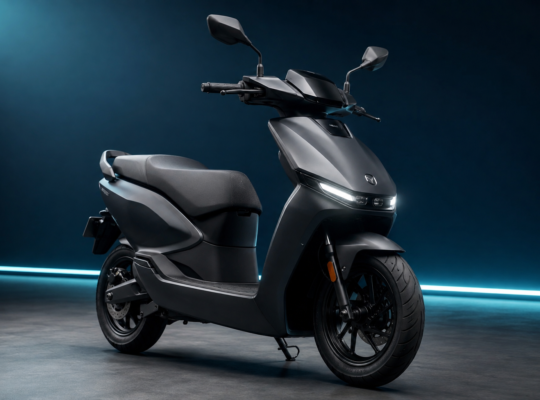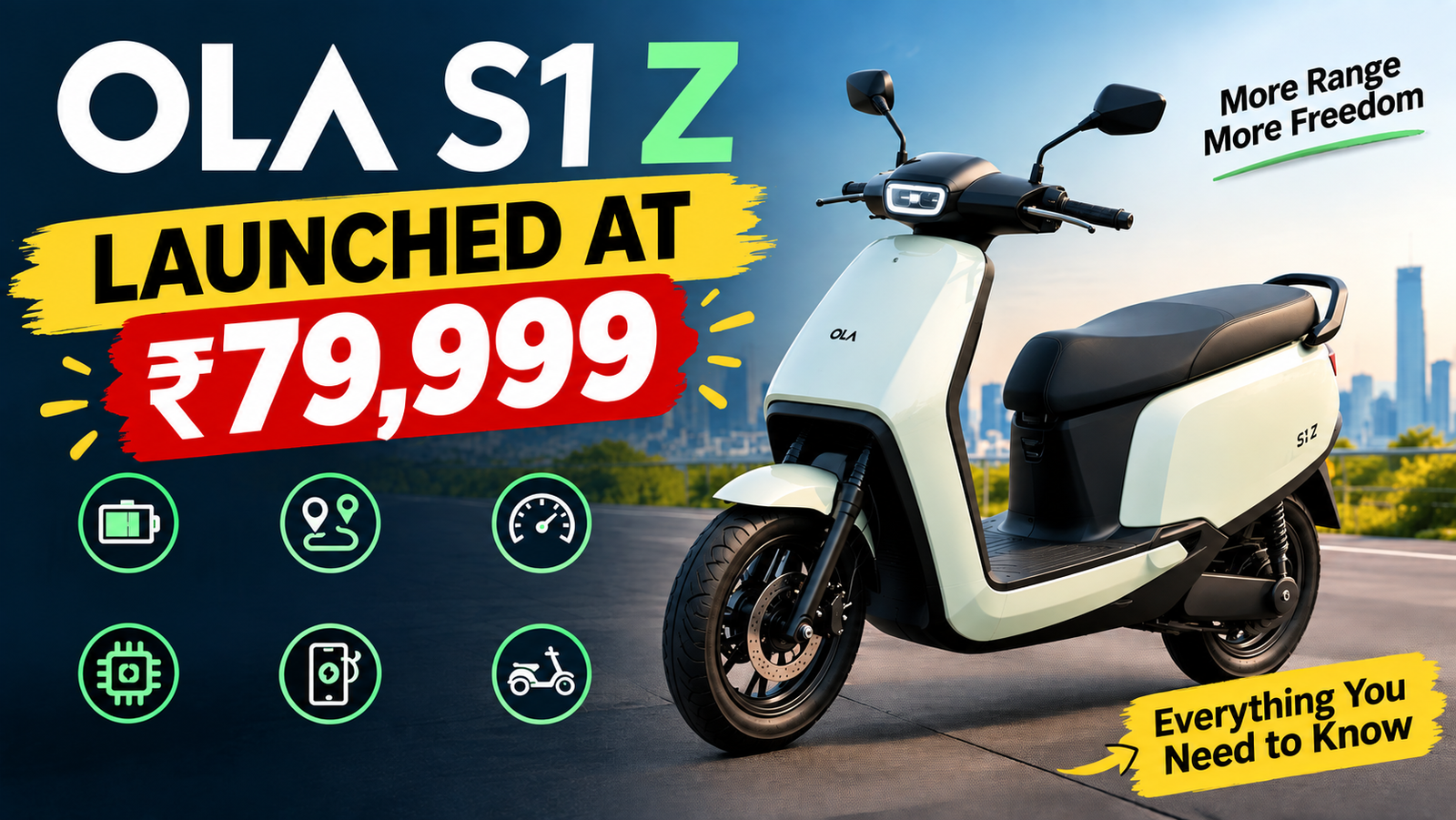
The Indian electric scooter market is becoming more competitive, but Ola Electric is taking a slightly different route with its latest product. The company has launched the Ola S1 Z with a starting introductory price of ₹79,999, bringing its locally developed LFP battery technology into a more affordable part of the electric two-wheeler market.
Unlike premium electric scooters that focus heavily on performance and connected technology, the S1 Z is positioned as a more practical, mass-market product. Ola is offering the scooter with 3.1 kWh and 5.1 kWh battery options, while the claimed IDC range goes up to 301 km on the larger battery version.
However, the biggest talking point is not just the range or price. The S1 Z is one of Ola Electric’s products to use its Bharat Cell LFP battery technology, which the company says has been developed and manufactured in India.
So, what exactly does the new Ola electric scooter offer, and does the ₹79,999 starting price make it an interesting alternative to conventional petrol scooters?
Let’s take a closer look.
Ola S1 Z Price in India
The Ola S1 Z is available in two battery configurations.
| Variant | Battery | IDC Range | Top Speed | Introductory Price |
|---|---|---|---|---|
| S1 Z 3.1 kWh | 3.1 kWh | 179 km | 70 km/h | ₹79,999 |
| S1 Z 5.1 kWh | 5.1 kWh | 301 km | 70 km/h | ₹99,999 |
Both prices are introductory ex-showroom prices. Ola’s official website currently lists the 3.1 kWh version at ₹79,999 and the 5.1 kWh version at ₹99,999.
The important point here is that the ₹79,999 figure applies to the smaller-battery version. Buyers wanting the headline 301 km IDC range will have to move to the ₹99,999 variant.
Ola has also opened reservations at ₹999 through its official website. The company currently lists deliveries for the 3.1 kWh version from December 2026, while the 5.1 kWh version is scheduled to start deliveries in March 2027.
Ola S1 Z Design: Simple and Practical Approach
The Ola S1 Z follows the familiar scooter design language of the company’s S1 family, but its positioning is clearly more practical.
The scooter gets 12-inch wheels, while Ola is offering four colour options:
- White
- Anthracite
- Sky Splash Blue
- Matcha Green
The overall approach is less about making the S1 Z look like an expensive performance scooter and more about creating an accessible electric scooter for everyday users.
That makes sense for Ola because the S1 Z is aimed at the volume end of the market.
Instead of trying to compete only with premium electric scooters, the new model has a much wider potential audience, including daily commuters and buyers who are primarily looking at running costs.
Battery Technology Is the Biggest Highlight
This is where the Ola S1 Z becomes more interesting.
The scooter uses Ola Electric’s Bharat Cell LFP technology. LFP stands for lithium iron phosphate, a battery chemistry widely known for its thermal stability and durability characteristics.
Ola says its LFP cells have been developed at its Battery Innovation Centre and manufactured at its Gigafactory in India. The S1 Z therefore represents an important step in the company’s strategy of bringing more battery technology in-house.
For buyers, the bigger question is what this means in daily use.
LFP chemistry is generally considered well suited to applications where durability, safety and cycle life are important. Ola itself says the battery technology is designed for Indian conditions and claims a longer battery life. However, real-world battery life will ultimately depend on usage, charging habits and operating conditions.
That distinction is important.
A manufacturer’s battery-life claim should not automatically be treated as a guarantee of how many years every owner will get from the battery.
Ola S1 Z Battery Options Explained
The S1 Z is available with two battery packs.
S1 Z 3.1 kWh
The entry-level model gets a 3.1 kWh battery and has an official IDC range of 179 km.
Its key specifications include:
- 3.1 kWh battery
- 179 km IDC range
- 4 kW peak motor
- 70 km/h top speed
- 0-40 km/h in 4.6 seconds
- 5 hours 42 minutes for 0-80% home charging
- LFP cell chemistry
- MoveOS 5
The introductory price is ₹79,999.
For someone primarily using the scooter for city commuting, this is arguably the more interesting version because it keeps the entry price below ₹80,000.
S1 Z 5.1 kWh
The bigger version gets a 5.1 kWh battery and an impressive claimed IDC range of 301 km.
Its specifications include:
- 5.1 kWh battery
- 301 km IDC range
- 4 kW peak motor
- 70 km/h top speed
- 0-40 km/h in 4.9 seconds
- 6 hours 16 minutes for 0-80% home charging
- LFP cell chemistry
- MoveOS 5
The introductory price is ₹99,999.
The 301 km number is clearly the headline figure, but buyers should remember that IDC range is a certified test figure and should not be treated as guaranteed real-world range.
Actual range can vary depending on speed, traffic, rider weight, riding mode, road conditions, temperature and use of electrical systems.
Performance: More About Efficiency Than Speed
The Ola S1 Z is not designed as a performance electric scooter.
Both versions use a 4 kW peak motor and have a claimed top speed of 70 km/h.
That makes the scooter more suitable for urban riding than high-speed highway use.
The 3.1 kWh version has a claimed 0-40 km/h acceleration time of 4.6 seconds, while the 5.1 kWh version takes 4.9 seconds according to Ola’s current specifications.
For everyday city traffic, that level of performance should be adequate.
But buyers looking for strong highway performance or a genuinely sporty riding experience will probably find the S1 Z less interesting.
And that is perfectly fine.
The purpose of the S1 Z is not to be the fastest scooter. Its objective is to make electric mobility more accessible while offering useful range and connected technology.
Ola S1 Z Features
Despite its affordable positioning, Ola has not stripped the S1 Z down to basic functionality.
The scooter gets MoveOS 5, Ola’s connected software platform.
The official equipment list includes:
- Cruise control
- Reverse mode
- Regenerative braking
- GPS tracking
- OTA software updates
- Geofencing
- Time and mode fencing
- Ride statistics
- Energy insights
- Easy Park function
The scooter also supports connected functions through the Ola Electric app.
This is one area where the S1 Z can have an advantage over a conventional petrol scooter.
Instead of simply providing transportation, Ola is trying to make the scooter part of a connected ecosystem.
Easy Park Could Be Useful in Daily City Riding
One of the more practical features is Easy Park.
Ola says the system is designed to help riders manoeuvre the scooter in tight parking spaces using a simple control input.
This may not sound like a major feature on paper, but it can be useful in real-world Indian cities where parking spaces are often tight.
For a scooter aimed at everyday commuters, these small convenience features can sometimes matter more than headline performance figures.
Charging Time
The S1 Z is designed for home charging.
According to Ola’s official specifications, the 3.1 kWh version takes 5 hours 42 minutes for 0-80% charging, while the larger 5.1 kWh battery takes 6 hours 16 minutes.
That means overnight charging should fit naturally into the ownership routine for most daily commuters.
However, the larger battery does take longer to charge, so buyers should consider their daily distance before choosing the 5.1 kWh version simply because of its larger range figure.
Warranty and Battery Life
Ola lists a standard scooter warranty of 3 years or 40,000 km for the S1 Z.
The company also says the coverage can be extended up to 8 years and 70,000 km depending on the applicable extended warranty plan.
The battery itself is obviously one of the most important components of an electric scooter.
Ola’s decision to use its own LFP cell technology is therefore significant, but long-term reliability will be judged by customers over several years rather than by launch specifications alone.
This is something potential buyers should keep in mind.
Ola S1 Z Real-World Range: What Should You Expect?
This is probably the biggest question for buyers.
Ola claims:
179 km IDC for the 3.1 kWh version.
301 km IDC for the 5.1 kWh version.
However, these numbers should not be interpreted as guaranteed everyday range.
IDC testing is performed under standardised conditions. Real-world riding is much less predictable.
Heavy traffic, frequent acceleration, higher speeds, riding with a passenger, tyre pressure, temperature and riding style can all affect energy consumption.
Therefore, the smarter way to look at the S1 Z is this:
The 179 km and 301 km figures show the certified range capability, while actual usable range will depend on how and where the scooter is ridden.
That is the more realistic approach for any electric vehicle.
Ola S1 Z vs Petrol Scooter: Is ₹79,999 Enough to Change the Game?
This is where Ola’s strategy becomes interesting.
A scooter priced around ₹80,000 enters a highly competitive part of India’s two-wheeler market.
Traditional petrol scooters have an established advantage:
- Easy refuelling
- Familiar ownership experience
- Large service networks
- No charging requirement
The S1 Z counters those advantages with:
- Lower energy cost potential
- Electric drivetrain
- Connected features
- Home charging
- No conventional engine maintenance
- LFP battery technology
For people who have predictable daily commuting requirements and access to home charging, an electric scooter can make considerable sense.
However, buyers who frequently travel long distances or don’t have convenient charging access may still find a petrol scooter easier to live with.
So the S1 Z is not automatically better than every petrol scooter.
It depends heavily on the owner’s usage pattern.
Ola S1 Z: Who Should Buy It?
The Ola S1 Z 3.1 kWh makes the most sense for buyers who:
- Mainly ride inside the city
- Have access to home charging
- Want to keep the purchase price below ₹80,000
- Want lower running costs
- Prefer connected features
- Don’t need high-speed highway performance
The 5.1 kWh version, meanwhile, makes more sense for riders who regularly cover longer distances and value additional range more than the lower upfront price.
But paying ₹20,000 more only for the larger battery should be considered carefully.
If your daily commute is short, the 3.1 kWh version may already provide enough range for your needs.
Ola S1 Z: What We Like
Affordable Entry Price
At an introductory ₹79,999, the S1 Z enters the mass-market electric scooter space aggressively.
Large Claimed Range
The 5.1 kWh version’s 301 km IDC claim is easily one of the scooter’s biggest talking points.
LFP Battery Technology
Ola’s homegrown LFP battery technology gives the S1 Z an interesting technical identity.
Connected Features
MoveOS 5 brings features such as GPS, OTA updates, cruise control and ride statistics to a more affordable scooter.
Two Battery Choices
Customers can choose between lower upfront cost and longer claimed range.
Ola S1 Z: What Could Be Better
70 km/h Top Speed
The scooter is clearly designed for urban use. Riders looking for highway-oriented performance may want something more powerful.
Real-World Range Still Needs Validation
The 179 km and 301 km figures are IDC claims. Independent real-world testing will be important to understand actual usable range.
Deliveries Are Still Some Time Away
The 3.1 kWh version is scheduled for December 2026, while the 5.1 kWh version is scheduled for March 2027.
Long-Term Battery Reliability Is Yet to Be Proven
The LFP technology is promising, but the S1 Z’s long-term reliability will ultimately depend on ownership experience over several years.
Ola S1 Z vs Other Electric Scooters
The S1 Z enters an electric scooter market that already includes products from several established two-wheeler manufacturers.
But direct comparison should not be based only on price.
Buyers should look at:
- Battery capacity
- Certified and real-world range
- Charging infrastructure
- Service support
- Warranty
- Software features
- Spare-part availability
- Battery replacement cost
- Local dealer/service presence
Ola is clearly trying to create an advantage around battery technology and pricing.
The real test will be whether those advantages translate into a better ownership experience.
Ola S1 Z Ownership: The Bigger Question
For a new electric scooter, the purchase price is only one part of the equation.
Ownership also depends on:
Charging convenience
Can you charge the scooter at home every night?
Service access
Is an Ola service facility easily accessible in your city?
Battery confidence
How does the battery perform after several years?
Software reliability
Do connected features continue to work smoothly?
Resale value
How will the used market value the scooter after three to five years?
These are questions that specifications alone cannot answer.
That is why the S1 Z looks promising on paper, but its long-term ownership story will be equally important.
Gaadi Xpert Verdict
The Ola S1 Z is an important scooter for Ola Electric because it takes the company’s battery technology into a much more price-sensitive segment.
At ₹79,999, the 3.1 kWh version makes the S1 Z accessible to a wider group of buyers. The 179 km IDC range, 4 kW motor, 70 km/h top speed and MoveOS 5 package make it reasonably well-equipped for city commuting.
Then there is the 5.1 kWh version.
At ₹99,999, it offers a claimed 301 km IDC range, which is the headline feature of the S1 Z range. But buyers should remember that this is a certified figure, not a promise of 301 km in every real-world riding condition.
For us at Gaadi Xpert, the most interesting part of the S1 Z is actually the combination of price + LFP battery technology + connected features.
It is not trying to be the fastest electric scooter in India.
Instead, Ola is trying to make a practical electric scooter that can appeal to everyday Indian commuters.
And if the company can deliver the claimed efficiency, maintain good battery durability and provide dependable after-sales support, the S1 Z could become a significant product in India’s affordable EV scooter market.
For short-distance city users, the 3.1 kWh version looks like the more sensible starting point. For high daily usage, the 5.1 kWh version is the more interesting choice.
The real verdict, however, will come when customer deliveries begin and independent real-world range and ownership tests become available.
Ola S1 Z Key Specifications
| Specification | S1 Z 3.1 kWh | S1 Z 5.1 kWh |
|---|---|---|
| Price | ₹79,999 | ₹99,999 |
| Battery | 3.1 kWh | 5.1 kWh |
| Claimed IDC Range | 179 km | 301 km |
| Motor | 4 kW peak | 4 kW peak |
| Top Speed | 70 km/h | 70 km/h |
| 0-40 km/h | 4.6 sec | 4.9 sec |
| Charging 0-80% | 5h 42m | 6h 16m |
| Battery Chemistry | LFP | LFP |
| Software | MoveOS 5 | MoveOS 5 |
| Warranty | 3 yr/40,000 km | 3 yr/40,000 km |
| Deliveries | December 2026 | March 2027 |
Specifications and prices based primarily on Ola Electric’s current official product information.
Final Word
The Ola S1 Z is not just another affordable electric scooter launch. It represents Ola Electric’s attempt to bring its homegrown LFP battery technology to a wider audience.
The ₹79,999 starting price makes the entry version particularly interesting, while the ₹99,999 5.1 kWh version grabs attention with its 301 km IDC claim.
But the numbers on paper are only half the story.
Real-world range, battery durability, service quality and ownership experience will determine whether the S1 Z can genuinely change the affordable electric scooter segment.
For now, though, Ola has certainly made the S1 Z one of the more interesting new electric scooters to watch in 2026.
Official Source
Ola Electric S1 Z – Official Product Page
Also Read About Ather REDUX Upcoming EV Scooter